
You're probably in one of two spots right now. You're either at a dealership in Knoxville trying to get proof of insurance on your phone before they hand over the keys, or you're at your kitchen table staring at a cheap quote that looks good until you read what it covers.
That's where most riders make the mistake. They shop for a legal card, not a survivable policy.
I've watched plenty of Tennessee riders save a little on the front end and get burned on the back end. Knoxville motorcycle insurance isn't just about getting registered and staying street-legal. It's about whether your policy still helps when the crash is serious, the bike is wrecked, and the other driver either has thin coverage or none at all.
Tennessee gives riders a low legal floor. Knoxville gives riders real traffic, real injury exposure, and too many bad outcomes to pretend minimum coverage is enough. The buying decision is simple once you strip away the fluff. You can buy the cheapest policy that gets you out the door, or you can buy coverage that stands up after a hard hit.
Table of Contents
- Riding Out of the Dealership With the Right Coverage
- Tennessee Motorcycle Insurance Requirements Explained
- What Knoxville Riders Actually Pay in 2026
- Coverage Options That Go Beyond the Legal Floor
- Getting Quotes and Buying a Policy Step by Step
- Discounts Worth Asking Your Agent About
- Choosing a Local Knoxville Motorcycle Insurance Agent
- Putting It Together Before You Ride
Riding Out of the Dealership With the Right Coverage
You sign the paperwork. The bike is fueled, cleaned up, and parked out front. Finance asks for proof of insurance before they release it. You pull up a binder on your phone, glance at the premium, and think, “Good enough.”
That moment matters more than most riders realize.
If you choose bare liability just to leave the lot, you've handled one problem. You've met the legal requirement to ride. You have not protected your bike, your body, or your paycheck if the next driver blows a light, cuts left in front of you, or taps your parked bike and disappears.
The desk decision that follows you for years
At the dealership, riders usually split into two camps.
One rider wants the lowest payment possible today. He takes liability-only, gets the tag squared away, and figures he'll “fix it later.” A lot of riders never do. Then they learn the hard way that liability only is built to pay for damage you cause to somebody else, not for your own bike, your own injuries, or the gap created by another driver with weak coverage.
The second rider slows down for ten extra minutes and builds a layered policy. That rider asks about collision, uninsured motorist, and medical protection. The monthly cost is higher, but the policy matches real-world riding.
Practical rule: If you'd be sick over losing the bike, missing work, or eating medical bills after a crash, minimum coverage isn't your plan. It's your paperwork.
Tennessee also requires helmets for riders. That's smart law and smart riding. But a helmet isn't an insurance policy. It can help protect your head. It won't pay the surgeon, the tow bill, the body shop, or the lender if the motorcycle is totaled.
What riders get wrong at pickup
The biggest mistake isn't buying cheap insurance. It's buying cheap insurance by accident.
A stripped-down quote can look clean and simple on a screen. It can also leave out the exact coverages that matter most once the bike leaves the lot. Riders see the low price and assume they're protected. They aren't. They're legal.
Before you roll out of a Knoxville dealership, ask yourself three plain questions:
- If the bike is totaled tomorrow, who pays for my bike?
- If the other driver has weak coverage, who pays for me?
- If I miss work after a wreck, what part of that loss lands on my household?
If you can't answer those clearly, you're not ready to bind the policy yet.
Tennessee Motorcycle Insurance Requirements Explained
A rider leaves a Knoxville dealership with the state minimum, gets clipped a week later by a driver with weak coverage, and learns the hard way what Tennessee law buys. It buys legal compliance. It does not buy much protection once medical bills, bike damage, and missed work start stacking up.
Tennessee requires motorcycle liability coverage at 25/50/25. That means $25,000 for injury to one person, $50,000 for injury to others in one crash, and $25,000 for property damage. Those limits satisfy the law. They also run out fast in a serious wreck.
What the state minimum covers
Liability coverage pays for damage or injuries you cause to other people when you are at fault. It does not pay to fix your motorcycle. It does not pay for your own injuries. It does not pay for your riding gear, accessories, or upgrades bolted onto the bike.
| Coverage Area | State Minimum | What It Pays | What It Leaves on You |
|---|---|---|---|
| Bodily injury to one person | 25/50/25 floor | Injury costs for the other person if you cause the crash | Your own injuries and any claim above your limit |
| Bodily injury per accident | 25/50/25 floor | Total injury costs owed to others in one wreck | Any amount above the cap, plus your own losses |
| Property damage | 25/50/25 floor | Damage you cause to another vehicle or other property | Your motorcycle, your gear, your custom parts, your repair bill |
If you want a fuller breakdown of how policies are built, start with these Tennessee motorcycle insurance coverage options.
Helmet law helps your body, not your claim
Tennessee requires every motorcycle rider to wear a helmet. Good. Wear it every ride, every season, no excuses.
But do not confuse a helmet law with financial protection. A helmet may reduce the severity of an injury. It will not pay for an ambulance, surgery, rehab, a totaled bike, or a loan balance after a bad crash.
That distinction matters more in Knoxville now because fatal crashes are moving the wrong direction. More severe wrecks mean higher injury costs, bigger liability claims, and more chances for bare-minimum coverage to fail exactly when you need it.
The real buying decision in Tennessee
The choice is not whether to meet the law. You have to meet the law.
The choice is whether you stop at the legal floor or buy coverage that can survive a crash with an uninsured or underinsured driver. That is the gap Tennessee riders miss. Minimum liability protects the other party when you cause the wreck. It does very little for you when somebody else causes it and cannot pay enough.
Minimum coverage keeps you legal. Stronger limits and first-party coverage keep one crash from wrecking your finances.
My advice is simple. Treat 25/50/25 as the bare floor and build up from there, especially if you ride in Knoxville traffic, commute on busy corridors, or financed the bike. That is how you buy insurance like a rider, not like somebody checking a box.
What Knoxville Riders Actually Pay in 2026
You leave a Knoxville dealership on a financed bike, carry the state minimum because the price looked good, and a week later an underinsured driver turns left in front of you on Kingston Pike. That is the moment the premium stops being an abstract number.
Price still matters. It just needs to be tied to what the policy will do after a wreck.
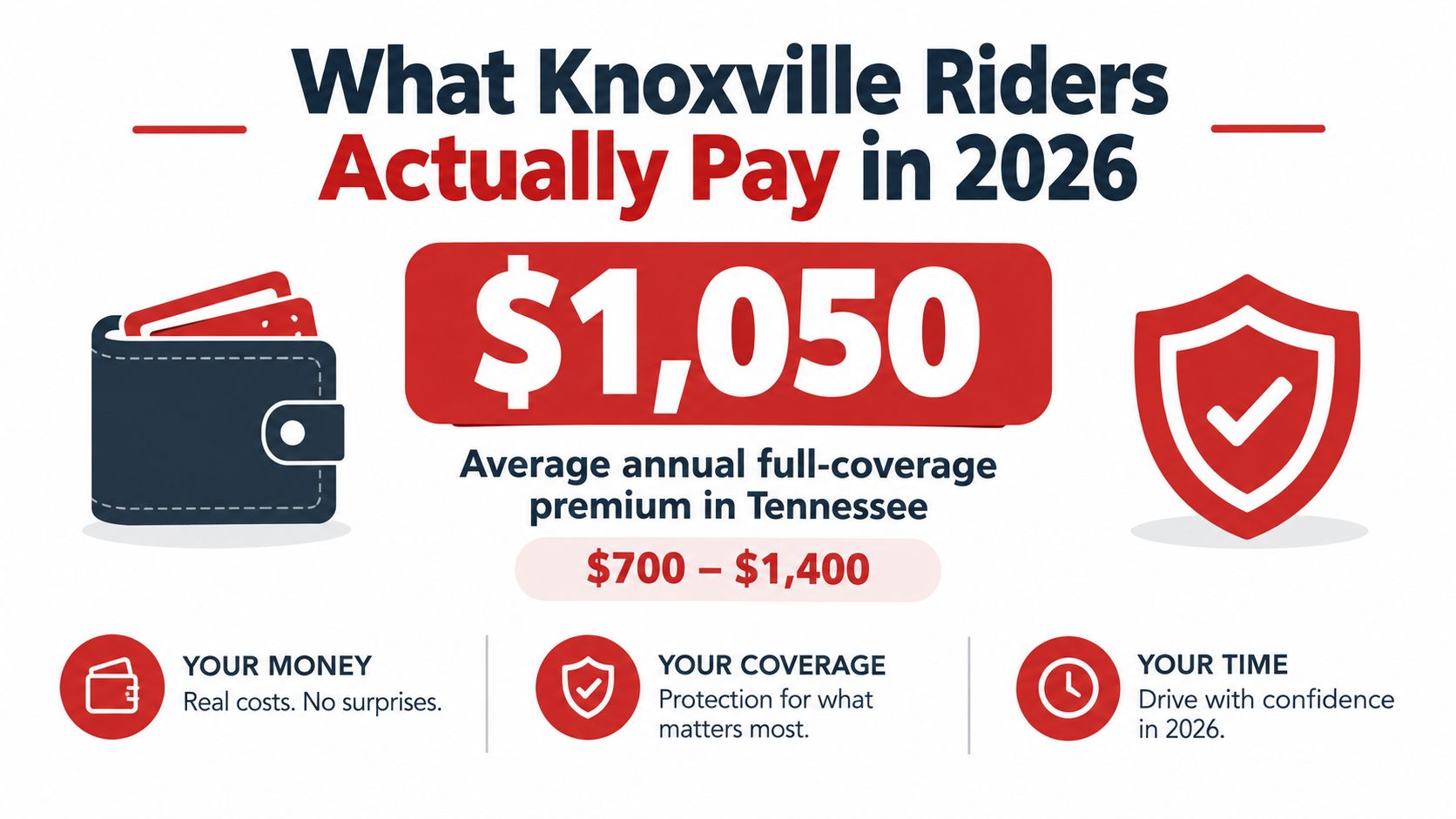
For Knoxville riders, the monthly bill usually swings on four things. Your bike. Your record. Where and how you store it. The coverage choices you make after the quote first pops up on the screen.
A standard cruiser ridden by an experienced owner and parked in a garage usually prices a lot differently than a sport bike, a custom build, or a bike ridden by somebody young with tickets or claims. That part is normal underwriting.
The bigger split comes from coverage level. Minimum liability is the cheapest way to stay legal in Tennessee. It is also the easiest way to leave yourself exposed. Once you add protection for your own bike and your own injuries, the premium climbs. That is not wasted money. That is the part of the policy that can keep a bad Knoxville crash from becoming a five-figure problem.
Here is the plain truth. The cheapest quote is often cheap because it cuts out the coverage that matters after someone else hits you and cannot pay enough.
That point matters more in Knoxville than riders want to admit. Fatal motorcycle crashes have been rising locally, which means more severe wrecks, bigger injury bills, and more pressure on weak policy limits. Tennessee's helmet law may reduce injury severity. It does nothing for your loan balance, your repair bill, or the gap left by an uninsured or underinsured driver.
So what should you expect to pay? Expect minimum coverage to look attractive. Expect better protection to cost more. Expect sport bikes, financed bikes, newer bikes, and shaky driving records to push the number up fast. And expect the first quote to be a starting point, not the answer.
My recommendation is simple. Use price to compare policies only after you match the limits and coverages side by side. If one quote is much lower than the rest, assume something important is missing until you prove otherwise.
A motorcycle policy should survive a real Knoxville wreck, not just satisfy Tennessee's liability floor.
Coverage Options That Go Beyond the Legal Floor
A Knoxville rider can do everything right, wear the helmet Tennessee requires, and still get cleaned out by a driver carrying weak limits or no usable coverage at all.
That is why I do not recommend stopping at the legal floor. Liability-only keeps you legal. It does a poor job of protecting your bike, your budget, or your recovery after a hard wreck.
The coverages that protect your side of the wreck
Collision pays for damage to your motorcycle after a crash, even if you caused it. If you low-side in a curve, get knocked over in traffic, or hit a car that turns across your lane, this is what keeps the repair bill from becoming your problem alone.
Other-than-collision coverage pays for theft, vandalism, weather damage, fire, and falling objects. Knoxville riders who park outside, store a bike in a carport, or leave it sitting through storm season should pay attention here.
Uninsured and underinsured motorist coverage is the coverage I push hardest. Tennessee's minimum liability limit is low. It does not take a major motorcycle injury to blow past it. If the driver who hits you carries bare-minimum coverage, or none that pays enough, this is the part of the policy that keeps their bad insurance decision from becoming your financial mess.
Medical payments coverage helps with immediate medical bills after a crash. If your health plan has a high deductible, spotty coverage, or a network that turns every claim into a hassle, this can save you real cash fast.
A side-by-side view of the smart add-ons
| Coverage | What It Covers | Typical Knox Choice | Premium Impact |
|---|---|---|---|
| Collision | Damage to your bike from a crash | Common for financed, newer, or high-value bikes | Higher than liability-only |
| Other-than-collision | Theft, weather, vandalism, fire, and other non-crash losses | Common for bikes stored outdoors or worth protecting | Moderate increase |
| Uninsured or underinsured motorist | Losses tied to a driver with no coverage or weak limits | Strong choice for daily or frequent riders | Usually worth the added cost |
| Medical payments | Immediate medical expense help after a crash | Useful for riders with weak health coverage | Varies by limit |
| Accessory or custom parts coverage | Added value from upgrades and non-stock equipment | Important for baggers, customs, and modified bikes | Depends on bike setup |
Where riders should spend and where they can hold back
Start with uninsured and underinsured motorist coverage. That is the first add-on I would protect before I worried about shaving a few dollars off the premium.
Then look at the bike itself. If it is financed, you will usually need coverage for damage to the motorcycle. If it is paid off and older, ask the only question that matters. Could you replace it tomorrow without blowing up your budget? If the answer is no, insure it like you mean it.
Accessory coverage gets missed all the time. Pipes, bars, bags, seats, paint, and electronics add up fast. After a claim, stock policy value does not magically stretch to cover custom money.
My advice is plain. Tennessee's liability floor is a starting line, not a protection plan. Helmet use may reduce some injuries. It does nothing for the gap left by an underinsured driver, a stolen bike, or a repair bill you cannot absorb. Build a policy that can survive a real Knoxville crash.
Getting Quotes and Buying a Policy Step by Step
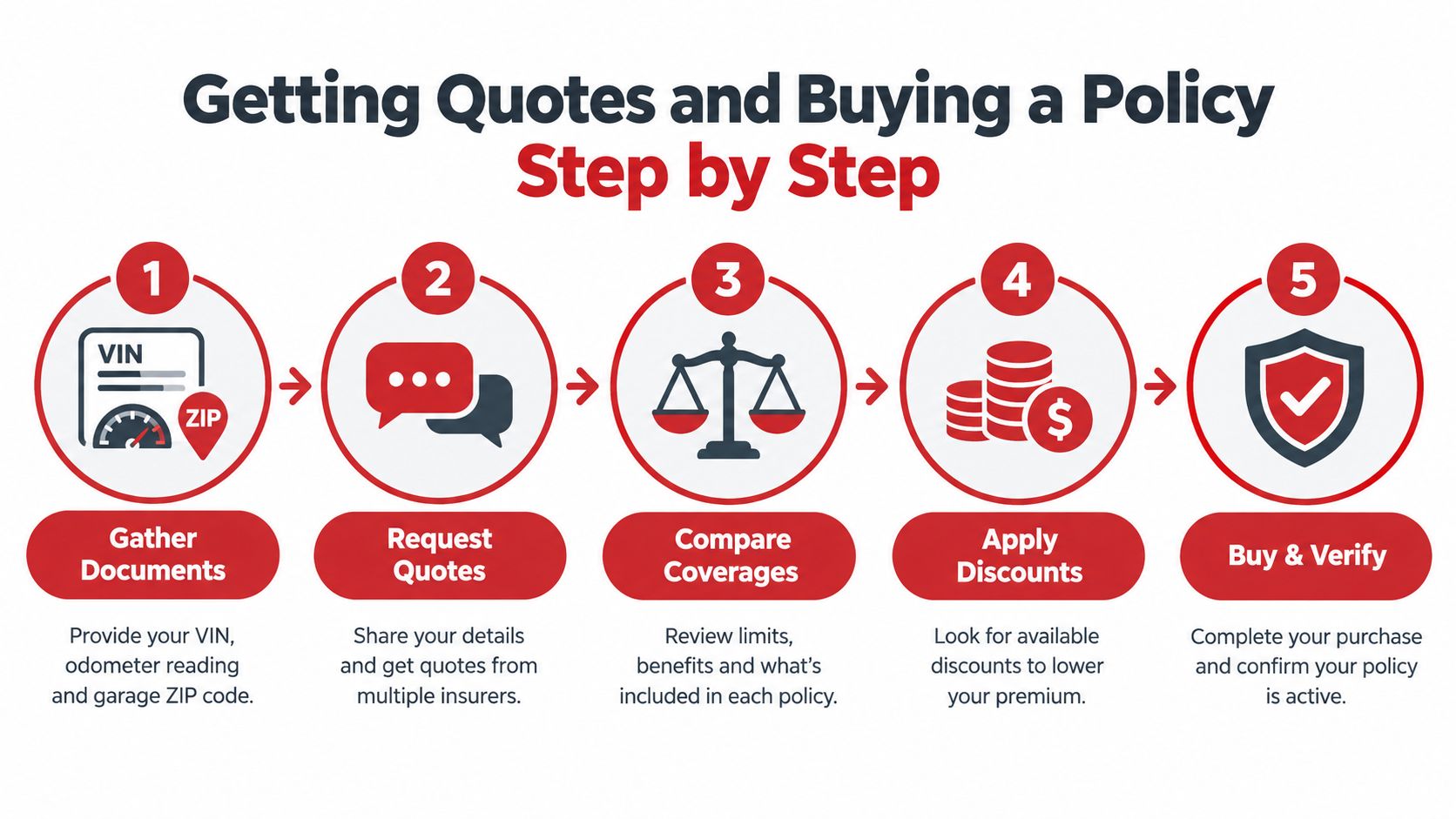
The cleanest way to buy Knoxville motorcycle insurance is to slow down and get organized before you ask for a single quote. Most bad policy decisions happen because riders rush the process, not because the information was unavailable.
Gather the details first
Before you call or go online, put these in front of you:
- Bike information: VIN, year, make, model, and whether it's stock or modified.
- Usage details: Estimated mileage, where it's garaged, and whether you ride seasonally or year-round.
- Rider history: License status, prior claims, tickets, and any riding course completion.
- Ownership paperwork: Lienholder information if the bike is financed.
Then use the same information for every quote request. If you change limits or deductibles between quotes, you're not comparing prices. You're comparing different products.
What to confirm before you pay
Don't bind a policy until you've seen the key details clearly. Riders skip this and end up with preventable problems.
- Check the named drivers. Make sure the operator list is right.
- Check the bike details. VIN mistakes create claim headaches fast.
- Check the effective date. It should start when you need to take possession or ride.
- Check the lienholder. If there's a loan, the lender information needs to be correct.
- Check added equipment. If the bike has accessories worth protecting, confirm how the policy handles them.
A practical walkthrough like this motorcycle insurance quote guide helps riders spot the details that usually get missed.
What you should receive right away
Once you bind the policy, you should get proof that the coverage exists and that the numbers match what you agreed to.
Ask for:
- An ID card
- A binder or proof of coverage
- A declarations page or summary
- Any financing or lienholder confirmation if needed
If anything looks off, fix it that day. Not next week. Not after your first ride.
Buy the policy when the paperwork is still in front of you and the facts are fresh. Corrections are easier before the mistake becomes a claim.
Discounts Worth Asking Your Agent About
Some discounts are worth the effort. Others are just decoration.
If you want to lower your Knoxville motorcycle insurance premium without gutting the policy, ask about the discounts tied to rider behavior, payment method, and household account structure. Those usually matter more than gimmicks.
The discounts that actually move the premium
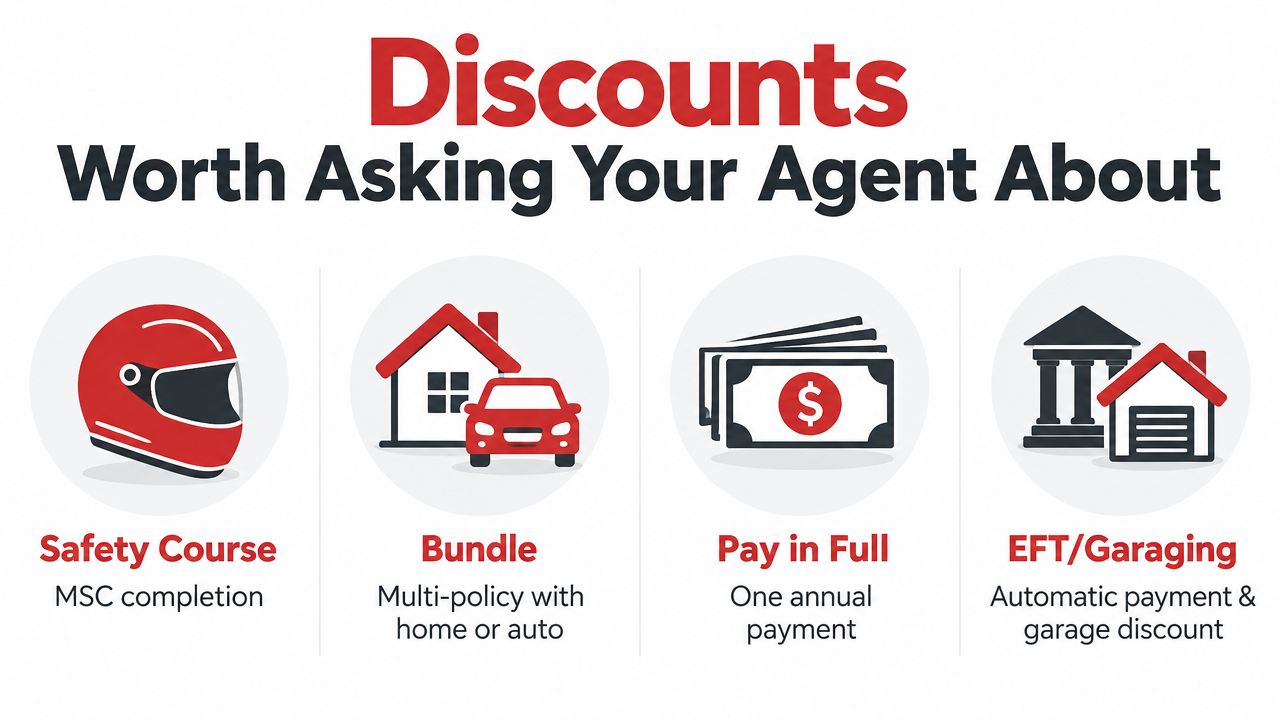
- Safety course completion: If you've taken a recognized rider course, ask for the discount and ask how long the certificate stays usable for underwriting.
- Multi-policy bundling: If your home, renters, or auto insurance sits elsewhere, price the package both ways. Sometimes the bundle helps. Sometimes the standalone motorcycle rate is still better.
- Paid in full: If you can afford the annual payment, this is often cleaner than monthly billing.
- Electronic funds transfer: Auto-draft discounts aren't glamorous, but they're easy savings.
- Garaging and storage details: A bike kept in a secure garage usually presents differently than one parked outside every night.
- Clean driving history: If your record has improved, make sure the quote reflects it.
- Club and affinity discounts: Some riders qualify and never ask.
Don't let a discount wreck the comparison
A common mistake is mixing discount assumptions into one quote and leaving them out of another. That makes the cheaper option look better than it really is.
Ask the agent to show you the quote with every known credit applied, then ask one very direct question in writing: “Which discounts are already included, and which ones still require proof or underwriting approval?”
That question saves a lot of confusion. It also helps you avoid shopping one premium that assumes course credit, EFT, and bundling against another premium that doesn't.
Some discounts get missed because nobody asks. If you changed riding habits, switched to a different class of bike, or cleaned up your record, bring it up. Underwriting only works with the information it has.
Choosing a Local Knoxville Motorcycle Insurance Agent
A local agent can help or waste your time. The difference usually shows up in the first conversation.
You don't need a slick pitch. You need somebody who understands motorcycle policies well enough to ask the right questions before a claim proves they didn't.
The five things I'd check first
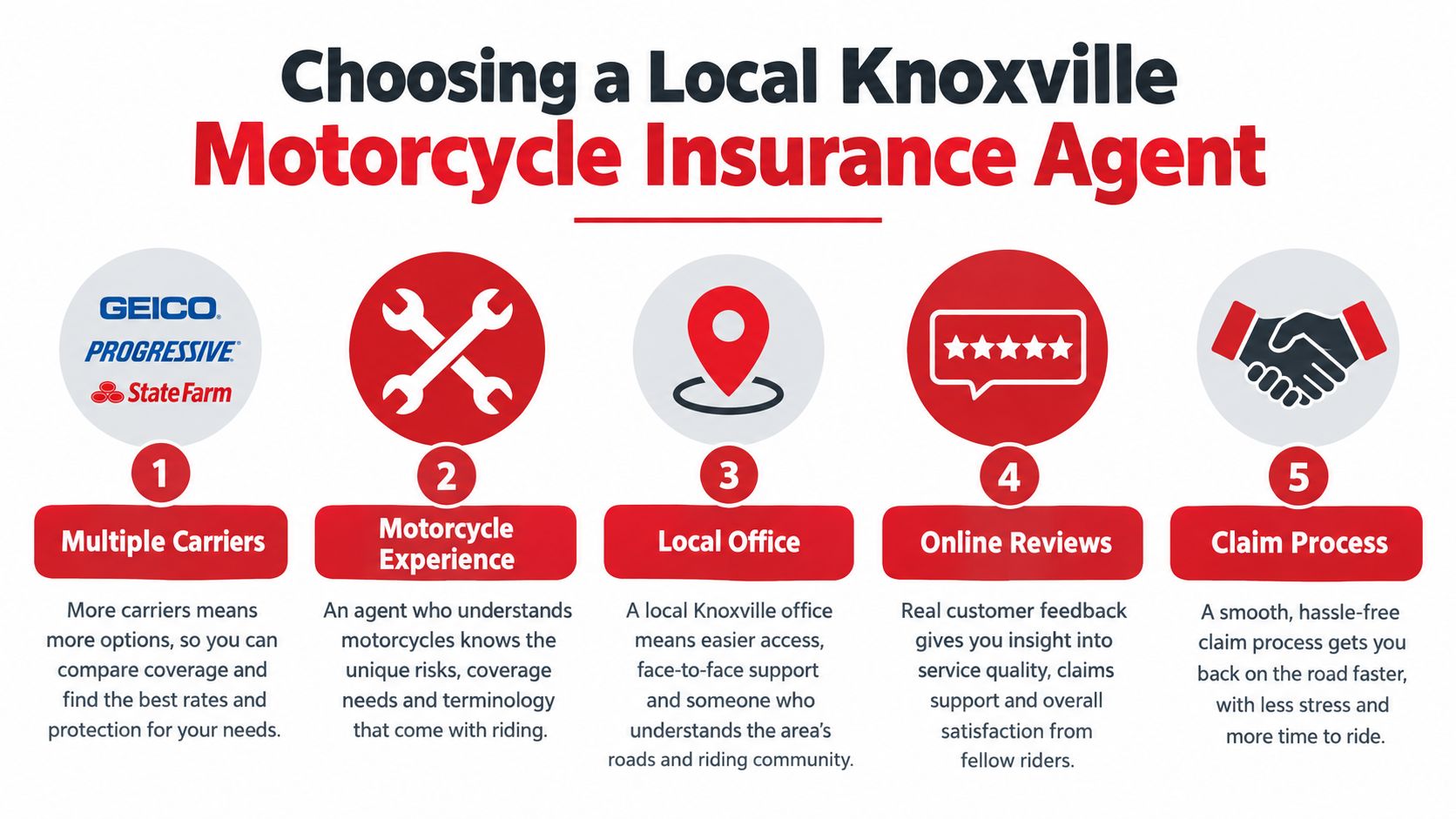
- More than one carrier option: A rider with a standard cruiser and a clean record may fit one market differently than a younger rider on a sport bike.
- Actual motorcycle familiarity: Ask how they handle modifications, custom parts, storage, and financed bikes.
- A real local presence: Knoxville riders sometimes need same-day help with binders, ID cards, or dealership paperwork.
- Plain-English answers: If the agent can't explain uninsured motorist or accessory coverage clearly, keep shopping.
- Accessible service hours: Weekend pickup happens. So do last-minute changes.
If you also want to see how an agency handles everyday Tennessee vehicle coverage generally, Knoxville auto insurance support from a local agency can give you a sense of the service model.
What a useful conversation sounds like
A solid agent asks where the bike is kept, whether it's financed, what upgrades are on it, and whether you want to protect only legal liability or the motorcycle itself. That's a real insurance conversation.
A weak agent jumps straight to price.
Select Insurance Group, Inc. is one example of the independent-agency model some riders prefer because it offers motorcycle coverage, works across multiple carriers, serves Tennessee riders, and has bilingual support. That setup can be useful for riders who want options without calling around all afternoon.
Putting It Together Before You Ride
Before you throw a leg over the bike, make three decisions and make them on purpose.
First, don't stop at the legal minimum just because it's available. Tennessee's floor is there to satisfy the law, not to solve a serious Knoxville motorcycle claim. If your household would feel the hit from a major liability claim, raise the limits.
Second, match your uninsured or underinsured motorist protection to the seriousness of the risk you're taking every time you ride. Too many riders buy for the registration line and not for the crash scene. That's backwards.
Third, decide whether the bike itself needs protection. If it's financed, expensive, customized, or not easy for you to replace, carry the physical damage coverage that keeps one wreck from turning into a long financial mess.
Here's the plain-spoken version.
- Raise liability if you can't absorb a bad loss
- Add uninsured and underinsured motorist coverage if you want the policy to hold up after a real crash
- Keep collision and if losing the bike would hurt more than the premium
Then do one last boring thing that saves a lot of grief. Confirm the VIN, the effective date, the listed drivers, and the declared equipment before you make the first payment. Riders get excited about the bike and sloppy with the paperwork. Don't.
A motorcycle policy should do more than get you out of the dealership parking lot. It should still make sense after the sirens, after the tow truck, and after the first body shop estimate.
If you want help sorting out Knoxville motorcycle insurance without guessing at the fine print, Select Insurance Group, Inc. can quote motorcycle coverage, walk through liability, collision, and uninsured motorist options, and help match the policy to the bike you ride. Visit Select Insurance Group, Inc. if you want a no-nonsense quote review before your next ride.