
You're staring at a renewal notice after another week of I-24 traffic, and the premium looks higher than it should. Before you accept it or slash coverage, compare the policy behind the price. Chattanooga auto insurance can be relatively affordable, but the cheapest liability quote may leave you exposed after a crash with an uninsured driver.
Table of Contents
- Why Chattanooga Drivers Pay Less (and When They Don't)
- Tennessee Minimum Coverage Explained for Chattanooga Drivers
- Choosing the Right Coverage Types for Your Situation
- Gathering Documents and Comparing Instant Quotes
- Cutting Your Premium Without Creating Coverage Gaps
- Chattanooga Auto Insurance FAQs and Your Next Step
Why Chattanooga Drivers Pay Less (and When They Don't)
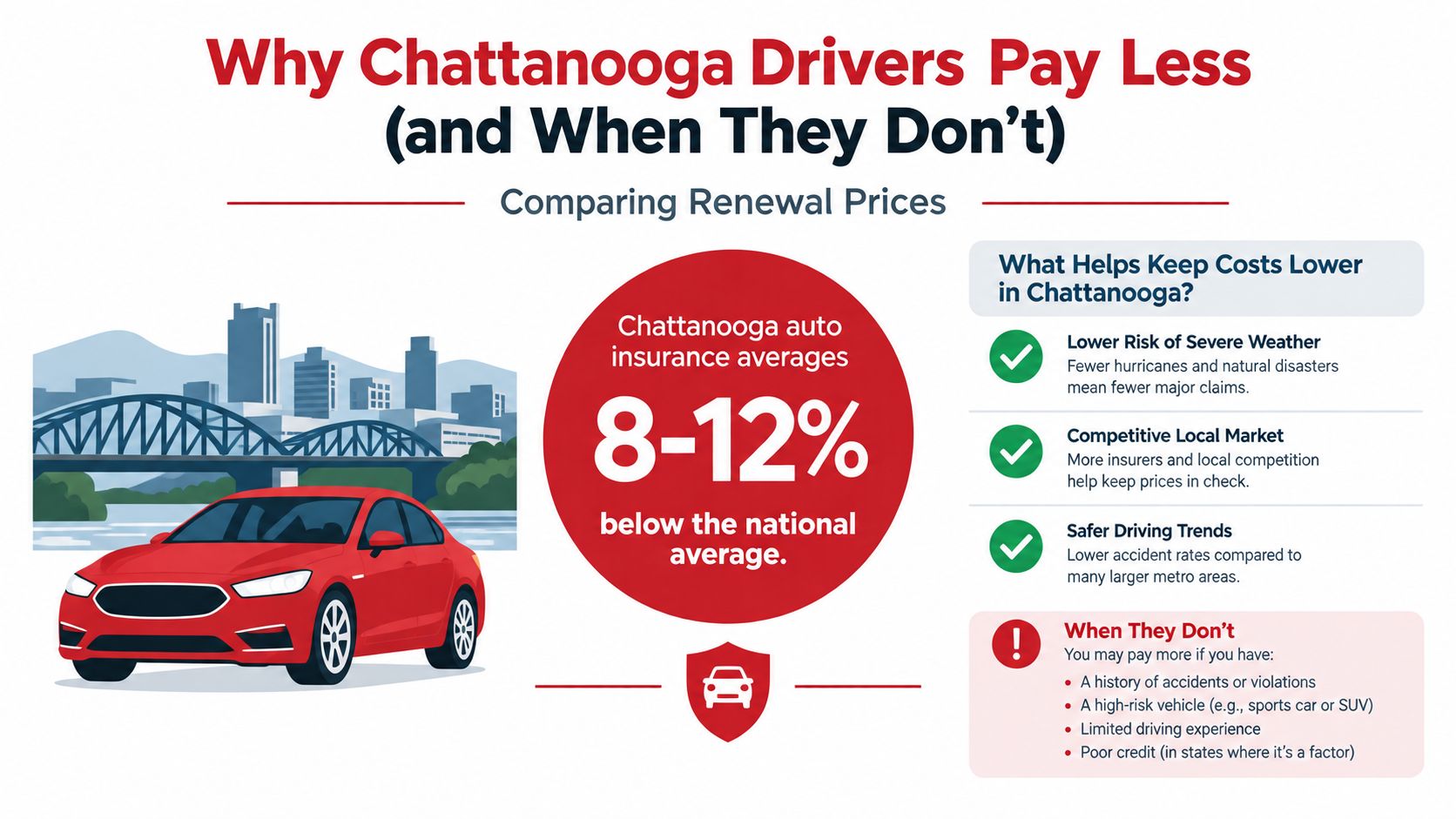
Chattanooga generally lands below the national auto insurance average. One 2026 estimate places the city's average cost at $101 per month, compared with a $142 national monthly average. Another estimate puts full coverage at $134 per month and liability-only coverage at $69 per month. You can review the underlying Chattanooga market snapshot at Compare.com's Chattanooga car insurance estimates.
Those figures are useful benchmarks, not promises. Your premium depends on age, driving history, vehicle, address, coverage limits, deductible, credit tier, and carrier. A young driver, a household with a recent claim, or someone insuring a newer financed vehicle can pay far more than the city average. An experienced driver with an older car and liability-only coverage may pay much less.
What a fair baseline looks like
Historical estimates show why coverage tier matters. One source reported Chattanooga minimum coverage at about $46 per month, or $548 per year, while another placed full coverage near $170 per month, or $2,042 per year. A separate estimate put annual full coverage at $2,141, with teen drivers reaching as much as $7,709 per year, or $642 per month. Those figures are reported in this Chattanooga premium analysis.
The practical lesson is simple. Don't compare your full-coverage renewal with a neighbor's liability-only policy and call one of you overcharged. Compare the same limits, vehicle use, deductibles, and driver information.
Why averages can mislead
City averages also conceal carrier differences. Chattanooga may be a low-to-mid-cost market overall, but insurers price the same driver differently because each company weighs claims history, territory, vehicle type, and risk factors in its own way. A quote that looks expensive may include stronger protection, while a cheap quote may use bare limits that won't handle a serious loss.
Use the rest of this guide to check three things in order: whether the limits comply with Tennessee law, whether the coverage protects your actual financial risk, and whether multiple carriers are pricing the same policy fairly. Drivers who want a broader Tennessee comparison can also review Knoxville auto insurance information to see how market context changes across nearby urban areas.
Tennessee Minimum Coverage Explained for Chattanooga Drivers
Tennessee requires drivers to carry liability coverage at 25/50/15. In plain English, that means:
- $25,000 bodily injury per person: The policy can pay up to this amount for one injured person when you're legally responsible.
- $50,000 bodily injury per accident: The policy can pay up to this amount for all injured people in one accident.
- $15,000 property damage: The policy can pay up to this amount for damage you cause to another person's vehicle or property.
These are legal minimums, not a recommendation for every household. Tennessee's requirements are summarized on this Tennessee auto insurance overview.
Where the limits run out
Consider a crash on Hixson Pike. If two people suffer injuries, the per-person limit applies separately, but the total bodily injury payment still can't exceed the per-accident limit. Medical treatment, lost income, rehabilitation, and other losses can consume those limits quickly after a serious collision.
The property-damage limit creates a separate problem. A single newer vehicle can represent a substantial claim, and one accident may involve more than one damaged vehicle, roadside structure, or other property. Once the policy limit is exhausted, you may face personal financial exposure if the damages exceed what the policy pays.
A financed or leased vehicle creates another requirement. The lender usually expects collision and full-vehicle coverage, because liability insurance protects other people but doesn't repair your vehicle after a covered loss. A state-compliant policy can therefore fail the contract requirements attached to your car.
Minimum coverage keeps you legal. It doesn't guarantee that your assets, vehicle, or medical costs are adequately protected.
How to read a cheap quote
Don't start with the monthly price. Start with the declarations page and verify:
- The bodily injury limits.
- The property-damage limit.
- Whether uninsured and underinsured motorist coverage is included.
- Whether collision and other-vehicle damage apply to your vehicle.
- The deductibles and exclusions.
If the quote is cheaper because it removes protection you need, it isn't a savings strategy. It's a transfer of risk from the insurer to you. Drivers who couldn't comfortably pay medical bills, replace a vehicle, or handle a lawsuit should be especially cautious about treating Tennessee's minimum as a complete insurance plan.
Choosing the Right Coverage Types for Your Situation
The right policy depends on what you drive, what you owe, and how much loss you could absorb without borrowing money. Liability coverage protects other people when you cause an accident. Collision and full protection cover your vehicle in different situations. Uninsured and underinsured motorist coverage addresses a gap many Chattanooga drivers overlook.
Coverage Types at a Glance
| Coverage Type | What It Pays For | Who Needs It Most |
|---|---|---|
| Liability | Injuries and property damage you cause to others | Every driver, at limits that match personal and financial risk |
| Collision | Damage to your vehicle after a collision | Drivers with financed or leased vehicles, and owners of vehicles worth repairing |
| Comprehensive | Covered non-collision losses such as theft, weather, falling objects, or animal strikes | Owners of newer or valuable vehicles, and drivers who couldn't replace their car easily |
| Uninsured or underinsured motorist | Your eligible injuries and, depending on the policy, vehicle damage caused by a driver with no or insufficient insurance | Drivers who rely on their vehicle, have limited savings, or regularly use busy roads |
A financed vehicle usually calls for collision and full-coverage policies because the lender has a financial interest in the car. If you own an older vehicle outright, compare the cost of those coverages and deductibles with the vehicle's realistic value. Dropping them can make sense in some cases, but only if you can replace or repair the car yourself.
The coverage gap most drivers ignore
Tennessee doesn't require uninsured or underinsured motorist coverage. Insurers must offer it, and drivers can reject it in writing. Yet roughly 15% of Tennessee motorists are uninsured, according to the Chattanooga-focused coverage discussion at Jerry's Tennessee insurance guide.
Suppose an uninsured driver hits you on I-75 and leaves you with injuries, vehicle damage, or both. Without UM/UIM, you may have to pursue the driver personally, rely on health insurance for medical treatment, or pay repair costs yourself. With appropriate UM/UIM protection, your own policy may respond according to its terms.
That doesn't mean every driver needs identical limits. It does mean rejecting UM/UIM solely because it makes the quote cheaper is often a poor trade for people who can't absorb the loss.
A practical decision rule
Keep broader protection when the car is financed, the vehicle is valuable, your commute is extensive, or your savings couldn't cover a serious accident. Consider narrower protection only after checking the vehicle's value, lender requirements, deductibles, and your ability to self-insure. For liability and UM/UIM, choose limits based on the financial harm you could face, not the lowest number displayed online.
Gathering Documents and Comparing Instant Quotes
You can get more reliable quotes in one sitting if you prepare before opening a phone, online, or text conversation. The goal isn't to rush through a form. It's to give every carrier the same information so the prices mean something.
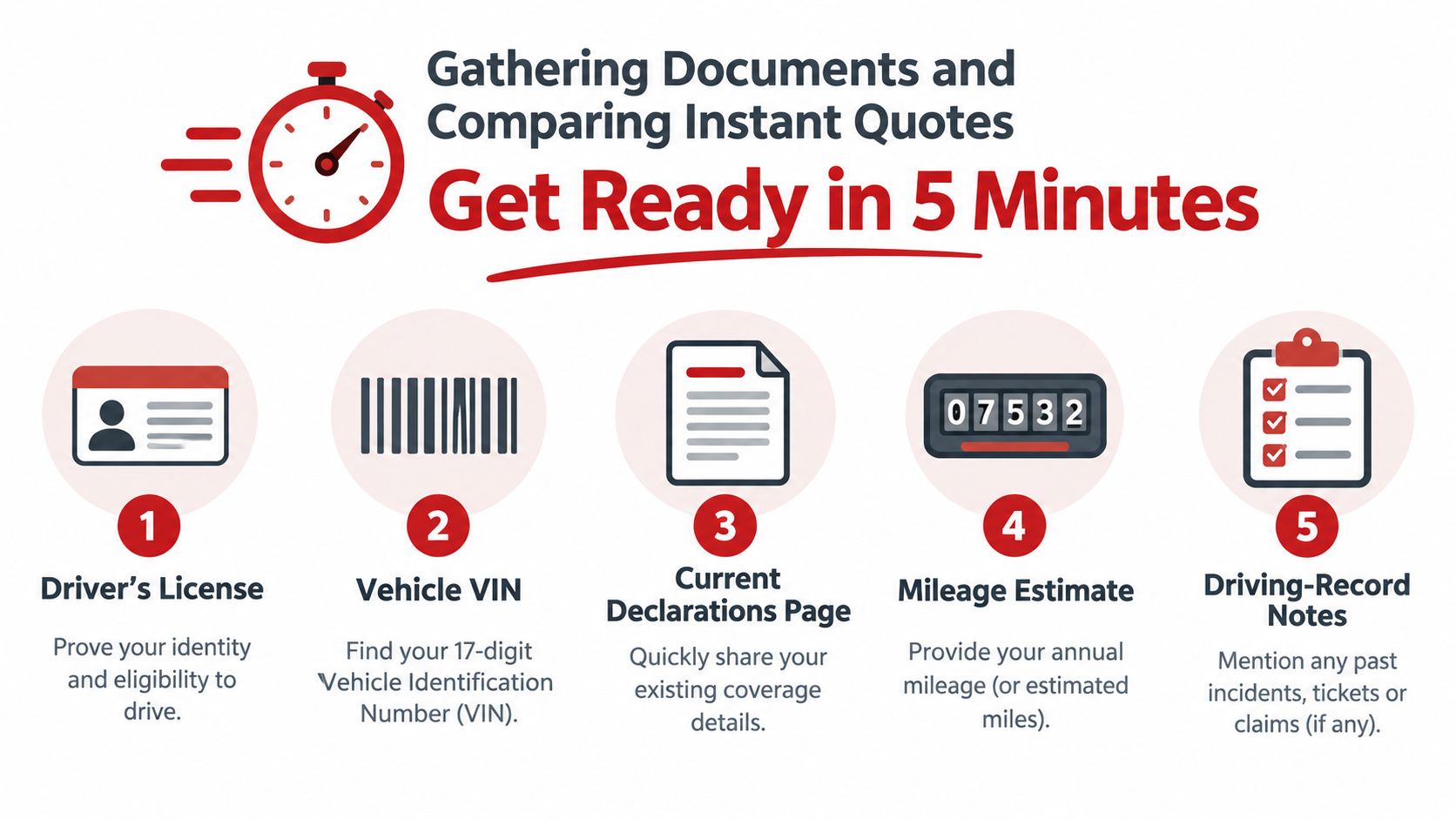
Have these items ready:
- Driver's license: Use the license information for every household driver.
- Vehicle VIN: The VIN identifies the exact vehicle, equipment, and model details.
- Current declarations page: This shows your existing limits, deductibles, vehicles, and listed drivers.
- Mileage estimate: Provide realistic annual use rather than guessing low.
- Driving-record notes: Record tickets, accidents, claims, and any defensive-driving information accurately.
Use an apples-to-apples quote routine
First, decide the limits and coverage types you want to test. Then request each quote using the same bodily injury limits, property-damage limit, UM/UIM selection, collision and other-than-collision deductibles, vehicles, drivers, and usage details.
Next, test one variable at a time. Raising the deductible can reduce the premium, but the new deductible must be an amount you could pay immediately after a loss. If you change limits and deductible together, you won't know which adjustment created the price difference.
Finally, compare the payment schedule. A policy with a lower total premium may still require a larger down payment, while another may spread payments differently. Ask for the total policy cost, installment amounts, fees, and renewal terms rather than focusing only on the first payment.
Choose the quoting channel that suits you
Online quoting works well if you have your documents nearby and want to review options independently. Phone support helps when a vehicle, household driver, or prior claim creates questions. Text support can be practical when you need to send documents or clarify a policy detail without repeating the entire application.
An independent agency that compares 20 to 40 carriers, such as Tennessee insurance quote assistance, can reduce the amount of separate shopping you must do. Regardless of the channel, ask the same questions and save each proposal. A quote is only comparable when the coverage underneath it matches.
Cutting Your Premium Without Creating Coverage Gaps
Chattanooga pricing can vary dramatically by carrier. One market snapshot reports six-month premiums ranging from about $441 to $1,486, depending on the insurer, as shown in this Chattanooga carrier comparison. That spread makes comparison your strongest savings tool before you cut protection.
Don't assume a price difference means one insurer has made a mistake. Companies use different pricing models and may view the same driver differently. The correct method is to compare matching policies, then adjust one lever at a time.
Four safer ways to lower the bill
- Shop the carrier, not just the coverage: Request matching quotes at renewal. Auto-renewal is convenient, but it doesn't prove you're receiving the strongest available price.
- Raise deductibles strategically: Choose a deductible you could pay without using emergency credit. A lower premium isn't helpful if a claim leaves you unable to repair the vehicle.
- Bundle where it fits: Combining auto with homeowners or renters coverage may create a discount, but compare the combined cost with separate policies. Never keep an unsuitable policy just to preserve a package price.
- Ask about available discounts: Confirm good-driver, household, safety, payment, and vehicle-related discounts. Eligibility varies, so ask the carrier or agent to review them rather than assuming they're automatic.
Drivers who manage commercial vehicles can also find useful risk-control ideas in this guide to reduce truck insurance premiums. The same principle applies to personal auto: better information and safer risk management can support savings without stripping essential coverage.
The cuts I wouldn't make casually
Dropping UM/UIM or collision to save a modest monthly amount can create a much larger bill after a crash. The decision is especially serious for drivers who depend on their vehicle for work or couldn't replace it from savings.
Teen pricing deserves an honest conversation with parents. One estimate places Chattanooga teen drivers as high as $926 per month, and another reports annual costs reaching $7,709, depending on the profile and coverage. Those figures come from the Chattanooga pricing estimates cited earlier, and they show why a teen should be quoted separately rather than inferred from an adult household premium. Ask about household-driver assignments, available discounts, vehicle access, and whether the coverage limits remain adequate.
Chattanooga Auto Insurance FAQs and Your Next Step
Do I need UM/UIM if it's optional?
For many drivers, yes. Optional doesn't mean unnecessary. Tennessee has a meaningful uninsured-driver exposure, and UM/UIM can help after a hit-and-run or crash with a driver who lacks enough liability insurance. Choose limits that reflect the medical and financial risk you couldn't handle alone.
What happens after an uninsured-driver crash on I-75?
Your own UM/UIM coverage may respond, subject to the policy terms, limits, deductible, and claim requirements. Without it, you may have to pursue the driver personally or pay eligible costs through other resources. Report the crash, document the scene, seek medical care when needed, and notify your insurer promptly.
Why do teen drivers pay so much more?
Insurers price teen drivers in a higher-risk category because they have less driving experience. The Chattanooga estimates cited above show how sharply age can change the premium. Quote the household accurately and ask about every available discount before reducing protection.
Can I get a quote in Spanish?
Yes. Bilingual specialists can explain coverage, payment options, document requests, and policy changes in Spanish. You can request a free, no-obligation quote by phone, text, or online, using secure tools for document uploads and payments.
Gather your license, VIN, declarations page, mileage estimate, and driving-record notes. Then request matching quotes and review the limits before choosing the lowest price.
Select Insurance Group, Inc. can compare Chattanooga auto insurance options across multiple carriers, provide bilingual guidance, and support quotes, document uploads, payments, and policy updates by phone, text, or online. Visit Select Insurance Group, Inc. for a free, no-obligation quote that puts coverage quality alongside price.