
You're comparing motorcycle quotes, and the cheapest option looks tempting. The premium fits your budget, the policy meets Tennessee's requirement, and you're ready to ride. The problem appears only after a serious crash, when the other driver has little or no insurance and your own policy won't cover enough of your medical bills, lost income, or motorcycle damage.
That's the hidden weakness in bare-minimum Chattanooga motorcycle insurance. A compliant policy can still leave you carrying a large financial gap. Smart coverage starts with the state requirement, then builds protection around the risks you face on Chattanooga roads.
Table of Contents
- Tennessee Motorcycle Insurance Requirements Explained
- Local Risk Factors Driving Chattanooga Insurance Costs
- Essential Coverages Beyond the State Minimum
- How to Compare Quotes and Lower Your Premium
- The Advantage of Using an Independent Insurance Agency
- Frequently Asked Questions About Chattanooga Motorcycle Insurance
- Next Steps to Secure Your Motorcycle Coverage
Tennessee Motorcycle Insurance Requirements Explained
You're riding through Chattanooga, perhaps heading across town or leaving the city for a longer route. Tennessee law requires motorcycle riders to carry liability insurance, and the current statewide minimum is 25/50/25. That means $25,000 for bodily injury to one person, $50,000 for bodily injury in one accident, and $25,000 for property damage in one accident, as explained in this Tennessee motorcycle insurance requirements guide.
Those limits protect other people when you cause a covered accident. They don't repair your motorcycle, pay your medical bills, replace damaged riding equipment, or compensate you for lost income. Liability coverage is designed to pay for your legal responsibility to others, not your own losses.
What 25/50/25 means in practice
The first number applies per injured person. If you injure one driver, passenger, pedestrian, or another rider, the policy can pay up to $25,000 for covered bodily-injury damages, subject to the policy terms.
The second number is the total bodily-injury limit for one accident. If several people are hurt, the insurer won't pay more than $50,000 for all covered bodily-injury claims combined. One serious injury can consume much of that limit before other injured people receive compensation.
The final number covers property damage you cause. Tennessee's minimum property-damage requirement increased from $15,000 to $25,000 effective January 1, 2023, according to the same state minimum coverage reference.
Practical rule: Legal minimums answer the question, “Can I ride compliantly?” They don't answer, “Will I be financially protected after a major crash?”
Why the minimum isn't enough for your motorcycle
Suppose another driver causes a collision. Your liability coverage generally won't pay to repair your own bike because you weren't making a claim against yourself. You need collision coverage for crash damage, and other coverage for non-collision losses such as theft, weather, vandalism, or falling objects, depending on the policy.
That distinction matters for every rider, but especially for anyone financing a motorcycle or relying on it for transportation. The right Chattanooga motorcycle insurance policy should satisfy Tennessee law while also protecting the machine, the rider, and the household budget behind the bike.
Local Risk Factors Driving Chattanooga Insurance Costs
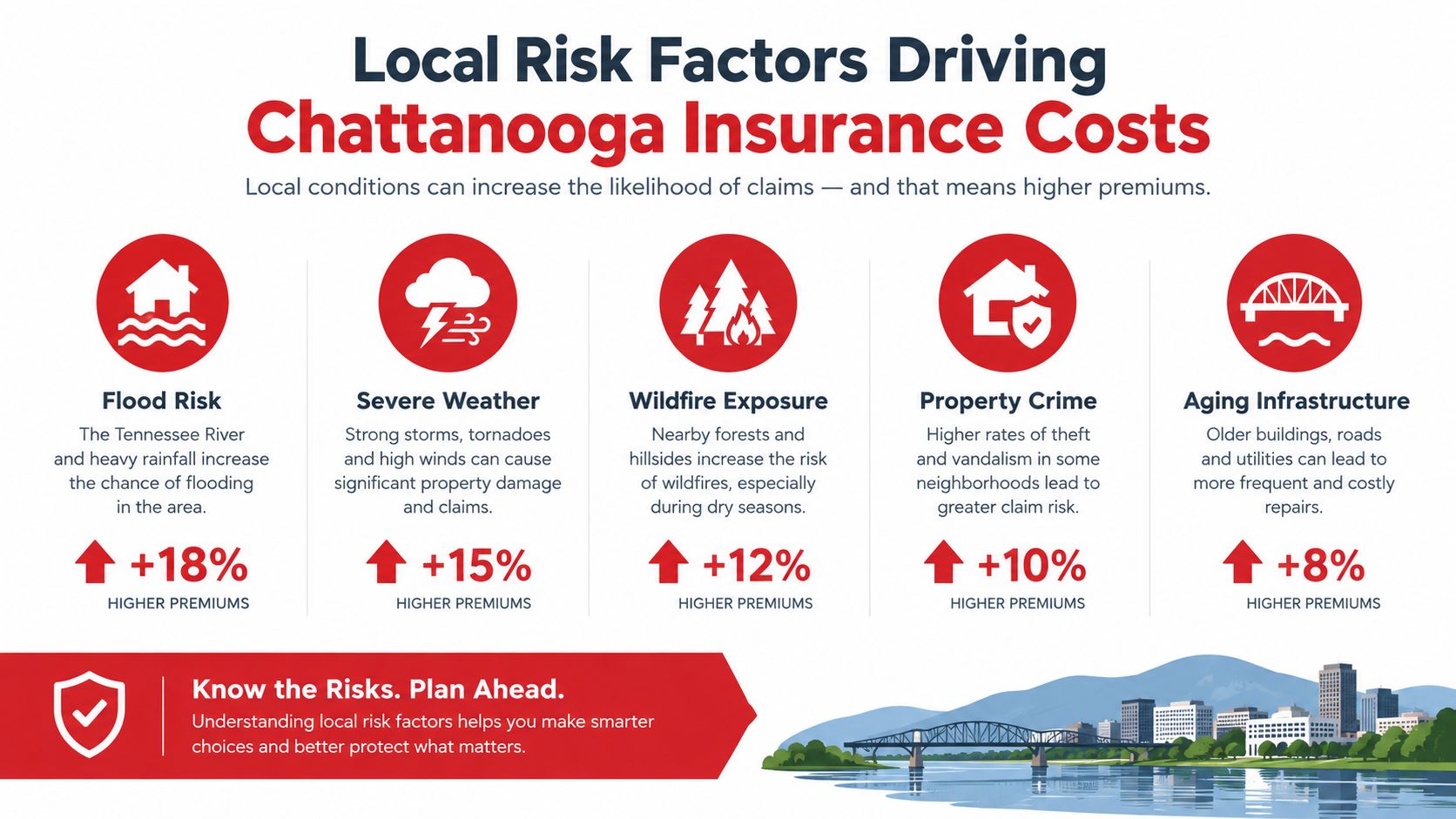
Chattanooga quotes don't vary because insurers pick numbers at random. They price expected exposure. A rider who uses a motorcycle for frequent commuting through crowded corridors presents a different claim profile from someone who rides occasionally and stores the bike securely between weekend trips.
National safety data shows why motorcycles receive serious underwriting attention. In 2024, motorcyclists were about 27 times more likely than passenger car occupants to die per 100 million vehicle miles traveled, and almost 5 times more likely to be injured, according to NHTSA motorcycle safety data. Insurers translate that severity difference into pricing for bodily injury, medical costs, repairs, and total losses.
How your riding pattern affects the quote
Your annual mileage is one of the clearest exposure signals. More miles generally mean more time around traffic, intersections, lane changes, road debris, and weather. A daily commute on traffic-heavy routes creates more opportunities for a claim than limited recreational use.
The motorcycle itself also matters. Engine size, repair costs, theft appeal, modifications, and replacement value can change the premium. A custom motorcycle with expensive accessories may need broader protection than a standard bike, even if both riders have similar driving histories.
What insurers typically review
Underwriters commonly examine:
- Driving and riding history: Violations, at-fault accidents, and prior claims can affect how the carrier assesses risk.
- Use of the motorcycle: Commuting, business use, recreational riding, and seasonal use create different exposure patterns.
- Storage and security: Garaging, locked storage, alarms, and other security measures can influence theft and loss assumptions.
- Coverage limits: Higher liability and UM/UIM limits cost more, but they also reduce the amount you personally absorb after a serious claim.
- Deductibles: A higher deductible can reduce the premium, but only choose one you could pay after a loss.
Chattanooga's urban traffic, nearby mountain routes, and connections across Tennessee and into Georgia give riders varied conditions in one policy territory. The right comparison is not just the lowest premium. It's the quote that accurately reflects your use while preserving the coverages you'll need when the accident doesn't follow a convenient script.
Essential Coverages Beyond the State Minimum
Bare-minimum liability is cheap because it protects a narrow slice of the financial risk. It pays for covered bodily injury and property damage you cause to others, within the selected limits. It doesn't protect your motorcycle from a crash, and it doesn't guarantee that another driver's insurance can pay for your injuries.
The most important upgrade for many Chattanooga riders is uninsured and underinsured motorist coverage, commonly called UM/UIM. Roughly 21.3% of Tennessee drivers were uninsured in 2023, making this protection especially important for riders, as reported in this Tennessee uninsured-driver analysis.
UM/UIM closes the driver-created gap
If an uninsured driver hits you, there's no liability policy from that driver to fund your covered losses. If the driver has insurance but the limits are too low, the available payment may fall far short of your medical expenses, lost wages, and other damages.
UM/UIM coverage can respond under your own policy, subject to its limits, exclusions, conditions, and claim procedures. Don't reject it casually just to make the quote look cheaper. Ask for limits that align with your broader financial exposure, and confirm whether the coverage applies to the motorcycle and situations you care about.
Protect your bike as an asset
Collision coverage addresses damage caused by a crash or impact, subject to the deductible. Coverage for non-collision losses addresses covered non-collision losses, such as theft, vandalism, fire, or weather-related damage. A motorcycle can be damaged even when nobody else is at fault, so liability-only coverage leaves a major hole.
If you financed the motorcycle, review the lender's requirements and ask whether your policy includes the protection needed to satisfy the loan. Also identify custom parts, safety equipment, and accessories. Standard coverage may not fully account for upgrades unless accessory coverage is added or scheduled.
Consider medical payments coverage
Medical payments coverage can help with eligible medical expenses after a covered motorcycle accident, depending on the policy. It can be useful when health coverage has deductibles, exclusions, delays, or other out-of-pocket costs.
The cheapest compliant policy is often the riskiest financial choice. Compare the total protection, not just the monthly payment.
A practical policy review should compare liability, UM/UIM, collision, full coverage, medical payments, and accessory protection side by side. If one quote removes UM/UIM or sharply raises deductibles to win on price, it's not an apples-to-apples bargain.
How to Compare Quotes and Lower Your Premium
Start with accurate information. An incomplete quote can look attractive because it leaves out details that later change the price or create coverage problems. Gather the motorcycle's VIN, registration or title information, current declarations page, riding history, driver information, financing details, annual mileage, and storage information before you request comparisons.
Use an apples-to-apples comparison
Request each quote with the same core limits and options. Compare:
- Liability limits: Check bodily-injury and property-damage limits, not just whether liability is included.
- UM/UIM protection: Confirm the limits, whether you can reject or reduce them, and how the coverage applies.
- Physical damage: Review collision and other-than-collision deductibles and covered loss types.
- Medical payments: Ask what the coverage is designed to pay and whether it fits your health and financial situation.
- Accessories and equipment: Confirm how custom parts, luggage, helmets, and riding gear are treated.
- Policy conditions: Review exclusions, permitted use, storage requirements, and seasonal restrictions.
Use multiple-carrier insurance quote options when you want a broader market comparison. A lower price matters only after the coverage structure matches.
Lower the premium without gutting protection
Reducing unnecessary exposure can help. The National Highway Traffic Safety Administration's motorcycle safety guidance identifies practical factors that can improve insurability and lower premiums, including reduced annual mileage, rider-safety training, documented garaging security, and a clean violation history.
Ask about these actions directly:
- Report mileage accurately: Don't overstate how often you ride, but don't underreport it either.
- Complete recognized safety training: Provide documentation so the carrier can evaluate any applicable discount.
- Secure the motorcycle: Tell the agent about enclosed garaging, locks, alarms, and other security controls.
- Keep your record clean: Safer riding habits help protect both your premiums and your claim position.
- Review deductibles carefully: Raising a deductible can reduce cost, but only if you can comfortably fund it after a loss.
Bundling policies may also create savings, but never accept a weaker motorcycle policy merely to qualify for a package discount. Review the full declarations page at each renewal, especially after changing motorcycles, mileage, storage, or household drivers.
The Advantage of Using an Independent Insurance Agency
A captive agent represents one insurance company. That agent may provide useful service, but the quote comes from one underwriting system. If that carrier prices your motorcycle aggressively because of your riding history, motorcycle type, mileage, or Chattanooga location, you may have no meaningful alternative through that channel.
An independent agency can request comparisons from multiple carriers. That matters because motorcycle pricing varies by underwriting model. One carrier may place more weight on mileage, another on the motorcycle's characteristics, and another on your broader driving profile.
What an independent agent can do differently
An independent agent can help you compare the same coverage design across different markets, identify missing protection, and explain why one quote is lower. That makes the conversation more useful than just asking which carrier has the cheapest motorcycle premium.
Look for an agency that can:
- Compare more than one carrier: This gives you a better view of available pricing and underwriting appetite.
- Explain coverage differences: The agent should show what changed between quotes, including limits, deductibles, exclusions, and endorsements.
- Support policy changes: Motorcycle purchases, storage changes, added accessories, and seasonal use all deserve prompt updates.
- Help during claims: You want a clear contact when you need to report damage or understand next steps.
- Offer accessible communication: Phone, text, digital documents, and bilingual support can make policy management easier for Southeast riders.
Local service still matters
A remote quote may not account for the details that shape your actual risk. An agent who asks where you store the bike, how you use it, and whether you commute or ride recreationally can help avoid an inaccurate policy setup.
Learn more about how an independent insurance agency works. The goal isn't to buy the most coverage blindly. It's to make an informed choice across price, limits, deductibles, exclusions, and service.
Frequently Asked Questions About Chattanooga Motorcycle Insurance
Why do Chattanooga quotes differ so much?
City-level comparisons list Chattanooga full-coverage averages around $41 to $72 per month, depending on the carrier and underwriting model, according to this Tennessee motorcycle insurance pricing comparison. Those figures are benchmarks, not promises.
Your actual quote can change with the motorcycle, mileage, driving history, storage, deductibles, liability limits, UM/UIM selection, and physical-damage coverage. Compare the declarations pages, not just the advertised average.
Can I drop coverage during winter?
Don't assume you can suspend coverage without consequences. A motorcycle may still be exposed to theft, fire, vandalism, weather, or other losses while stored, and a lender may require continuous protection. Ask your agent about permitted seasonal changes before removing coverage or allowing a policy to lapse.
Does carrying a passenger change my policy?
It can. Review whether the motorcycle is rated and equipped for passenger use, and ask how bodily-injury liability, UM/UIM, and medical payments apply to an occupied passenger seat. Never assume your passenger has the same protection you do without reading the policy terms.
What should I ask before riding into Georgia?
Tell your agent if interstate or cross-border riding is part of your normal use. Confirm that your liability, UM/UIM, physical-damage, and roadside options remain appropriate when you travel outside Tennessee, and carry proof of insurance with you.
Should I choose the cheapest quote?
Only after confirming identical limits and coverages. A low premium may reflect lower UM/UIM limits, higher deductibles, limited accessory protection, or liability-only coverage. Choose the quote that protects your likely financial loss, not merely the one that satisfies the legal floor.
Next Steps to Secure Your Motorcycle Coverage
Start with your current declarations page. Mark the liability limits, UM/UIM limits, deductibles, medical payments, and collision coverage, and any listed accessories. If you can't explain what each item does, don't renew blindly.
Next, gather your VIN, mileage, storage details, riding history, and financing information. Request several quotes using the same coverage design. Ask each agent to show the premium difference created by changing deductibles or removing optional protection, rather than presenting one stripped-down price.
Your final review should answer four questions:
- Can liability limits handle a serious claim against you?
- Would UM/UIM help if the other driver has no insurance or too little?
- Could you repair or replace your motorcycle after a covered loss?
- Can you pay the selected deductible without creating a financial crisis?
Chattanooga motorcycle insurance should make every mile more manageable, not leave you hoping the other driver carries enough coverage. Take a few minutes to compare the protection carefully, update the policy when your motorcycle or riding pattern changes, and keep proof of insurance available whenever you ride.
Select Insurance Group, Inc. compares motorcycle insurance options, including liability, collision, other-than-collision, and accessory coverage, for Tennessee riders. Visit Select Insurance Group, Inc. to request a free quote and get straightforward help choosing protection that fits your Chattanooga riding needs.