
A wet floor, a hurried turn, and suddenly a Chattanooga business owner is dealing with an injured employee, medical questions, paperwork, and a possible claim. The owner may wonder whether the injury is covered, whether the business has followed Tennessee rules, and whether the next renewal will cost more.
That uncertainty is manageable when workers compensation is treated as both an insurance policy and an operating process. The right classification, prompt reporting, accurate payroll, useful safety procedures, and a practical return-to-work plan all matter. Chattanooga employers also operate within Tennessee's statewide system, so local purchasing decisions are connected to a legal framework that has been developing for more than a century.
Table of Contents
- What Workers Compensation Means for Chattanooga Employers
- Tennessee Legal Requirements Every Chattanooga Business Owner Must Know
- How Workers Comp Premiums Are Calculated in Chattanooga
- Filing a Claim and Returning to Work Faster
- Where to Buy Coverage and How Independent Agencies Compare
- Smart Ways Chattanooga Employers Can Lower Their Workers Comp Costs
- Common Questions Chattanooga Employers and Workers Ask
- Your Next Steps and Local Resources in Chattanooga
What Workers Compensation Means for Chattanooga Employers
Maria owns a small restaurant in North Chattanooga. During a busy service, an employee slips near the dishwashing area, catches herself on a counter, and immediately complains of back pain. Maria's first reaction is panic. She worries about the employee, the cost of treatment, and whether one accident could threaten the business.
Workers compensation gives Maria a defined path. It is a no-fault insurance system that generally pays authorized medical treatment and part of an injured worker's lost wages when the injury arises from employment. In exchange, the system usually limits the employee's ability to bring a negligence lawsuit against the employer. The employer receives a structured way to handle the injury instead of facing an unpredictable civil claim for every workplace accident.
Tennessee's framework dates to 1919, when the General Assembly passed the Workmen's Compensation Act and Governor Albert Roberts signed it on April 15 of that year. The state's historical review explains that Tennessee had no workers compensation law in 1911, and that lawmakers spent nearly a decade settling on the first version of the system. The original law capped certain permanent-total-disability benefits at $5,000, approximately $74,000 in today's dollars, which illustrates how limited early benefits were compared with modern coverage. Tennessee's official workers compensation history provides the historical context behind today's system.
The practical trade-off
Employees generally give up the right to sue an employer for ordinary negligence within the workers compensation system. Employers, in turn, pay predictable premiums for protection that can include claim administration and legal defense when a dispute arises. That exchange doesn't make every claim simple, but it gives both sides a defined process.
Practical rule: Treat the first report, the medical appointment, and the job description as connected parts of one claim. Inconsistent information creates avoidable questions.
A Chattanooga policy can provide authorized medical care, temporary disability benefits, permanent disability benefits or settlements where applicable, and death benefits for eligible family members. It can also support the employer when the worker, medical provider, or insurer disputes responsibility or the extent of the injury.
Employers building a broader safety program may also benefit from practical guidance outside insurance, including this resource on navigating safety regulations Tampa. The location differs, but the underlying lesson applies in Chattanooga too. A written process is more useful than a binder that nobody follows.
Tennessee Legal Requirements Every Chattanooga Business Owner Must Know
Tennessee workers compensation compliance starts with the employee count and the nature of the work. Many employers with five or more workers must carry coverage, and the rule can apply across full-time, part-time, seasonal, and family employment arrangements. The coal mining industry has a different threshold, so businesses in or connected to that work need specialized guidance before hiring.
A sole proprietor, partner, or member of an LLC may have an option to exclude themselves in some circumstances, but that choice doesn't automatically remove obligations for other workers. Owners should confirm the current election process with the Tennessee Bureau of Workers' Compensation rather than relying on an informal assumption that an owner or contractor is “not covered.”
Build compliance around actual work
Job titles don't settle employee classification. A person called a contractor may still function like an employee based on the working relationship, control, and duties involved. A staffing-agency worker assigned to a Chattanooga manufacturing line also requires careful coordination between the staffing company and the host employer. The contract should identify who provides coverage, who reports injuries, and who controls the medical process.
A practical compliance file should contain:
- Coverage evidence: Keep the current policy, endorsements, and certificates accessible to managers.
- Payroll records: Separate payroll by the work employees perform, not just by department name.
- Workplace notices: Post Tennessee-required notices where employees can see them, and provide language access that workers can understand.
- Incident procedures: Tell supervisors whom to contact immediately after an injury and preserve photographs, witness details, and the employee's description.
- Medical coordination: Follow the authorized provider process and give the worker clear instructions instead of sending them to an unfamiliar clinic without explanation.
Tennessee's rules and forms can change, so a business should review them with its agent and the state bureau before opening, expanding, or changing its operations. The Tennessee workers compensation insurance guidance can serve as a starting point for that review.
Going uninsured creates more than a coverage gap. It can expose the business to state enforcement, direct responsibility for benefits, and serious financial consequences after an injury. A policy should be in place before employees begin work, not after the first accident makes the need obvious.
How Workers Comp Premiums Are Calculated in Chattanooga
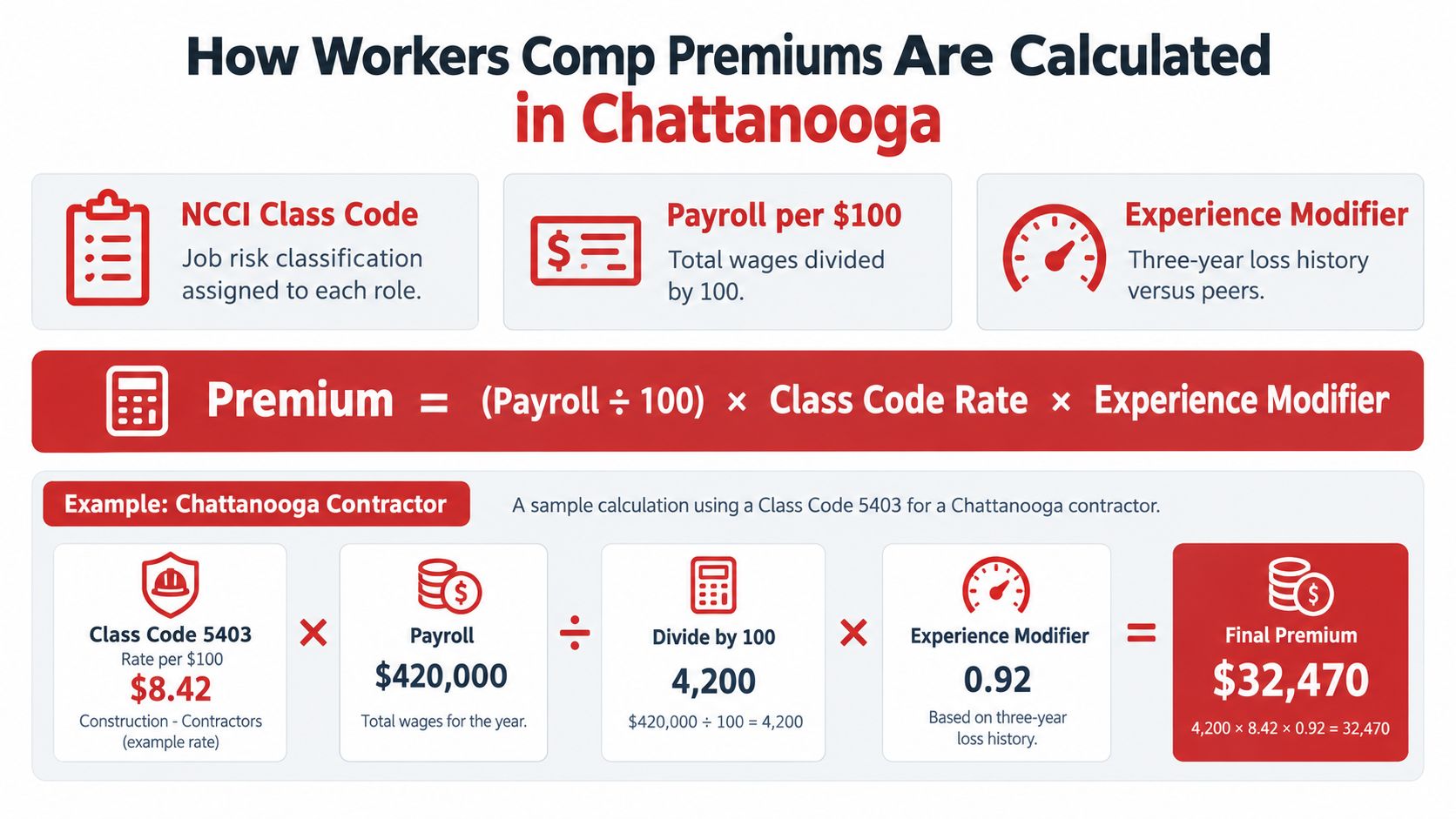
A Chattanooga workers compensation premium starts with a simple idea, but the details matter:
Premium is driven by payroll, job classification, and loss experience.
The carrier assigns a class code based on the work employees perform. A restaurant, office, machine shop, and roofing contractor don't present the same exposure, even if they have similar payroll totals. The carrier then applies the rate for each class to the payroll assigned to that class. An experience rating or other underwriting adjustment can move the final price up or down based on the employer's loss history and operating profile.
What changes the quote
Payroll is usually estimated when the policy begins and reviewed later against actual wages. If an employer places field employees into a clerical classification, or fails to separate distinct duties, the audit can produce an unexpected balance. Accurate job descriptions and payroll records make the underwriting process more defensible.
Loss history matters because an insurer wants to understand whether a claim reflects an isolated event or a recurring control problem. Frequent injuries, delayed reporting, and weak documentation can make an account harder to place. A clean record helps, but it doesn't replace accurate classification.
Secondary factors can include payment arrangements, premium credits, schedule adjustments, deductibles, and documented workplace safety practices. Ask the agent to show which parts of the quote are fixed by classification and which parts can be improved through better information or risk controls.
Tennessee's pricing history provides useful context. In 2012, the state's workers compensation insurance cost was $2.02 per $100 of payroll, equal to 107% of the median among all states, according to the state's historical review. That relative position changed after later reforms. The 2013 reform era followed a state-authorized research project, and Tennessee's official materials describe lower overall workers compensation costs after those reforms. The state's compensation-rate materials also explain the weekly benefit structure and periodic rate updates.
Filing a Claim and Returning to Work Faster
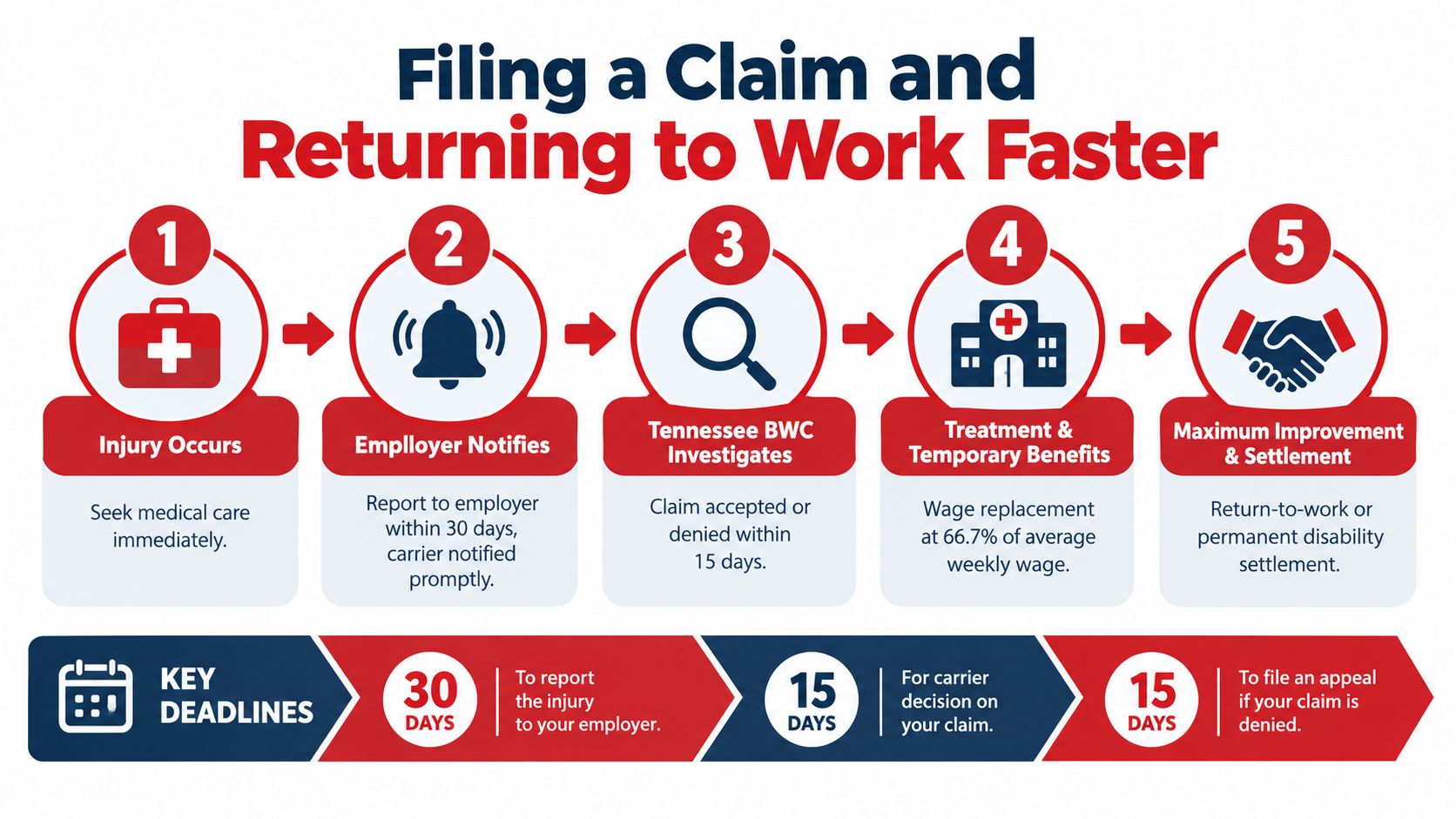
A Chattanooga employee strains a back lifting inventory, a cook suffers a burn, or a contractor falls from a jobsite. The first hours determine how clearly the claim can be documented. The employee should report the incident promptly, obtain appropriate medical care, and describe the event accurately. The supervisor should record the time, location, witnesses, equipment involved, and immediate response without arguing about fault.
The employer or claims contact then completes the formal reporting steps. Tennessee's century-long workers compensation system still requires practical decisions in 2026, including timely injury reporting and use of the authorized medical process. An injured employee generally receives a choice from an approved medical panel, rather than choosing any physician and assuming the insurer will pay every charge.
A workable claim sequence
- Stabilize the situation. Provide first aid or emergency care when necessary. Preserve the scene and correct the immediate hazard.
- Notify the right people. Report the injury promptly to the employer, carrier, or claims administrator. Delay can make witnesses, timing, and causation harder to verify.
- Use authorized care. Give the worker clear instructions about the approved provider process. Keep appointment records, work restrictions, and medical communications organized.
- Track wage benefits. Tennessee generally bases weekly wage-replacement benefits on 66.67% of the worker's average weekly wage, subject to state minimum and maximum levels tied to the injury date. The Tennessee compensation-rate page explains the benefit structure and rate updates.
- Plan suitable work. If the physician sets restrictions, offer duties the employee can safely perform and put the offer in writing. The worker should not be pressured to exceed medical limits.
A return-to-work program supports recovery when it matches the physician's restrictions. It keeps the employee connected to the workplace, may shorten the period of wage-replacement benefits, and gives the adjuster clearer evidence that the employer is managing the claim responsibly. The trade-off is administrative effort. A rushed or unsuitable assignment can worsen the injury and create a second dispute.
Tennessee's post-reform results support prompt, active claim management. The state reports a roughly 30-week reduction from injury to claim conclusion, a decline from about 44 weeks to 27 weeks from maximum medical improvement to conclusion, and 72% of injured workers returning to the same employer in post-reform cases. The 2025 Bureau of Workers' Compensation annual report also records 2,455 successful mediations, 8,723 court-approved settlements, and ombudsman assistance to 13,067 employees and employers. For questions about filing steps or when legal advice may be appropriate, consult workers comp from Morgan & Morgan.
Where to Buy Coverage and How Independent Agencies Compare
Chattanooga employers usually have three purchasing paths. The voluntary market is the normal destination for businesses that meet an insurer's underwriting requirements. The assigned-risk market exists for employers who can't obtain coverage through standard channels. An independent agency can gather and compare options rather than presenting only one carrier's terms.
| Channel | Best for | Pros | Cons |
|---|---|---|---|
| Voluntary market | Businesses with organized records and acceptable loss experience | Broader underwriting flexibility and potential pricing options | One quote may not reflect the full market |
| Assigned-risk market | Employers unable to secure standard coverage | Provides a route to legally required coverage | Fewer pricing and payment choices may be available |
| Independent agency | Owners who want several options evaluated | Compares classifications, limits, billing structures, and underwriting questions | The quality depends on the agency's workers compensation experience |
A single quote can be useful as a reference, but it doesn't tell you whether the class code is correct or whether another underwriter views the same operation differently. This matters for contractors with mixed field and office payroll, restaurants with changing duties, and manufacturers that add a new production line.
What a local review should include
Ask for a side-by-side explanation of the class codes, estimated payroll, payment plan, deductible terms, exclusions, audit rules, and available safety credits. An agent who understands Chattanooga operations should ask how employees spend their day, not just copy the occupation listed on a business application.
Online portals can be convenient for a quick indication, but they rarely replace a detailed classification review. Guidance on what an independent insurance agency does explains why access to multiple markets can matter when the risk doesn't fit a simple application.
Smart Ways Chattanooga Employers Can Lower Their Workers Comp Costs
A Chattanooga restaurant can lose premium control before renewal if kitchen, serving, management, and office payroll are combined without checking the carrier's classification rules. A contractor faces the same issue when field labor, supervisors, and clerical work are recorded under one code. Review those inputs first. A discount request rarely fixes inaccurate payroll or duties.
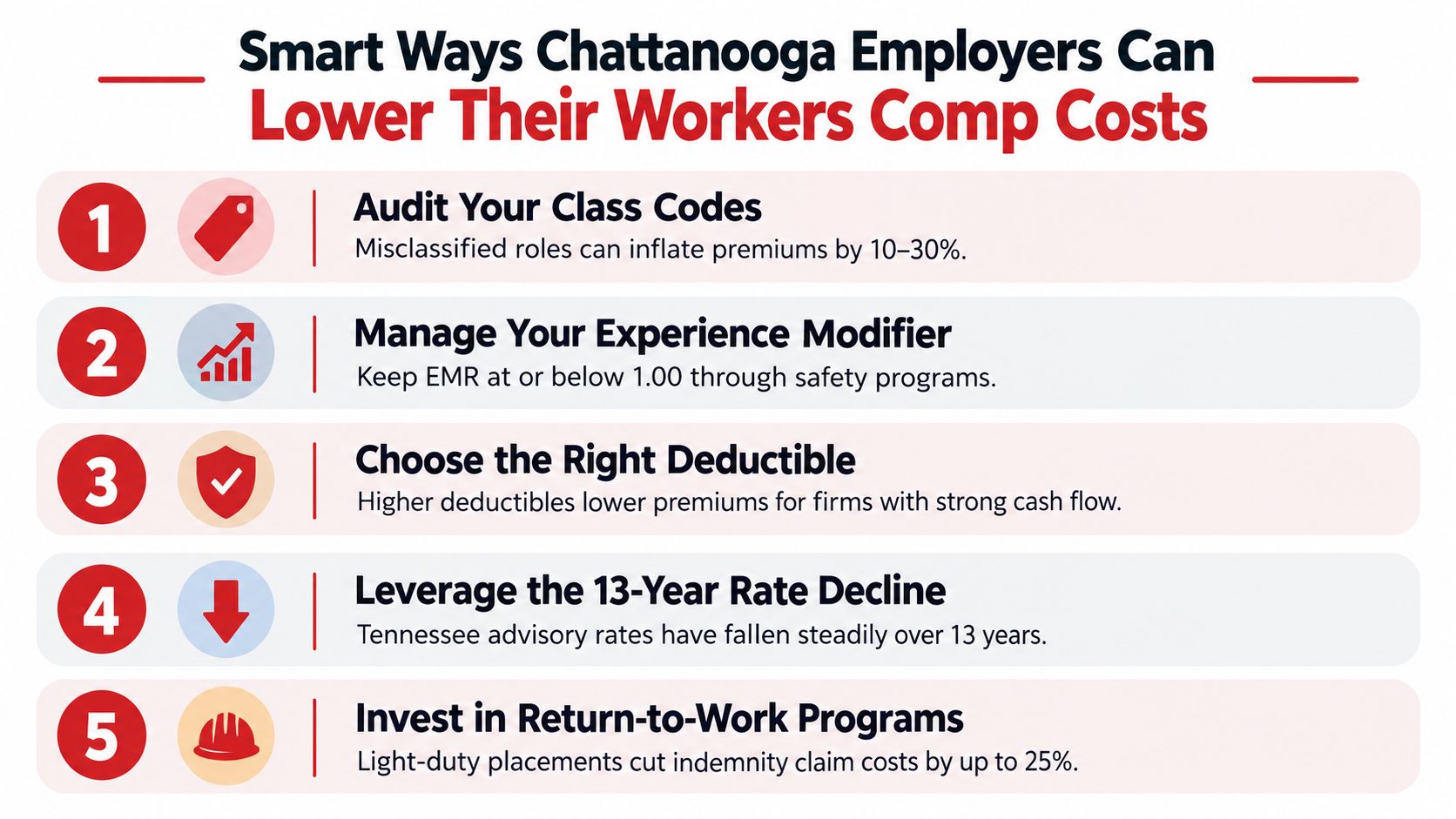
Tennessee's workers compensation system has developed across a century of state rules, yet the practical question for an employer buying coverage in 2026 remains straightforward: are the policy details accurately describing the business? Tennessee reported a 2% overall loss-cost decrease for new and renewal policies beginning March 1, 2026, with a 1.1% decrease in the assigned-risk rate level. This marked the 13th consecutive annual decline in Tennessee workers compensation rates, as explained in The Tennessee Department of Commerce and Insurance announcement. The statewide trend helps, but it cannot correct poor loss experience or an incorrect workforce classification.
Actions that influence the renewal
- Review class codes before renewal: Match classifications to actual duties and separate payroll by role where the rules permit it.
- Control small incidents early: Record near misses, correct hazards, and identify patterns by shift, location, or task.
- Use a written return-to-work process: Coordinate restricted duties with the treating physician, then document the offer and the employee's response.
- Check subcontractor insurance: Keep current certificates and contracts so uninsured subcontracted work does not create a coverage dispute.
- Evaluate payment and deductible options: A higher deductible can reduce premium, but it shifts claim costs to the business. Choose it only if the company can fund and administer those expenses.
A drug-free workplace program or another documented safety initiative may qualify for a credit when applicable Tennessee requirements are satisfied. Request the exact documentation before assuming the credit applies.
A 1099 label does not settle worker status. If a person operates like an employee, an auditor or state authority may challenge the classification. Accurate records and an honest description of who controls the work provide safer pricing than choosing the cheapest label.
Common Questions Chattanooga Employers and Workers Ask
Tennessee's workers compensation system has developed over roughly a century, but the questions facing a Chattanooga employer in 2026 remain practical: who is covered, how quickly must an injury be reported, and what happens when work crosses a state line? Clear records and prompt communication still move a claim forward.
Are 1099 contractors automatically exempt?
No. A contract label does not decide the relationship. Review who controls the work, how it is performed, who supplies equipment, and whether the person operates an independent business. If the classification is uncertain, ask an insurance professional to confirm the current Tennessee position before an injury occurs.
How quickly should an injury be reported?
Report the injury promptly, even when the worker expects the pain to pass. The employer should notify its carrier or claims administrator without delay and preserve the basic facts, including when, where, and how the incident occurred. A worker facing a disputed or delayed claim should obtain advice about applicable notice and filing deadlines rather than waiting for the issue to resolve.
Does coverage follow an employee into another state?
It may. The answer depends on the employee's home state, where the work occurs, how long the assignment lasts, and the policy's territorial provisions. A Chattanooga contractor sending a crew across a state line should ask the agent to review the policy before the job begins. A certificate alone does not settle the question.
Can an employee sue the employer?
Workers compensation generally replaces a negligence lawsuit for an injury covered by the system. Separate legal issues may arise when someone other than the employer contributed to the injury or when the facts involve conduct outside ordinary workplace negligence. Serious or disputed injuries warrant prompt legal review.
How are weekly benefits calculated?
Tennessee generally bases wage-replacement benefits on 66.67% of average weekly wage, subject to state minimum and maximum levels that change according to the injury date. Medical benefits and other benefit categories may also apply, so every claim is not resolved as one lump-sum payment. The official compensation-rate materials explain the benefit structure.
Where can Spanish-speaking workers get help?
Employers should provide instructions in a language employees understand and should not leave a worker without support for medical appointments or hearings. Tennessee's Bureau of Workers' Compensation can direct parties to approved interpreter resources. Bilingual assistance helps the worker describe the injury mechanism, work restrictions, and changes in symptoms accurately.
Your Next Steps and Local Resources in Chattanooga
A sensible review starts before the renewal application arrives. Pull together the current policy, payroll by job function, recent loss runs, subcontractor certificates, and a list of any operational changes. Then ask an agent to confirm the classifications, compare available markets, and explain how the experience history affects the next quote.
Use this checklist:
- Confirm the workforce: Count employees and review owner, member, temporary, seasonal, and contractor arrangements.
- Verify classifications: Compare the carrier's descriptions with the work performed in the kitchen, shop, office, warehouse, or jobsite.
- Prepare the claim file: Keep incident forms, witness information, medical instructions, and return-to-work documents in one accessible location.
- Review state resources: The Tennessee Bureau of Workers' Compensation can provide current forms, benefit information, dispute-resolution guidance, and official filing instructions.
- Ask local organizations for navigation help: Chattanooga-area small-business support organizations, the Hamilton County Chamber of Commerce, approved medical networks, and legal-aid resources may help owners and workers identify the next appropriate contact.
The state's workers compensation system is mature, but maturity doesn't eliminate friction. A claim can still stall when the employee gives incomplete notice, the employer uses the wrong classification, the medical process isn't explained, or the carrier receives inconsistent facts. Good administration connects the legal, medical, and insurance pieces from the first report through final resolution.
Select Insurance Group, Inc. offers Tennessee commercial coverage, including workers compensation, and can help Chattanooga businesses compare policies, handle certificates for general-contractor requirements, and organize the early stages of a claim. Employers seeking broader Chattanooga commercial insurance guidance can use the review to identify related liability and property exposures as well.
Start before the next renewal cycle. Confirm your classifications, gather the records an underwriter will request, and ask for a coverage review while there is still time to correct the application.
Select Insurance Group, Inc. helps Chattanooga employers compare workers compensation options, review classifications, and coordinate certificates and claim-support steps. Visit Select Insurance Group, Inc. to request a practical policy review and discuss coverage for your business.