
You open your North Shore boutique on a busy Saturday and hear a customer fall near a display. The customer has tripped over a fixture, suffered a serious wrist injury, and now wants payment for medical treatment. Your landlord wants to know whether you carried insurance, while your attorney asks for the policy and incident report.
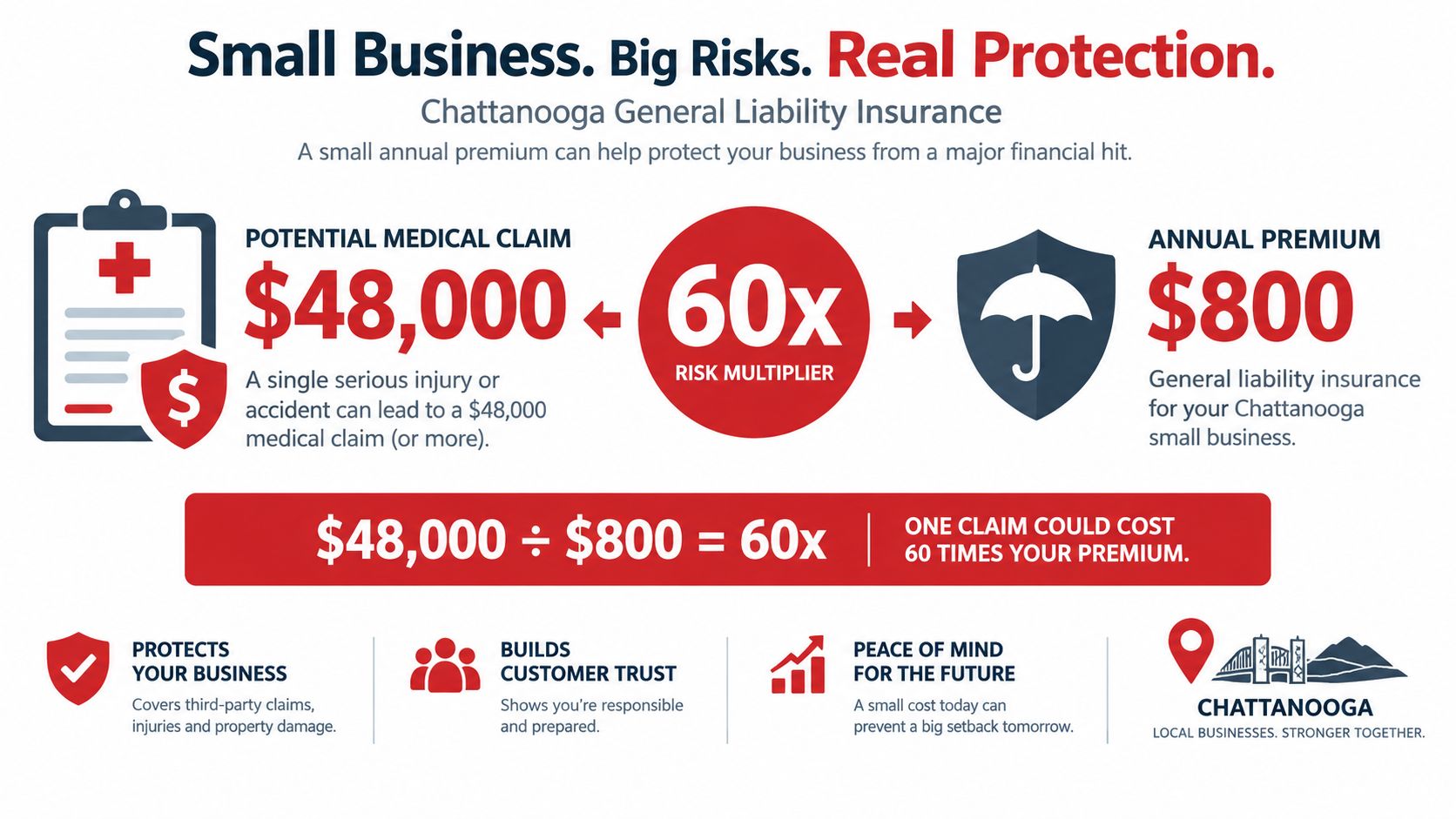
That's where Chattanooga general liability insurance earns its place. General liability responds to covered claims involving third-party bodily injury, third-party property damage, and legal defense costs. It won't solve every business problem, but without it, one accident can put operating cash, a lease, and commercial relationships under immediate pressure.
Table of Contents
- Why Chattanooga Small Businesses Cannot Afford to Skip General Liability
- What Chattanooga General Liability Actually Covers
- Where General Liability Stops and Other Policies Start
- Limits and Endorsements That Fit Chattanooga Operations
- What General Liability Costs in Chattanooga and Tennessee
- Tennessee Rules and Chattanooga Realities Buyers Often Miss
- Getting and Comparing Quotes the Right Way
- Chattanooga General Liability Questions Business Owners Ask Most
Why Chattanooga Small Businesses Cannot Afford to Skip General Liability
A retail owner may think a clean floor and careful staff eliminate most liability risk. They don't. Customers enter with different footwear, mobility limitations, and expectations, and a single accident can create both a medical claim and a premises liability lawsuit. The owner may have done everything reasonably possible and still need a carrier to investigate, negotiate, and defend the business.
Hamilton County had 9,726 business establishments in 2022, according to the Census of Business Patterns data summarized for Chattanooga businesses. That commercial density matters. Retailers, restaurants, contractors, service companies, and customer-facing offices all invite people onto their premises or send employees into someone else's property.
Chattanooga's riverfront activity, tourism, retail corridors, restaurants, and ongoing construction create different versions of the same exposure. A boutique faces a customer injury. A contractor can damage a client's building. A service technician can leave a tool behind, scratch flooring, or cause an accident while working inside an occupied property.
The cash-flow problem behind one claim
General liability isn't only about paying a settlement. It also supports the legal defense that begins when someone alleges the business caused harm. Legal bills, investigation costs, expert involvement, and negotiations can put pressure on a small operation before anyone decides whether the claim has merit.
Practical rule: If your business can't comfortably fund a serious defense while continuing payroll, rent, inventory, and vendor payments, going without liability coverage isn't a cost-saving strategy. It's a transfer of risk to your personal and business assets.
A claim can also create a contract problem. A landlord may treat missing insurance as a lease violation. A client may suspend work until receiving a certificate of insurance. A lender or business partner may question whether the company can meet its obligations after a major incident.
The right policy doesn't make the risk disappear. It gives the business a defined response when an outside party alleges injury or damage. For a useful operational companion, plumbing contractors can also review Exayard plumbing estimating software to document scopes, materials, and job assumptions more consistently. Better documentation won't replace insurance, but it can help clarify what work was proposed and performed.
What Chattanooga General Liability Actually Covers
General liability works best when you understand the type of claim it was designed to handle. It primarily protects against allegations that your business caused physical injury or property damage to someone outside the company, along with certain personal and advertising injuries.
Coverage A and everyday third-party accidents
Coverage A is the part most owners think about first.
A customer slips on a forklift ramp at a Hixson warehouse and alleges bodily injury. A subcontractor scratches a marble lobby while carrying equipment into a downtown project. A child cuts an arm on a sharp display edge inside a Hamilton Place retailer. These are recognizable third-party injury or property damage scenarios.
Coverage may include investigation, settlement, and defense, subject to the policy terms, exclusions, deductibles, and limits. A contractor's completed work can also create later property damage allegations, which makes completed-operations wording important for trades that install, repair, grade, renovate, or modify property.
Coverage B and communications-related allegations
Coverage B addresses certain personal and advertising injury allegations. Depending on the policy wording, examples can include defamation, some copyright-related allegations in advertising material, or wrongful eviction claims.
A business owner who replies angrily to a negative review could create a defamation allegation. A marketing firm could face a claim involving material used in a brochure. A landlord or tenant could dispute statements made in connection with an eviction. These claims don't look like slip-and-fall accidents, but they can still require a legal response.
Coverage B is not a license to publish whatever you want. Intentional misconduct, known violations, and many intellectual property disputes may be excluded or restricted.
Coverage C and small medical payments
Medical Payments coverage is a narrower bucket. It can pay certain medical expenses for a third party without requiring the injured person to prove negligence or file a lawsuit, subject to the policy's conditions and limit.
That coverage is useful for minor incidents where prompt payment may help resolve a situation. It isn't a substitute for the broader bodily injury protection under Coverage A.
| Coverage | What It Pays For | Chattanooga Example |
|---|---|---|
| Coverage A | Covered third-party bodily injury, property damage, defense, and related settlement costs | A customer falls in a shop or a contractor damages a client's lobby |
| Coverage B | Certain personal and advertising injury allegations | A disputed public statement or advertising-related claim |
| Coverage C | Certain medical expenses for a third party without a lawsuit | A visitor seeks treatment after a minor store accident |
GL normally excludes employee injuries, professional advice errors, business auto claims, pollution losses, and intentional acts. Defense costs are also commonly subject to the policy's limit structure, so a defense can reduce what remains available for settlement. The policy must be coordinated with other coverage rather than treated as a complete commercial insurance program.
Where General Liability Stops and Other Policies Start
The most expensive insurance mistake isn't always buying too much. It's buying a policy that answers a different question from the one your business is asking.
General liability responds mainly to outside-party injury, property damage, and specified personal or advertising injury. Workers' compensation addresses employee work injuries. Professional liability addresses financial harm arising from professional services. Commercial property protects your own building and contents. Commercial auto addresses vehicles used for business.
A side-by-side coverage test
| Policy | Primary Coverage | Does GL Cover This? | Typical Chattanooga Buyer |
|---|---|---|---|
| General Liability | Third-party injury, third-party property damage, and covered defense | Yes, when the claim fits the policy | Retailers, restaurants, contractors, service firms |
| Workers' Compensation | Employee injuries and occupational illness | No | Businesses with employees |
| Professional Liability or E&O | Claims alleging advice, design, consulting, or service errors | Usually no | IT firms, accountants, consultants, marketing agencies |
| Commercial Property | Business building, contents, and eligible business income losses | No | Shops, offices, warehouses, restaurants |
| Commercial Auto | Business-use vehicles and related liability | No | Contractors, delivery businesses, trades, fleets |
An IT consultant in Chattanooga's Innovation District can have a clean general liability policy and still need errors and omissions coverage. If a client claims faulty advice caused financial loss, that allegation belongs in the professional liability conversation, not the GL conversation.
A retailer whose own inventory is damaged by fire has a property claim. A customer injured by falling merchandise may create a GL claim. The same event can involve more than one policy, but each policy has a separate job.
Build the commercial stack around the actual operation
A Business Owner Policy can bundle general liability and commercial property for eligible small businesses. Bundling may simplify administration and can be more economical than placing every coverage separately, but the package still needs accurate limits and endorsements.
Commercial auto deserves special attention when an owner or employee uses a branded pickup, van, or other vehicle for business. Review the exposure with a specialist through Chattanooga commercial auto insurance guidance rather than assuming a personal auto policy will respond.
Cyber liability is another separate decision. A standard GL policy generally isn't designed to handle the full cost of a data incident, privacy allegation, notification obligation, or technology interruption. Tennessee businesses handling customer, employee, or payment information should discuss cyber coverage as part of the broader program.
Limits and Endorsements That Fit Chattanooga Operations
For many Chattanooga small businesses, the familiar structure is $1 million per occurrence, $2 million aggregate, and $1 million for products-completed operations. Tennessee market data identifies the first two limits as common commercial certificate figures, and the Tennessee general liability cost benchmark uses that structure for its small-business premium comparison.
The per-occurrence limit is the most available for one covered incident. The aggregate is the most the policy generally pays for covered claims during the policy period. Products-completed operations applies to qualifying injury or damage allegations arising after work or products are completed.
Don't confuse a certificate with broader protection
Two separate claims can consume the aggregate even when neither claim individually reaches the per-occurrence limit. A certificate of insurance proves that a policy exists at a stated time. It doesn't rewrite exclusions, add an additional insured, or guarantee that a particular contract requirement has been satisfied.
For many leased shops and offices, the common limit structure is a practical starting point. A contractor working for a larger client, signing a lease with demanding insurance language, or performing higher-severity work may need higher limits. Above the primary limit, an umbrella is usually the cleaner way to add capacity than repeatedly modifying the underlying policy.
Endorsements should follow the work
| Endorsement | What It Covers | Chattanooga Operations That Need It |
|---|---|---|
| Contractors or trade-specific wording | Addresses classifications and operations relevant to qualifying trade work | Roofers, HVAC technicians, plumbers, remodelers |
| Additional insured status | Extends defined protection to another party when the policy permits it | Contractors working under client or landlord contracts |
| Tenant improvements | Addresses selected exposures connected with alterations to leased space | Businesses fitting out warehouse or riverfront commercial space |
| Signs and outdoor property | Addresses selected property exposures outside the basic premises setup | North Shore storefronts and businesses with exterior displays |
| Liquor liability | Addresses alcohol-related liability that GL may exclude or restrict | Breweries, bars, restaurants, and event venues |
| Cyber or media coverage | Addresses selected technology, privacy, advertising, or media exposures | Agencies, consultants, and firms handling sensitive data |
Review the contract before binding coverage. The insurance requirement may specify an additional insured, waiver of subrogation, primary and noncontributory wording, completed operations, or a particular limit. Buying a generic policy first and trying to force it into the contract later is how gaps and delays happen.
What General Liability Costs in Chattanooga and Tennessee
A Chattanooga contractor can pay far more for general liability than a small technology office, even when both buy the same standard limits. Tennessee pricing reflects the work being performed, the people entering the premises, and the chance that a completed job creates a claim later. The Tennessee premium analysis provides a useful benchmark instead of an invented Chattanooga price chart.
For a small business with one to four employees, coverage with $1 million per occurrence and $2 million aggregate limits averages about $112 per month, or $1,346 per year. Tennessee comes in about 9% below the U.S. average and ranks 25th nationally for affordability in that comparison.
Those figures are benchmarks, not quotes. Class code drives the result. Technology and IT firms average about $26 per month, while construction and contracting businesses average about $294 per month. That creates an 11x spread, showing why accurate classification matters more than shaving a small amount from an otherwise suitable policy.
What underwriters actually price
| Cost Driver | Why It Matters in Chattanooga |
|---|---|
| Industry classification | Contractors, retailers, consultants, restaurants, and manufacturers create different injury and property damage exposures |
| Payroll and business size | More workers and more third-party activity increase the exposure base |
| Claims history | Prior incidents affect eligibility, pricing, and underwriting questions |
| Coverage scope | Higher limits, completed operations, contract requirements, and selected endorsements change the premium |
| Premises and operations | Older buildings, patios, deliveries, and work at customer sites create distinct loss scenarios |
The same source reports that sole proprietors average about $62 per month, while businesses with 20 to 49 employees average about $2,030 per month. Those amounts cannot be transferred directly to a Chattanooga quote. Payroll, revenue, operations, premises, and claims history all change the calculation.
Chattanooga buyers should disclose customer foot traffic, outdoor seating, delivery activity, mixed-use premises, aging buildings, and work inside occupied properties. A quiet office presents a different risk from a restaurant with a patio or a contractor working in a downtown building. Contractors also need pricing that accounts for completed operations, since Tennessee liability timing can keep past work relevant after a project ends.
The money-saving approach is accurate classification, not cutting limits until the policy becomes hard to use. Submit identical operations to at least three markets, compare matching terms, and coordinate property or auto coverage where appropriate. A lower premium with a missing classification or narrower protection is not a lower-cost policy.
Tennessee Rules and Chattanooga Realities Buyers Often Miss
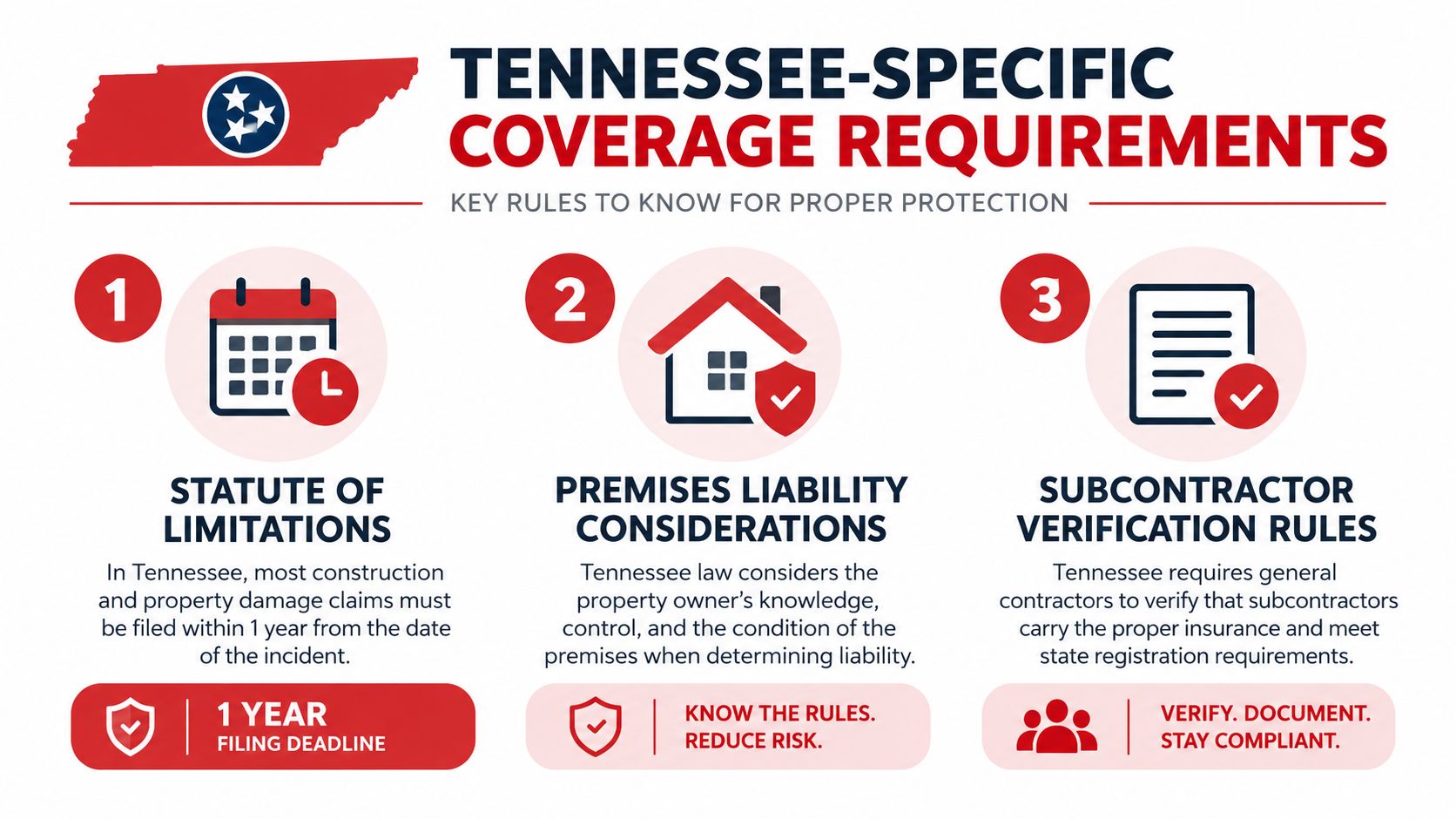
Tennessee's liability timing rules deserve attention from every contractor and service business. The state generally applies a one-year limit for personal injury claims and a three-year limit for property damage claims, while construction disputes can involve additional timing questions connected to substantial completion and later-discovered harm. The Tennessee construction law compendium explains why project closeout doesn't automatically end every potential liability issue.
That timing affects records and completed-operations planning. Keep contracts, change orders, photographs, inspection notes, delivery records, certificates, and correspondence in a way that allows the business and its insurer to reconstruct the job later. Report circumstances promptly rather than waiting to see whether a complaint becomes formal.
Coverage may be required by the deal
Tennessee generally doesn't impose a blanket general liability requirement on every business. Licensed contractors, however, must carry coverage meeting the Tennessee Board for Licensing Contractors requirement, including a $100,000 minimum noted in the Chattanooga insurance overview. Landlords, commercial clients, and municipalities may require more than the state baseline before allowing a business to lease, bid, or work.
The local business mix makes that distinction important. Chattanooga includes logistics, advanced manufacturing, retail, tourism, construction, and craft food operations. Each sector creates its own contract requirements and premises exposures. A business can be legally allowed to operate without a broad GL mandate and still be unable to win work or sign a lease without proof of insurance.
Tennessee's contributory negligence framework also raises the value of a strong defense. Fault allocation can affect recovery, but it doesn't prevent a claimant from making allegations or forcing the business to respond. Defense quality, documentation, and adequate limits remain practical priorities.
For a broader compliance process, a business can use the Safety Space compliance guide as a resource when organizing operational controls and records.
Contractors should also review Tennessee general liability coverage guidance before submitting bids or renewing a policy. The practical question is not only whether the policy is active. It is whether the policy, completed-operations terms, subcontractor documentation, and contract requirements line up.
Getting and Comparing Quotes the Right Way
A good quote starts with a clean submission. Underwriters don't need a polished sales pitch. They need an accurate description of what the business does, where it operates, who performs the work, and what has gone wrong before.
Prepare the information in order
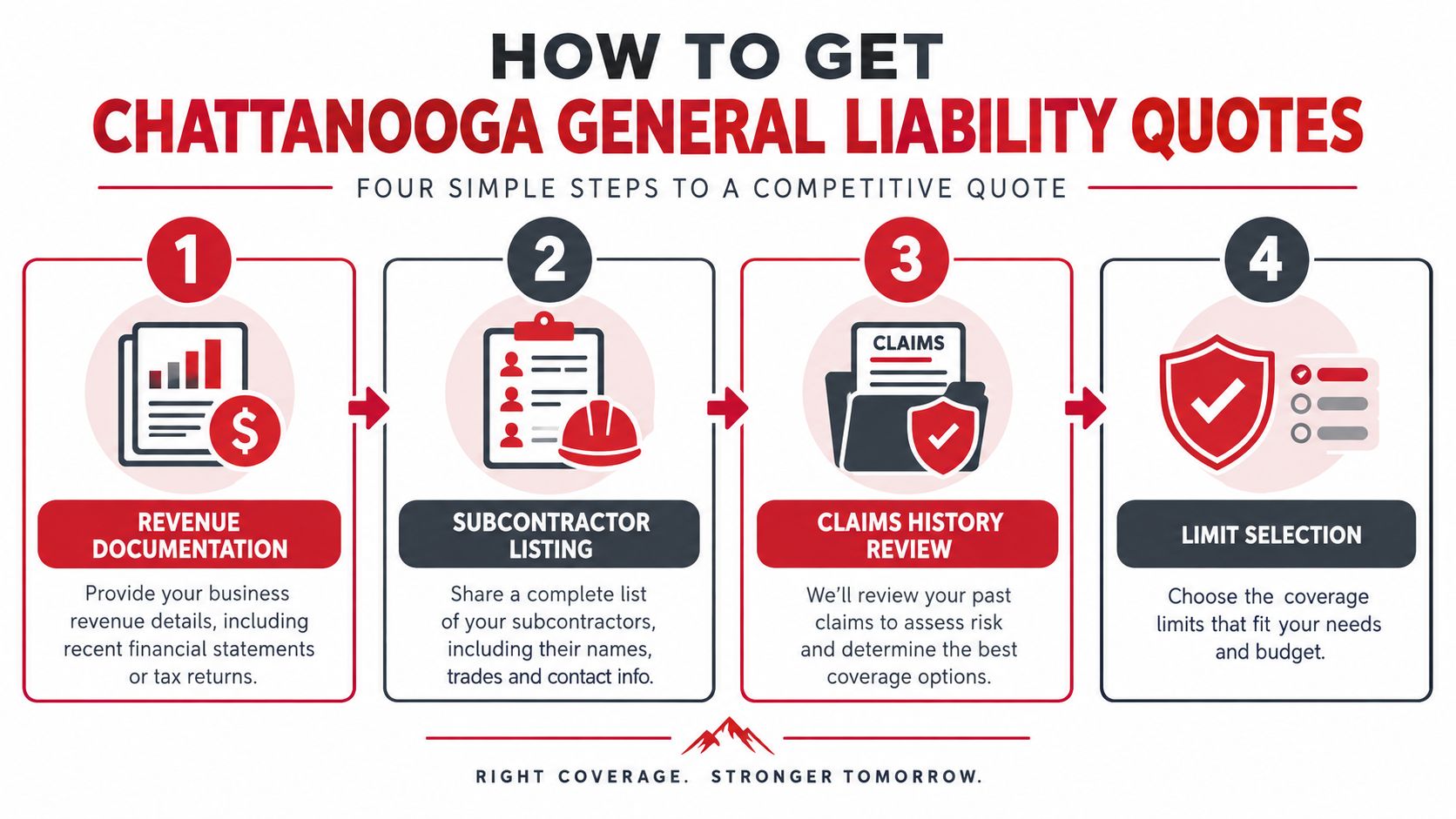
Gather financial details. Prepare current revenue and payroll information, separated by operation where possible. Retail sales, installation income, consulting fees, and subcontracted work may need different treatment.
List subcontractor exposure. Identify the trades used, the work they perform, and how you verify their insurance. Don't assume a subcontractor's promise protects your business. Obtain and retain certificates, and review contract requirements before work begins.
Disclose prior claims. Explain what happened, what was paid, what controls changed, and whether the matter remains open. A clear explanation is more useful than omitting an incident and forcing the underwriter to discover it later.
Choose the limit strategy. Start with the contract requirements, then decide whether the common primary structure is sufficient or whether higher limits and an umbrella are appropriate.
Retailers should provide square footage, occupancy details, storage arrangements, and visitor activity. Contractors should provide project descriptions, subcontractor use, work heights, excavation or hot-work exposure, and completed-operations details. Service firms should identify client premises, certificate requirements, vehicles, and professional services.
Compare quotes only when the limits, deductible, endorsements, exclusions, classification, and effective date match. A quote that leaves out contractors classification questions, changes the deductible, or excludes a required operation isn't an apples-to-apples alternative.
Watch for cancellation provisions that don't fit your contract obligations and non-admitted placements where surplus lines handling hasn't been clearly explained. Before binding, confirm the policy documents, request the certificate issuance process, and schedule the renewal review well before the current term ends.
Businesses that need a broader program can review Chattanooga commercial insurance options and ask the agency to place the same submission across appropriate markets.
Chattanooga General Liability Questions Business Owners Ask Most
Does a sole proprietor without a storefront need GL? Often, yes. A mobile contractor or service provider still enters customer property and can cause bodily injury or damage. No storefront doesn't mean no third-party exposure.
How do I provide a certificate to my landlord? Ask the agent to issue a certificate naming the required parties and showing the required limits. If the lease requires additional insured wording, a certificate alone isn't enough. Request the endorsement as well.
Does my policy cover a subcontractor? Usually not automatically. Require the subcontractor to carry its own policy, obtain current proof, and have the contract address indemnity and insurance obligations. Add your business as an additional insured when the contract and policy support it.
What happens if a tenant sues a landlord? The answer depends on the lease, the allegation, additional insured wording, and who controlled the condition that caused the injury. Don't assume either party's certificate settles responsibility.
Is a home-based business different inside Chattanooga city limits? The address changes, but the exposure remains. A homeowner policy may restrict business property, visitors, inventory, and liability. Tell the agent about the business rather than relying on personal coverage.
How quickly should I report a claim? Report an incident or potential claim promptly under the policy's notice conditions. Waiting for a formal lawsuit can make investigation harder and may create a coverage dispute.
Is an umbrella worthwhile? For contractors, landlords, customer-facing operations, and businesses with substantial contracts, it can be a sensible way to add capacity above the primary policy. For a low-exposure office, the priority may be correcting exclusions and professional liability gaps first.
Select Insurance Group, Inc. can review your Chattanooga operation, compare commercial coverage options, and help align general liability with property, workers' compensation, auto, and contract requirements. Visit Select Insurance Group, Inc. to request a commercial insurance review and a no-obligation quote.