
You're under contract on a home in Orlando. The inspection is done, the lender is moving, and then the insurance conversation changes tone. A carrier flags the property as “high-risk,” or your lender asks whether the home sits in a FEMA flood zone, or the quote comes back much higher than you expected for a house that isn't anywhere near the beach.
That moment throws a lot of buyers off because “high-risk” sounds like a label for coastal mansions or homes with obvious damage history. In Orlando, it's often much more local than that. One street can price differently from the next because insurers look at flood mapping, wind exposure, prior loss patterns, roof condition, and territorial rating. If you've also been comparing neighborhoods and ownership costs, Global's property owner guide is a useful companion read for understanding the broader Orlando housing picture.
The good news is that this usually isn't a dead end. It's a sorting problem. Once you know what the insurer is reacting to, and how a standard policy, flood coverage, and deductibles fit together, the process gets much easier to control. If you want a baseline on how coverage works in Florida before diving into the high-risk details, Florida home insurance options are a good starting point.
Table of Contents
- Securing Your Orlando Dream Home in a High-Risk Zone
- What Really Makes an Orlando Home High-Risk
- Decoding Your Insurance Options for Flood and Wind
- When Private Insurers Say No Understanding Citizens Insurance
- Controlling Costs Key Premium Drivers and Mitigation Discounts
- Your Step-by-Step Guide to Securing High-Risk Coverage
- Common Pitfalls and How to Avoid Them
- Partner with Select Insurance Group for Expert Guidance
Securing Your Orlando Dream Home in a High-Risk Zone
A lot of Orlando buyers hit the same sequence. They find a home inland, assume the insurance side will be straightforward, and then discover the carrier cares about things the buyer never noticed. The lot may sit in a flood-sensitive pocket. The roof may be older than expected. The neighborhood may fall into a rating territory that carries more claims pressure than nearby areas.
That doesn't mean the home is uninsurable. It means the insurance market is looking at a more detailed risk profile than most buyers do at first glance.
I've seen this catch people off guard most often when the house “looks normal.” No visible water line. No canal behind it. No direct coastal exposure. But insurance pricing isn't based on appearances. It's based on mapped risk, construction details, and how carriers classify that location.
Practical rule: Don't react to the phrase “high-risk zone” as if it's a final answer. Treat it as a signal to verify the property details that are driving the quote.
The buyers who handle this well usually do three things early. They confirm the parcel's flood designation, they gather the home's inspection and roof information, and they compare coverage structure rather than shopping on premium alone.
That last part matters. A cheap quote can leave out the protection you need, especially when water and wind are both part of the conversation. Orlando homeowners insurance for high-risk zones works best when you build it deliberately instead of letting the lender's deadline dictate every choice.
What Really Makes an Orlando Home High-Risk
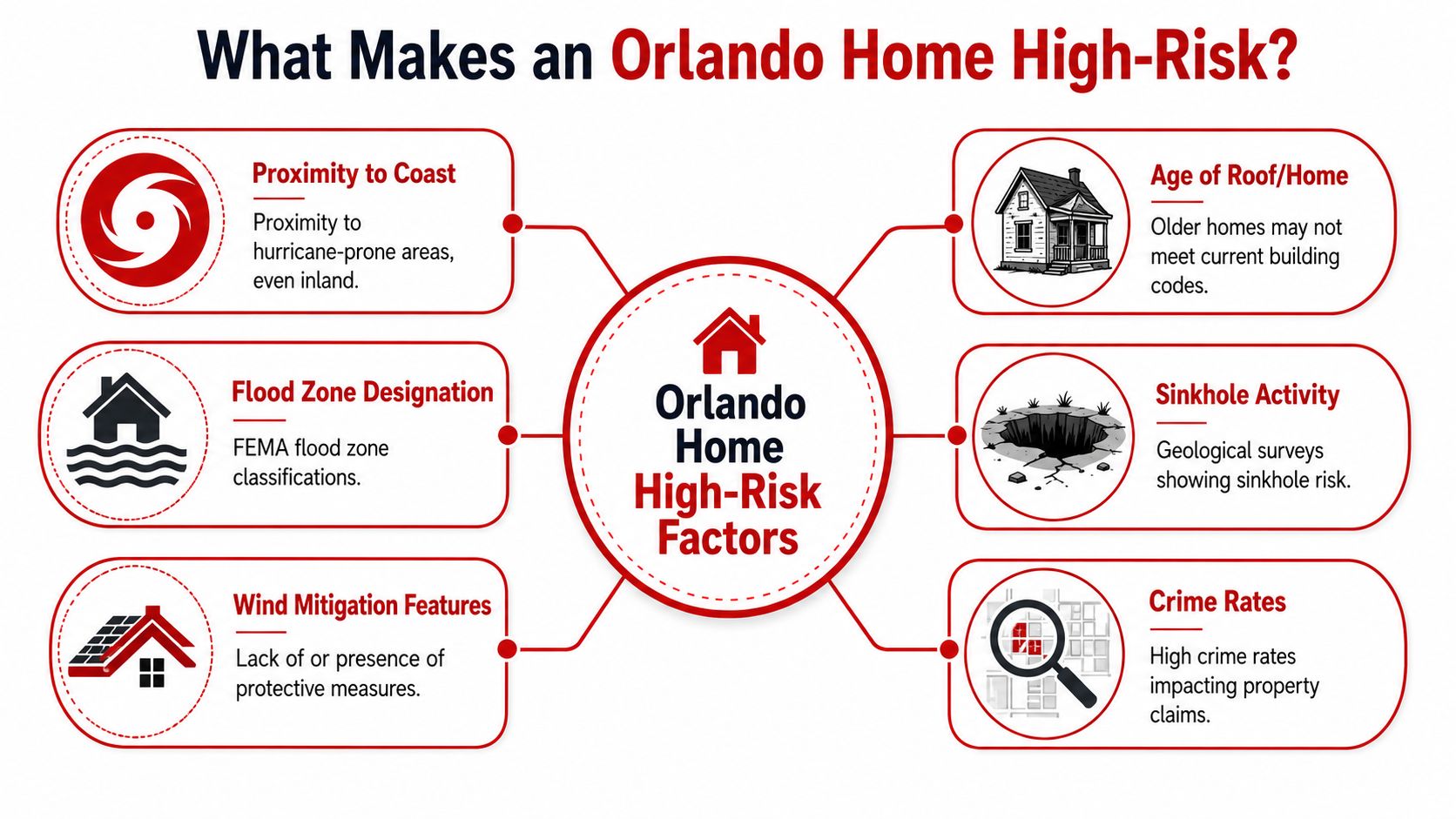
“High-risk” in Orlando usually comes from a mix of factors, not one dramatic red flag. I tell homeowners to think of it as a risk recipe. Flood mapping might be one ingredient. Roof age and condition might be another. Territorial rating, claims environment, and crime exposure can all affect the final result.
Here's the visual version of that idea.
Flood maps matter more than most buyers expect
The technical trigger for flood risk is whether the home sits in a FEMA Special Flood Hazard Area. The zones most commonly treated as high-risk are A, AE, AH, AO, and VE, while Zone X usually is not. The most reliable first step is checking the exact parcel on the FEMA flood-zone guide for Florida homeowners.
That parcel-level check matters because broad neighborhood assumptions are often wrong. A buyer will say, “This area never looked flood-prone to me,” but the lender and insurer aren't working from curb appeal. They're working from the map and the property file. If the parcel falls in a Special Flood Hazard Area, flood coverage may become part of the deal whether the buyer expected it or not.
If the property has an elevation certificate available, review it. Site-specific elevation can affect how the home is evaluated, and it gives useful context beyond a simple zone label.
Territorial rating changes the story
Flood maps are only part of the picture. Orlando also gets priced through territorial rating, which is where many inland buyers get surprised. Policygenius reported an average annual Orlando home insurance premium of $2,353 for ZIP code 32825, and said a $500,000 dwelling-coverage policy in Orlando averaged $3,848 per year, about $1,500 above the citywide average. That spread shows how location inside the metro can change pricing by more than 60% depending on ZIP code and coverage structure, according to Policygenius's Orlando homeowners insurance analysis.
That kind of spread exists because risk isn't uniform across the city. The same source described Orlando's property-crime exposure as roughly double the Florida state average. For insurers, theft and vandalism exposure sits on top of weather risk instead of replacing it.
A few practical examples often explain it better than a definition:
- One home sits higher and drains better. Even if two houses share the same school district, the lower lot may draw more concern.
- One roof has stronger documentation. A home with clear proof of updates and mitigation features often presents differently to underwriters than a similar home without records.
- One territory produces more claims friction. Carriers watch local claim patterns and litigation pressure, not just storm tracks.
For homeowners trying to make sense of water risk around the property, even outside a classic flood scenario, expert advice on basement flooding can help you think through drainage and runoff issues that buyers often overlook.
High-risk in Orlando often means “highly specific,” not “obviously dangerous.”
Decoding Your Insurance Options for Flood and Wind
The biggest mistake I see is assuming one policy handles every kind of storm damage. It doesn't. If you own or are buying a home in an exposed area, the important part is fitting the right coverages together so there isn't a gap when a claim happens.
What a standard homeowners policy does not solve
A typical homeowners policy may exclude flood damage, even when the flooding happens during a hurricane. Damage from rising water is treated differently than damage from wind-driven rain, and that distinction can lead to denied claims when the homeowner never bought separate flood coverage, as explained in this climate-risk and coverage-gap report.
That sounds technical until a real loss happens. Water enters the home after a storm. The homeowner thinks, “This was hurricane damage.” The policy review asks a narrower question: did the water come from above because wind damaged the structure, or did it rise from the ground and enter as flooding? Those are not handled the same way.
If a loss can involve both wind and water, don't assume your homeowners policy alone is enough.
NFIP vs. Private Flood Insurance Comparison
If flood coverage is needed, homeowners usually look at two categories. One is the National Flood Insurance Program. The other is private flood insurance. The right fit depends on the property, timing, and policy design.
| Feature | NFIP (National Flood Insurance Program) | Private Flood Insurance |
|---|---|---|
| Who provides it | Government-backed program | Private insurance carrier |
| When it fits | Common baseline option when flood insurance is required | Useful when a private market option matches the property better |
| Coverage structure | Standardized program format | Can vary by carrier and form |
| Underwriting style | Program rules drive much of the structure | Carrier-specific underwriting can be more tailored |
| Shopping approach | Often straightforward to identify and quote | Requires careful comparison of forms, exclusions, and deductibles |
| Best use | Reliable starting point for required flood coverage | Strong option when terms and pricing align well with the home |
For many Orlando buyers, the key isn't picking a side in theory. It's reading the actual form and making sure the flood policy works with the homeowners policy already in place. If you want a plain-English overview of when flood insurance becomes part of the conversation in Florida, Florida flood insurance requirements are worth reviewing.
How deductibles change your real risk
Deductibles deserve more attention than they usually get. A homeowner may focus on premium and overlook the amount they'd need to pay out of pocket after a storm.
That matters most when the policy includes a separate hurricane deductible or another higher storm-related deductible structure. A policy can look affordable on the front end and still leave the homeowner stretched at claim time if they haven't planned for that out-of-pocket amount.
When you compare options, ask three simple questions:
- What damage does the homeowners policy cover?
- What water loss requires separate flood insurance?
- What deductible applies if the loss is tied to a hurricane event?
If those answers are clear, your policy setup is usually on solid ground. If they aren't, keep digging before you bind coverage.
When Private Insurers Say No Understanding Citizens Insurance
Some Orlando homeowners do everything right and still hit a wall in the private market. The house may be in a tougher wind or flood profile, the roof may fall outside what a carrier wants, or the territory may be harder to place. That's where Citizens Property Insurance Corp. enters the conversation.
Why more homeowners end up there
Florida's private market tightened sharply, and more homeowners were pushed toward Citizens as an insurer of last resort. APM Research Lab reported that Citizens expanded rapidly, and that homeowners with homes under $700,000 in replacement value, or $1 million in Miami-Dade County, could usually access it when private insurers would not write wind coverage. The same report said Florida's non-renewal rate increased 280% between 2018 and 2023, which shows how quickly carriers pulled back statewide in tougher segments of the market, according to APM Research Lab's Florida property insurance graphs.
For an Orlando homeowner, the practical takeaway is simple. If private options narrow or disappear, Citizens may be the backstop that keeps the transaction moving and the property insured.
How to think about Citizens practically
Citizens serves an important purpose, but it's best viewed as a safety net, not a long-term shopping strategy.
A few realities help keep expectations in line:
- Eligibility depends on market conditions: It's there when comparable private-market coverage isn't available on acceptable terms.
- Coverage review still matters: Don't assume a last-resort option means every feature of the policy will line up with your ideal protection.
- Your placement may not be permanent: Some homeowners later receive opportunities to move back into the private market.
The right mindset is to use Citizens when it solves an immediate availability problem, then keep reviewing your options as the home, roof, mitigation features, and market conditions change.
Controlling Costs Key Premium Drivers and Mitigation Discounts
You can't move your lot out of a rating territory, and you can't redraw the flood map yourself. You can still influence what the insurer sees when they evaluate your house. That's where cost control starts.
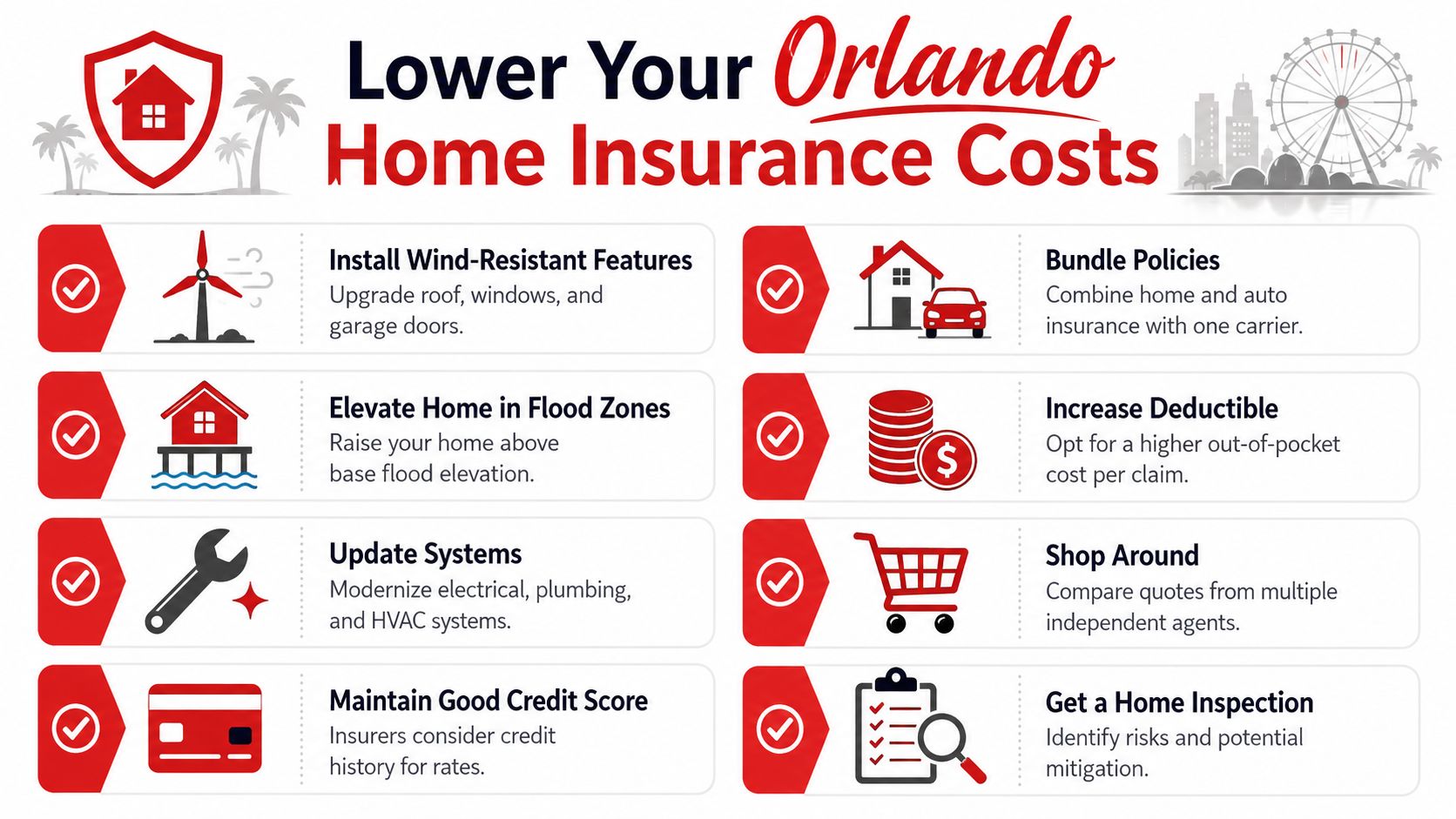
Here's a practical checklist homeowners can use.
What you can control
The strongest cost-saving moves usually come from documented mitigation, not guesswork. Carriers want proof. If the roof attachment, opening protection, roof shape, or other wind-resistant features are improved and documented, that can change how the home is viewed.
Start with the parts of the home that matter most to underwriting:
- Roof condition: If the roof is aging or poorly documented, it often creates both pricing pressure and placement problems.
- Wind mitigation features: Shutters, impact protection, and stronger structural features can help if they're verified properly.
- Systems and maintenance: Updated electrical, plumbing, and related components can reduce the concerns that come with older homes.
- Deductible choice: A higher deductible can lower premium, but only choose an amount you could realistically handle after a loss.
One of the clearest examples of why this matters is how much location changes pricing in Orlando. Policygenius reported that location within Orlando can change premium by over 60%, and that a $500,000 dwelling-coverage policy averaged $3,848 annually, roughly $1,500 above the citywide average in the example cited earlier. That's a reminder that you may not control the territory, but you should control every house-specific factor you can document.
What usually does not work
Homeowners often waste time on changes that look impressive but don't move underwriting much. Cosmetic upgrades rarely carry the same insurance value as structural or documented risk improvements.
These are the weak moves I'd avoid relying on:
- Renovating for appearance only: New finishes don't mean much if the roof, openings, or systems remain unchanged.
- Assuming “inland” equals cheap: Orlando homeowners insurance for high-risk zones doesn't price by beach distance alone.
- Shopping one quote at a time: If the home is even moderately difficult, you need side-by-side comparison and form review, not one fast quote and a guess.
Reality check: The discount comes from what the carrier can verify, not what the homeowner intends to do later.
Your Step-by-Step Guide to Securing High-Risk Coverage
A lot of Orlando buyers hit the same problem in the final days before closing. The lender asks for proof of insurance, the homeowners quote looks acceptable, and then someone realizes the property also needs separate flood coverage or has a hurricane deductible the buyer did not budget for. That delay is avoidable if you build the file in the right order.
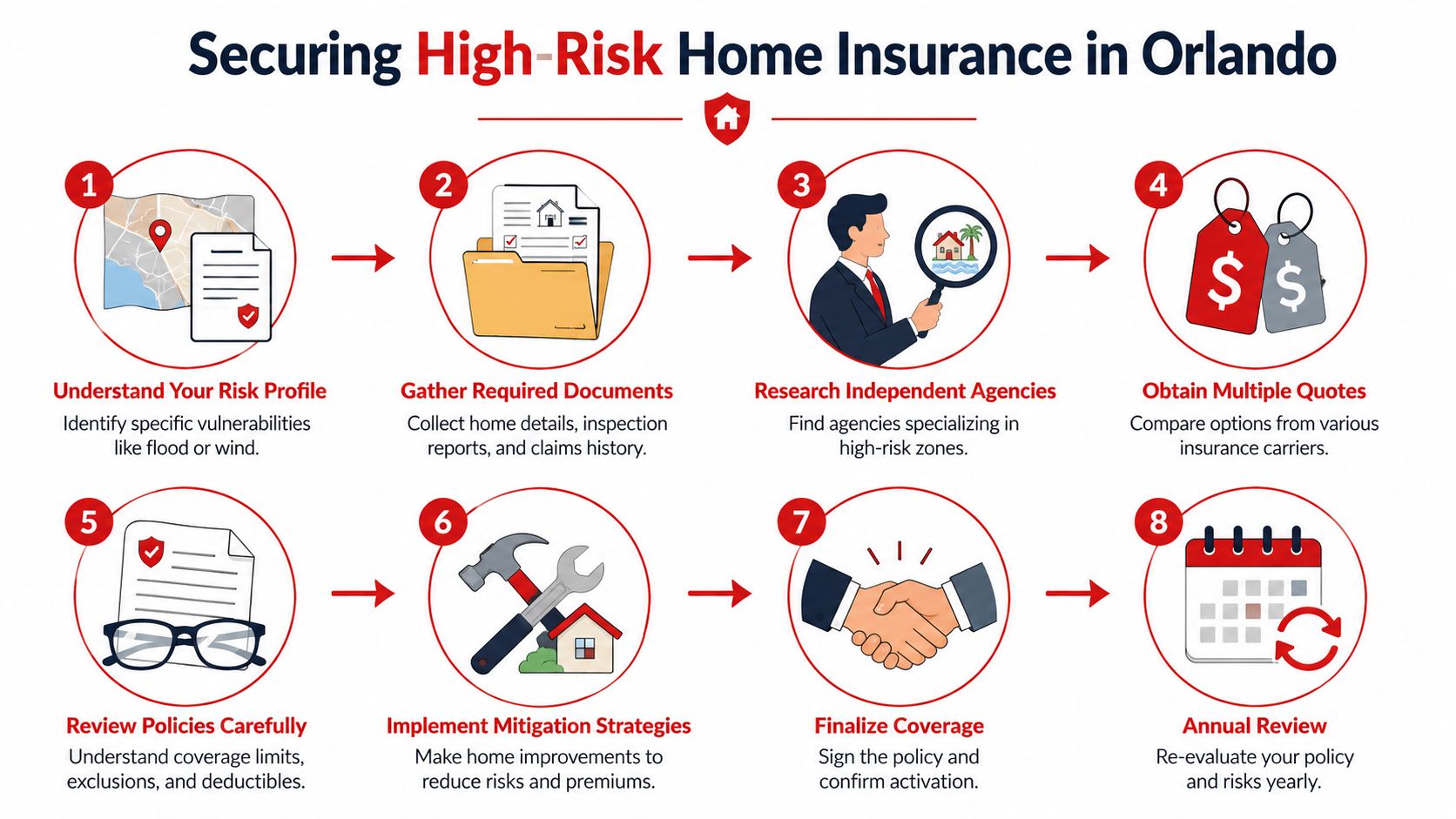
Start with the property, not the quote
Before asking for final pricing, confirm how the home is being classified. In Orlando, that means more than checking whether the house is inland. I tell buyers to verify the exact parcel's flood map status, review the insurance history if available, and gather any documents that explain the home's actual condition. Underwriters price what they can verify on paper.
The core file should include:
- Flood zone confirmation for the exact address. A nearby home can rate differently, so use the parcel, not the neighborhood description.
- Recent inspection documents. A 4-point inspection and wind mitigation report often answer underwriting questions before they turn into delays.
- Roof details. Include the roof age, permit records if available, and any invoices or inspection notes.
- Prior loss and insurance information. If you are buying the home, ask the seller for as much detail as possible.
This part saves time because it reduces the last-minute document chase that can stall approval.
Build the coverage stack correctly
For many high-risk Orlando homes, one policy is not the full answer. The homeowners policy may cover the dwelling for many causes of loss, but flood is usually separate, and the hurricane deductible works differently from the standard all-peril deductible. Buyers who miss that distinction often think they are fully covered when they are only partially set up.
A practical review should answer three questions:
- What does the homeowners policy cover?
- Is separate flood insurance needed for the property or the loan?
- How much would you pay out of pocket after a hurricane claim versus a non-hurricane claim?
That is the coverage gap that causes the most confusion.
Compare quotes line by line
Once the file is complete, review options side by side instead of treating premium as the only decision point. Two quotes can look similar until you compare water exclusions, deductible structure, settlement terms, and endorsements.
Use a short binding checklist:
| Checkpoint | What to confirm |
|---|---|
| Named insured and address | Match the deed, loan documents, and occupancy details |
| Dwelling and property limits | Fit the rebuild exposure and major contents categories |
| Deductible structure | Separate hurricane and standard deductibles are clearly understood |
| Flood setup | Separate flood coverage is active if the home or lender requires it |
| Effective date | Coverage starts on the date the closing package requires |
I also recommend documenting the home before move-in. A room-by-room inventory with photos makes it easier to simplify insurance claims if you ever have to prove what was damaged or lost.
Bind early enough to fix problems
Do not wait until the day before closing to finalize coverage. If underwriting asks for updated documents, roof clarification, or occupancy details, you need enough time to respond without risking the transaction. High-risk placements usually go better when the buyer, lender, and agent are working from the same checklist a week or two before closing.
The homeowners who get through this cleanly are usually the ones who verify every layer of coverage before they sign, especially the parts that do not show up in the first premium number.
Common Pitfalls and How to Avoid Them
The first pitfall is assuming all storm damage falls under one policy. It doesn't. If water rises and enters the home as flooding, that can be treated very differently from wind-driven rain. Homeowners often discover that distinction after the loss, which is the worst possible time to learn it.
The second pitfall is thinking a high quote must be a mistake because the house is inland. In Orlando, insurers use granular territorial rating based on flood history, wind exposure, and local claims and litigation patterns, not just distance from the coast, as explained in Greene Insurance's county and territorial pricing overview. That's why one neighborhood can price very differently from another nearby neighborhood.
The third pitfall is buying on premium alone. A lower premium can hide a deductible structure or coverage gap that becomes expensive when you need the policy.
A short prevention list helps:
- Read the water-loss language: Don't assume “hurricane” means every related water claim is covered.
- Ask why the quote is high: The answer may be territorial, structural, or map-driven.
- Document your property before a claim: A detailed home inventory makes the claims side much easier. If you haven't done one, this guide on how to simplify insurance claims gives a practical framework.
The cheapest policy is often the most expensive one after a denied or underpaid claim.
Partner with Select Insurance Group for Expert Guidance
A lot of Orlando buyers reach this point after an uncomfortable surprise. The home is inland, the roof looks acceptable, and the first quote still comes back higher than expected. Then the follow-up questions start. Is this because of the flood map, the insurer's territory, the age of the plumbing, or the hurricane deductible?
That is usually the point where independent advice helps. Select Insurance Group, Inc. works with homeowners who need help sorting through harder placements, especially when the actual issue is not just price but how the homeowners policy, flood coverage, and deductible structure fit together. If you want local help reviewing those pieces side by side, the Orlando independent insurance broker on Semoran Boulevard is a practical starting point.
In my experience, this kind of review matters most when the property does not look obviously high-risk at first glance. Inland Orlando homes can still draw tougher underwriting because of very specific factors tied to the address and the carrier. A good agency review can help separate what is driving the quote from what can be changed before closing or renewal.
The process should be straightforward. You provide the property details, inspection findings, prior loss history if there is any, and your timeline. The agency compares available options, points out where one quote leaves a water-loss gap that another quote handles differently, and helps you decide which deductible trade-offs make sense for your cash reserves.
That saves time. It also reduces the chance of buying a policy that looks fine on the declarations page but creates a problem when a storm claim involves both wind and water.