
You're probably shopping with a knot in your stomach. You've got a zip code, a couple of quotes, and a bad feeling that none of them really answered the question you care about, which is simple: will this agency help me if something goes wrong, or am I just reading marketing copy dressed up as a review? That's the reason people search for Select Insurance Group reviews, they want to know whether the agency is legitimate, how it works, and whether it's worth asking for a quote before they hand over personal information.
Table of Contents
- The Situation Most Shoppers Are Actually In
- What Select Insurance Group Actually Does
- What the Public Reviews Actually Show
- Why an Independent Agency Model Changes the Math
- How to Read Reviews Without Getting Misled
- Verifying Trust, Credentials, and Data Security
- Pricing, Quotes, and What to Realistically Expect
- Next Steps, Alternatives, and Common Questions
The Situation Most Shoppers Are Actually In
You're in Alabama, Florida, Georgia, North Carolina, South Carolina, Tennessee, or Virginia, and you're trying to separate a real agency from a polished website. Maybe a direct quote felt too rigid. Maybe an agent on the phone skipped over your coverage limits and pushed price first. Maybe you just want a local person who can compare options without making you sit through a sales pitch.
That's where Select Insurance Group reviews get interesting, because the brand sits in the gap between a call-center insurer and a one-carrier agency. The question isn't just whether people liked the service. It's whether the agency can match you with the right carrier, explain the difference between options, and stay accessible after the quote is issued.
What reviews can answer
Reviews can tell you whether people felt heard, whether the office responded quickly, and whether the quote process felt clear. They can also show whether a location seems organized or sloppy. Those are useful signals, but they're not the whole story.
What reviews cannot answer
A review can't tell you whether a policy was underpriced for the risk, whether the carrier paid the claim, or whether the problem came from the agency or the insurer behind the policy. That distinction matters with independent agencies. If you treat every bad claim story as an agency problem, you'll misread the evidence.
Practical rule: If the question is “Do they exist, and do they look competent?”, reviews help. If the question is “Will my claim be paid exactly the way I expect?”, you need licensing, carrier, and policy verification, not star ratings.
The smartest move is to stop asking whether a single score proves trust. It doesn't. A better question is whether the agency's structure, public footprint, and review pattern line up with the kind of coverage you need.
What Select Insurance Group Actually Does
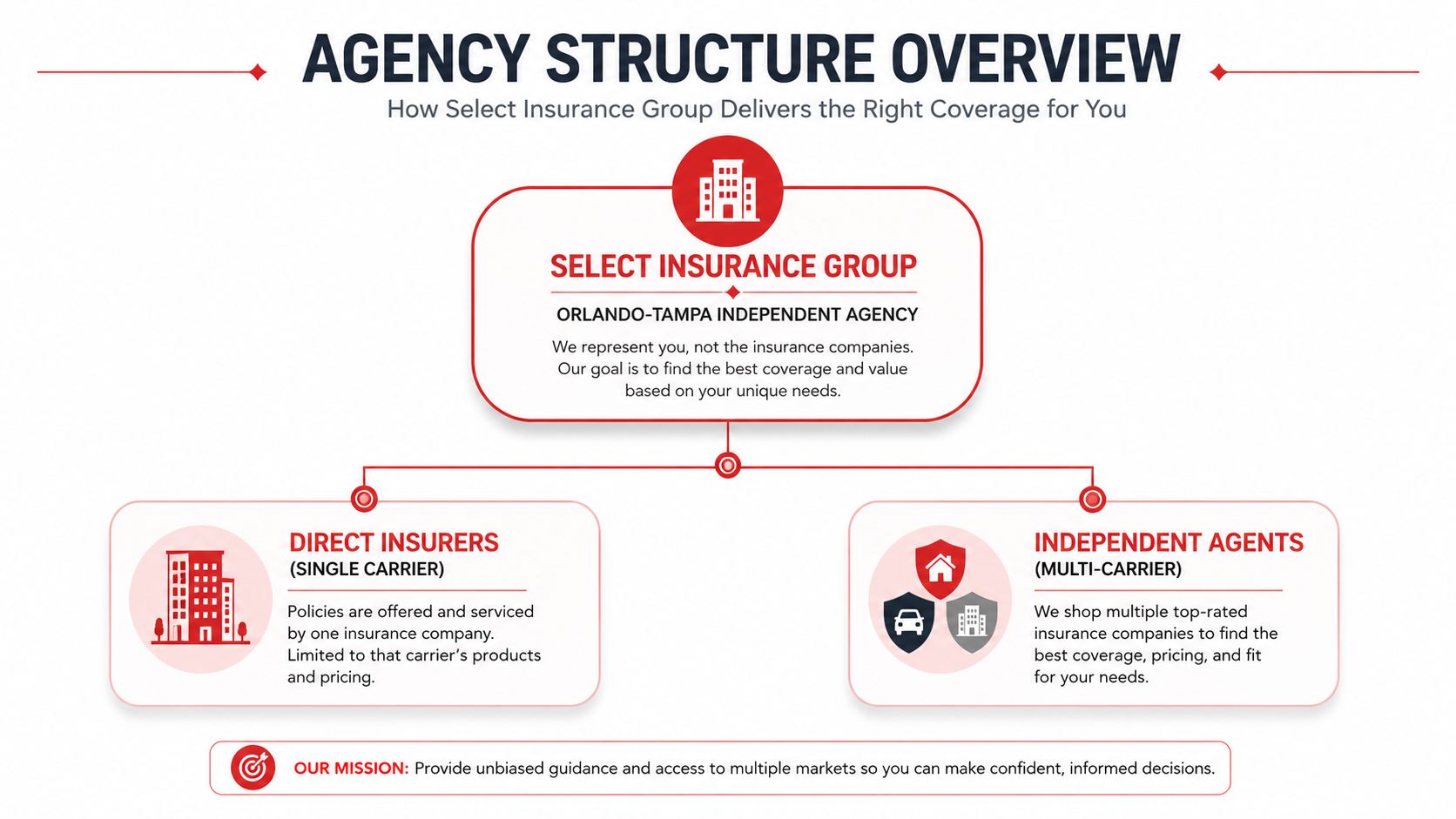
Select Insurance Group operates as an independent insurance agency, not a single-carrier insurer. That means it compares quotes from multiple carriers instead of selling one company's product line. The structural difference is the point, because an independent agency can match more kinds of risk to more kinds of underwriting appetite, which is the mechanism described in Selective's public market materials for independent-agent distribution (market description of independent retail and wholesale agent distribution).
The practical effect is straightforward. A direct writer can only offer what its own underwriting engine accepts. An independent agency can move your application across multiple carriers, which gives you a better shot at finding a fit when your profile doesn't line up neatly with one company's rules.
Where it operates and what it sells
The agency is positioned for customers in Alabama, Florida, Georgia, North Carolina, South Carolina, Tennessee, and Virginia, with regional service centered in the Orlando-Tampa metro area. It serves both personal and commercial buyers, so the product mix is broader than a basic auto-only shop.
On the personal side, the agency places auto, homeowners, renters, motorcycle, and RV coverage. On the commercial side, it handles general liability, commercial property, workers' compensation, commercial auto, and trucking. That split matters because review quality often depends on what kind of policy the customer bought in the first place.
How the agency model helps
If you're a driver, homeowner, or small business owner, the value here is comparison. You're not stuck with one rate book. You're comparing options across carriers with different appetites, which is exactly why some shoppers end up here after a direct quote disappoints.
The agency also highlights bilingual support and office-based help, which matters for customers who want a person, not a portal, when they're buying or updating coverage. If you want the brand's own service overview, the agency's Select Insurance Group Orlando page gives you the local-office framing shoppers usually look for first.
What the Public Reviews Actually Show
Public review data for Select Insurance Group is uneven, and that's the honest starting point. Brand-level feedback is fragmented across business listings and directories, and some office locations have only a thin trail of comments. That doesn't automatically mean the agency is weak. It does mean the review picture is too incomplete to treat like a mass-market insurer with a huge, uniform review base.
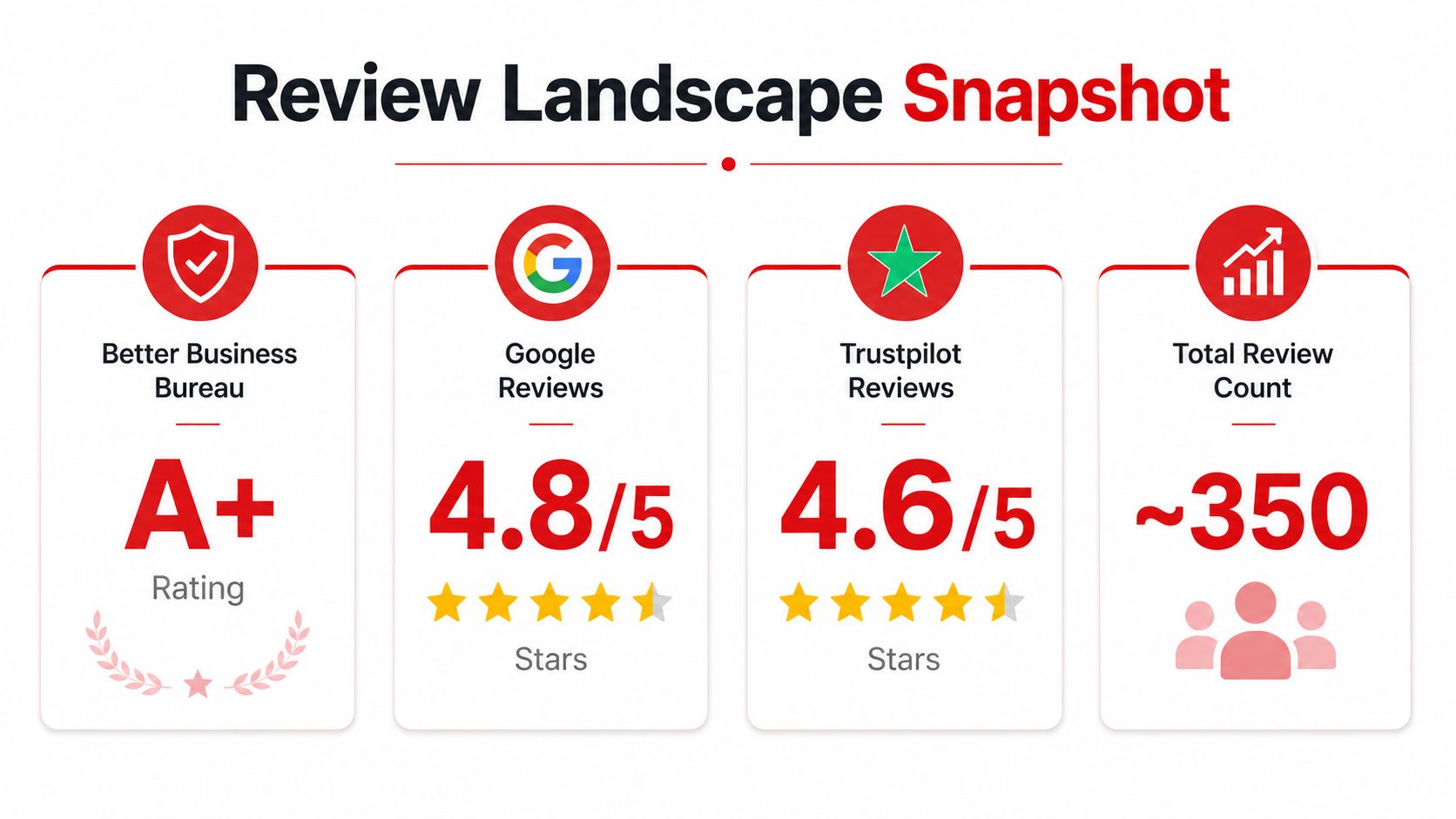
The strongest thing you can say from the public footprint is that shoppers are seeing the business through multiple lenses, not one clean scoreboard. That creates noise. It also creates risk, because a local office with a few reviews can look either excellent or suspicious just because there isn't enough volume to judge.
What tends to show up
When people leave meaningful feedback on an independent agency, the comments usually revolve around responsiveness, document handling, quote clarity, and whether someone could explain the policy. Those are the right themes to look for. They tell you more than generic praise ever will.
What you should not do is confuse a claims complaint with an agency complaint. If the review is about a carrier denying a claim or disputing loss details, that's not the same thing as the agency failing to source a policy. A good agency can still place a policy with a carrier that later handles the claim poorly.
For a useful outside perspective on how buyers evaluate the evidence in appraisal-heavy situations, the write-up on what policyholders say about appraisals is a helpful reminder that public feedback often says more about process friction than final outcomes.
Why sparse reviews change the reading
With low volume, one loud review can distort your impression. A five-star comment with no detail is weak evidence. A one-star complaint with no policy context is weak evidence too. You need patterns, not isolated reactions.
That's the big lesson here. For this brand, the review landscape says “verify first, then quote,” not “trust blindly” and not “walk away immediately.” Sparse feedback is a reason to ask sharper questions, not a reason to panic.
Why an Independent Agency Model Changes the Math
A direct insurer sells its own policies. An independent agency sells access to multiple carriers. That sounds like a small distinction until you see how it changes the quote outcome for a real household or business.
Take a driver with a recent not-at-fault accident, a motorcycle that only gets used seasonally, and a home near the coast that may need more than a standard homeowners policy. One carrier may price that whole picture aggressively. Another may dislike one piece of it and refuse the account entirely. An independent agency can keep moving the file until it finds a better fit.
Why shoppers notice the difference
When you compare across multiple carrier appetites, you're not just chasing the lowest number. You're looking for the carrier most likely to accept your actual risk profile without forcing you into a worse fit. That matters in personal lines, and it matters even more in commercial lines where a business might need a combination of general liability, property, or auto coverage.
If you want the conceptual version of that setup, the agency's independent insurance agency explanation is worth reading because it reflects the basic distribution model shoppers are dealing with here.
A single-carrier quote can be efficient. A multi-carrier comparison is usually more useful when your risk profile is even slightly messy.
Where the model has limits
Independent agencies aren't magic. They still rely on the carriers they can access, and some niche commercial risks are too specialized for standard placement. In those cases, a wholesale path may be the best answer, not a retail quote shop.
That's why I like this model for ordinary Southeast drivers, homeowners, and many small businesses, but I don't oversell it. Its strength is fit, not miracles. The win is more options, better alignment, and fewer dead ends.
For a related example of how customer feedback is often used to judge service fit in another operational context, effective ITAD customer feedback is a useful reminder that the best reviews tend to describe responsiveness and process, not marketing language.
How to Read Reviews Without Getting Misled
Most shoppers read reviews backwards. They start with the star count and only later ask whether the review says anything useful. That's the wrong order, especially for an independent agency where office quality can vary by location and carrier issues can get mistaken for agency issues.
Review signals and what they actually mean
| Signal You See | What It Likely Means | How to Verify |
|---|---|---|
| Short five-star praise with no details | The customer may have had a fine experience, but the review gives little evidence | Look for specifics about the quote, follow-up, and policy changes |
| Angry claim complaint | The policy may have run into a carrier decision, not necessarily an agency failure | Ask which carrier wrote the policy and who handled the claim |
| Very few reviews at one office | The location may be new, small, or simply under-reviewed | Check licensing, office contact info, and carrier appointments |
| Mixed feedback across locations | Service may vary by office or staff member | Read location-level reviews, not just brand-level ones |
| No reviews at all | You don't have enough public evidence to judge | Verify credentials directly before sharing information |
Four traps to avoid
Inflated praise is the first trap. If every comment sounds like a template, assume you're looking at noise, not signal.
Carrier complaints are the second trap. An agency can place a policy with a carrier that later frustrates the customer on claims. That doesn't make the agency useless, but it does change how you assign blame.
Sparse volume is the third trap. With too few reviews, you can't make strong statistical claims about service quality. You can only look for consistency.
Identity confusion is the fourth trap. Some shoppers don't know whether they're dealing with a carrier, a broker, or an agency. If the review site is fuzzy on that point, you need to verify it yourself.
Clear test: If a review tells you what happened, who handled it, and how fast it moved, it's useful. If it only says “great service” or “terrible experience,” it's decoration.
Verifying Trust, Credentials, and Data Security
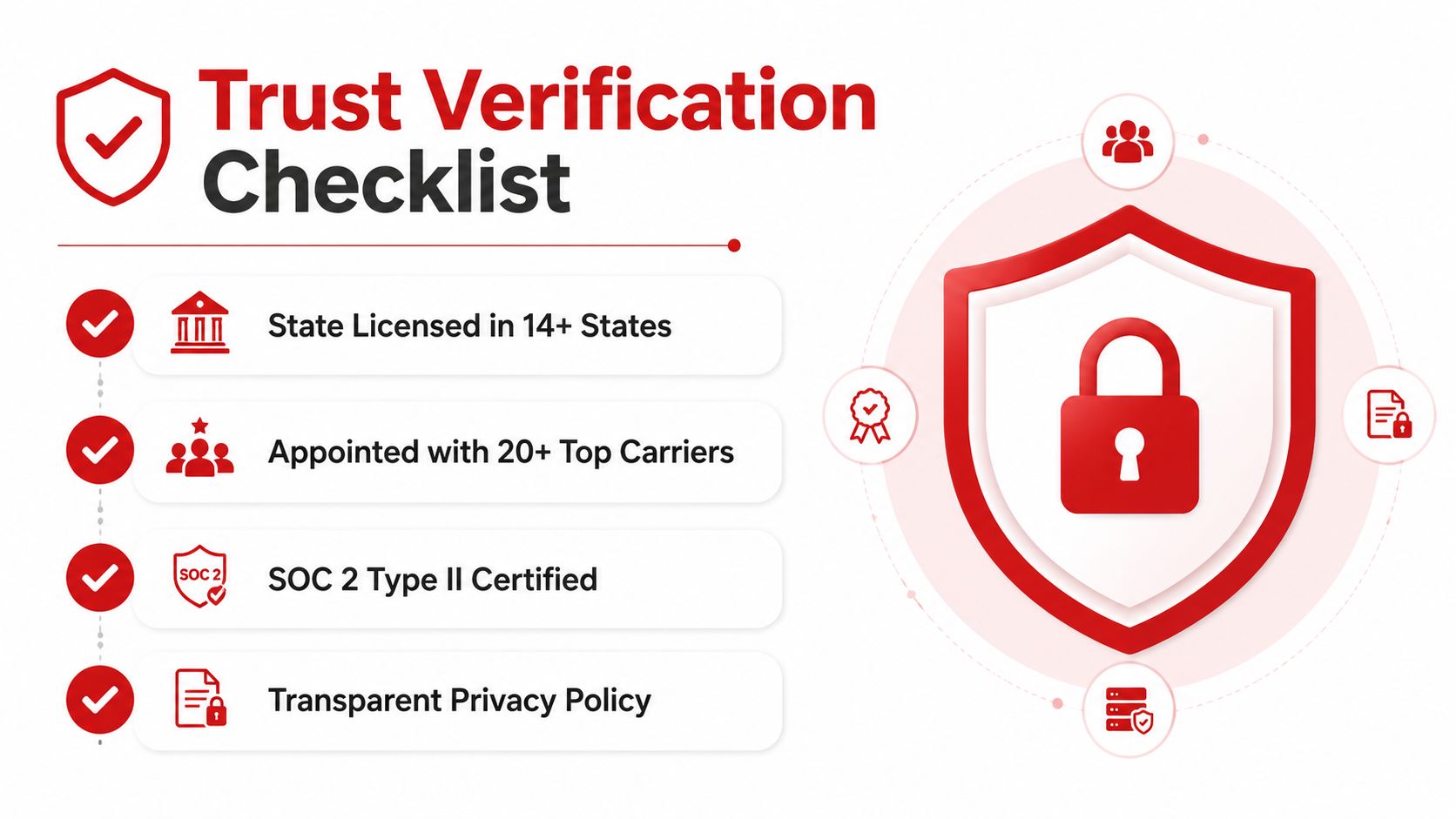
When review volume is thin, the next best evidence is structural. Check the license, confirm the appointments, and see whether the agency is set up to handle documents and payments securely before you share anything sensitive.
The ten-minute verification routine
Start with the state insurance license in your own state. If an office can't be tied to a valid license, stop there. Then confirm which carriers the agency is appointed to place business with, because that tells you whether it can offer real comparison or just talk about it.
After that, look at the contact workflow. Secure upload and payment tools matter more than polished language. If the agency wants everything sent through email attachments, that's a weaker setup than a documented portal with clear instructions.
What to trust and what to test
The company's own description emphasizes local offices, phone and text support, bilingual service, notary support in some locations, and secure tools for document upload and policy updates. Those are helpful claims, but they're still claims. You can verify some of them by calling the office, testing responsiveness, and checking whether the published contact channels work as advertised.
If Spanish-speaking service matters to you, ask for it before you submit any paperwork. Don't wait until after your quote arrives. A competent office will answer the question plainly.
Best practice: Don't hand over a driver's license, mortgage statement, or business documents until you've confirmed the agency name, the licensed office, and the carrier relationship behind the quote.
The final point is simple. Trust is not a vibe. It's a checklist, and that checklist should be boring, repeatable, and easy to confirm.
Pricing, Quotes, and What to Realistically Expect
Select Insurance Group doesn't publish a rate card, because it isn't a carrier. It sources quotes from multiple carriers, so the number you get depends on your state, your coverage choices, your risk profile, and which carrier ends up taking the file.
That means “cheap” is the wrong first question. The better question is whether the quote reflects the coverage you need.
What usually moves the number
Coverage limits and deductibles matter first. Bundling home and auto can matter too, if the carrier offers a meaningful package structure. Safe-driver programs and telematics can change the outcome for some drivers, but they're only useful if the rest of the policy still fits.
For a quote to move quickly, have the basics ready. Driver information, current declarations pages, vehicle VINs, mortgage details for homeowners, and loss runs for commercial accounts all help shorten the back-and-forth.
What “free, no-obligation quote” really means
It means you can ask for pricing without committing to buy. That's useful, but it doesn't mean the quote should be treated as final until the agency has enough information to place the risk correctly. A fast quote can be convenient. An accurate quote is better.
I'd be cautious if the first number looks unusually low and the coverage details are thin. In insurance, a low premium with vague wording usually means one of two things, limited protection or missing information. Neither is a good surprise later.
For readers comparing their own shopping process, the agency's auto insurance switching guide is relevant because it shows what to gather before you move policies, not after.
Next Steps, Alternatives, and Common Questions
If you want to test Select Insurance Group properly, gather your current policy declarations, a list of vehicles or property details, and any loss history you already know about. Then compare the quote against a direct-writer quote on the same coverage limits, not a cheaper quote with weaker protection.
Good alternatives to consider
A captive agent makes sense if you want one-company simplicity and don't mind a narrower comparison. A general online comparison path can be useful for speed, but it won't always explain coverage tradeoffs well. A wholesale broker belongs in the conversation when the risk is unusually complex or commercial.
Straight answers to the questions shoppers ask most
Is Select Insurance Group a carrier? No. It's an independent agency.
Are the quotes free and nonbinding? Yes, that's the stated model, but you still need to verify the policy terms before you bind.
Who handles the claim? The carrier does. The agency can help, but it isn't the underwriter.
Can Spanish-speaking customers confirm support first? Yes, and they should. Ask before sharing documents or payment details.
My blunt advice is this. If you want a local office that can compare multiple carriers, Select Insurance Group is worth a call. If you want a single company with one policy app and one underwriting stack, keep looking elsewhere.
Select Insurance Group, Inc. offers independent agency access to auto, homeowners, renters, motorcycle, RV, and commercial coverage across the Southeast, and that matters if you're trying to judge Select Insurance Group reviews the right way. If you want to compare what a multi-carrier agency can do for your situation, visit Select Insurance Group, Inc. and see how their quote process fits your needs.