
You're probably here because workers' comp has stopped being a vague insurance term and turned into a live business question. Maybe you hired your first employee in Alabama. Maybe your Florida crew drives to job sites. Maybe a remote admin in North Carolina asked what happens if they get hurt while working from home. Or maybe someone on your team already got injured, and now you need answers fast.
When a worker gets hurt, business owners usually have the same reaction. They want to take care of the employee, keep the business operating, and avoid making a costly mistake with insurance or state compliance. That's exactly where workers' compensation insurance comes in. It works like a safety net under your payroll. It helps the injured worker get care and income support, and it helps the employer manage legal and financial exposure.
I'm writing this the way I'd explain it to a small business owner in a review meeting. Clear terms. Real-world what-ifs. No fluff. If you've been asking what does workers compensation insurance cover, the short answer is medical care, wage replacement, and related statutory benefits for work-related injuries or illnesses. The more useful answer is in the details, especially if your business operates across Southeast states and your staffing setup doesn't fit a simple template.
Table of Contents
- Why Every Business Needs a Plan for Workplace Injuries
- What Is Workers Compensation A No-Fault Safety Net
- The Four Pillars of Workers Compensation Coverage
- Common Coverage Gaps and Exclusions to Know
- From Injury to Recovery The Workers Comp Claim Process
- Navigating Workers Comp Rules in the Southeast
- Protect Your Business Today with the Right Coverage
Why Every Business Needs a Plan for Workplace Injuries
A cook in Birmingham slips near the prep sink before the lunch rush. A roofing helper in Tampa twists a knee climbing down a ladder. A delivery employee in Charlotte gets hit at a red light while making the last stop of the day. Each event starts as a normal workday problem. Within minutes, it becomes a medical, payroll, and reporting problem too.
That is why every business needs a plan before anyone gets hurt.
Without a plan, owners tend to make decisions in the wrong order. They argue about fault before getting treatment arranged. They wait too long to document what happened. They assume a small injury will stay small. In states across the Southeast, those delays can create bigger problems than the original injury, especially for businesses juggling field work, vehicles, heat exposure, and fast-paced service jobs.
Workers' comp helps your business respond like a system instead of a scramble. It works like a financial safety net under the employment relationship. When someone is injured on the job, the policy can create a path for medical care, wage support, and claim handling while you keep the business operating.
For a small business owner, that structure protects more than one thing at once. It helps the injured employee get directed care. It helps supervisors know who to call and what to document. It helps protect cash flow from a sudden out-of-pocket hit. It also helps you meet state requirements that are easy to overlook if you operate in more than one state.
That last point trips up many Southeast employers. Alabama, Florida, Georgia, North Carolina, South Carolina, Tennessee, and Virginia do not all use the same employer thresholds, posting rules, or reporting expectations. A business with crews crossing state lines, seasonal hires, or subcontracted labor can assume it is set up correctly and still miss a requirement. If you run a trade business, this guide to insurance for contractors is a useful companion because job site risk, auto exposure, and workers' comp often overlap in real life.
You buy workers' comp for the ordinary day that suddenly stops being ordinary.
Owners also worry about lawsuits, and that concern is fair. Workers' comp is often part of the answer, but it is not a substitute for knowing how work injury claims and employer liability can intersect. Mattiacci Law's guide to work injuries gives helpful context on that question.
A practical injury plan starts with simple decisions made in advance. Who gets medical help first. Who collects the incident details. Who reports the claim to the carrier. Which state's rules apply to that worker. When those answers are clear before an accident, a hard day stays manageable instead of turning into a compliance and cash-flow crisis.
What Is Workers Compensation A No-Fault Safety Net
A tech strains his back lifting equipment in Birmingham. A roofer slips on a damp job site outside Atlanta. A delivery driver in Charlotte is rear-ended while making the day's last stop. In each case, the first question under workers' compensation usually is not who messed up. The question is whether the injury came from the employee's work.
Workers' compensation works like a state-run safety net that employers fund through insurance. If a covered employee gets hurt or becomes ill because of work, the policy is designed to pay defined benefits without requiring that employee to prove the employer was careless. That no-fault structure is the part many owners hear about first, but the practical point is simpler. The system is built to get an injured worker into treatment and wage support faster than a standard lawsuit process.
The legal test often centers on whether the injury arose out of and in the course of employment. That phrase sounds technical, so translate it into plain English. Did the job create the risk, and was the employee doing work or something closely tied to work when the injury happened? If yes, the claim may fall inside workers' comp. If no, it may not.
Why people call it the grand bargain
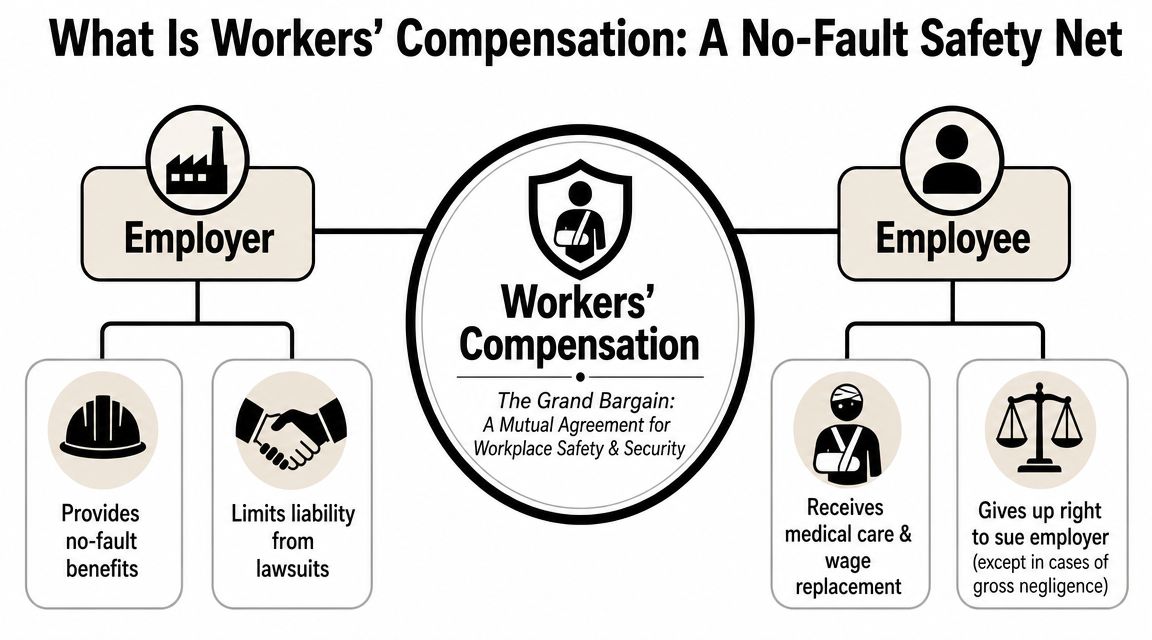
Owners often hear workers' comp described as the grand bargain because both sides give up something to gain something. The employee gets access to a defined benefits system for job-related injuries. The employer usually gains protection from a standard negligence lawsuit over that same covered injury.
That trade makes workers' comp very different from general liability insurance. General liability disputes often turn on fault, damages, and legal defense. Workers' comp is more like a rulebook. If the injury is work-related and the claim fits the state's rules, benefits are handled through that system instead of a typical civil case.
For a small business owner, that changes how you should respond on day one. Arguing about blame too early can waste time and create reporting mistakes. A better first move is to treat the situation like a process problem. Get medical care started, gather the facts, preserve records, and report the claim under the correct state's requirements.
How it protects both sides
For employees, no-fault treatment can mean fewer delays in getting care after an accident at a shop, office, warehouse, restaurant, or job site. For employers, it creates more predictability. You are not writing an open-ended promise to pay every claim in any amount. You are buying into a state-based system with defined benefits, deadlines, and procedures.
That said, no-fault does not mean no questions. Southeast employers run into this often when work crosses state lines. A Tennessee company may send a crew into Virginia. A Georgia contractor may pick up a short project in South Carolina. A Florida employer may have a remote worker who lives in North Carolina. The policy can still act as a safety net, but only if it is set up for where employees work and where claims may be filed.
Business owners also ask whether an injured employee can still sue. Sometimes the answer is no because workers' comp is the exclusive remedy for the covered injury. Sometimes the answer gets more complicated because of third-party liability, intentional conduct allegations, or disputes over whether the claim belongs in the workers' comp system at all. If you want a plain-English legal perspective on where those lines can matter, Mattiacci Law's guide to work injuries is a helpful supplemental read.
Practical rule: If an injury appears tied to the job, start with care, facts, and timely reporting. Sort out fault questions after the claim is on the right track.
The Four Pillars of Workers Compensation Coverage
A workers' comp policy works like a four-part safety net. If one part is missing or misunderstood, the claim can stall, the employee can feel stranded, and the business can end up guessing about its next move.
For a small business owner, these four pillars answer the practical question behind the policy: what does workers compensation insurance cover when someone gets hurt? In plain terms, it usually pays for medical treatment, replaces part of lost income, supports a return to work when the employee cannot go back to the same job, and provides benefits to surviving family members after a fatal work injury. The exact details come from state law, which matters a lot in Southeast states where benefit rules, doctor choice rules, and reporting deadlines can differ from one border to the next.
| Benefit Type | What It Covers |
|---|---|
| Medical benefits | Authorized treatment for a job-related injury or occupational disease |
| Wage replacement | Partial income support during temporary or permanent disability |
| Vocational rehabilitation | Help returning to work, sometimes in a modified or different role |
| Death benefits | Benefits for survivors, often including funeral-related support under state rules |
Medical care after a work injury
Medical benefits are usually the first part of the policy an employer sees in action. An employee gets hurt. Treatment starts. Bills begin to come in quickly.
Workers' comp usually covers reasonable, necessary, and authorized care tied to the work injury or occupational illness. That often includes emergency treatment, follow-up visits, diagnostic testing, surgery, medication, physical therapy, and other approved care. The word "authorized" matters because workers' comp does not function like a personal health plan. In many states, the employer or insurer has a role in directing care, approving providers, or managing referrals.
That catches Southeast employers off guard more often than it should. In Florida and Georgia, for example, employer-directed care rules are a major practical issue. In Virginia and the Carolinas, provider selection and panel rules can affect whether a bill gets accepted. If you have crews working across AL, FL, GA, NC, SC, TN, and VA, it is smart to ask your agent and carrier a simple question before an injury happens: who chooses the doctor in each state where my employees work?
A real-world example makes this clearer. A field technician slips off a ladder at a customer location and injures a shoulder. Medical benefits may cover the urgent visit, imaging, specialist evaluation, medication, and therapy that follows, as long as the treatment fits the claim and follows the state's process.
Wage replacement when work stops or hours are reduced
The second pillar is wage replacement. Medical treatment helps the employee heal. Wage benefits help keep income from dropping to zero or near zero while that recovery is happening.
These benefits do not usually replace the employee's full paycheck. They generally pay a portion of lost wages based on state formulas and disability status. That is one reason owners should not promise an injured worker that "workers' comp will pay everything." The system has limits, categories, and waiting periods.
You will hear terms like these:
- Temporary total disability: The employee cannot work at all for a period of time.
- Temporary partial disability: The employee can work, but only in a reduced role, at fewer hours, or with lower earnings.
- Permanent partial disability: The injury causes a lasting impairment, even though the employee may still be able to work.
- Permanent total disability: The injury leaves the employee unable to return to gainful work under the applicable state standard.
This pillar affects more than payroll. It affects staffing, overtime, scheduling, and retention.
A restaurant owner in South Carolina may need to reshuffle shifts after a cook suffers a serious hand injury. A contractor in Tennessee may have to decide whether light duty is available for a worker with lifting restrictions. A Virginia employer with no modified-duty plan may end up with a longer and more expensive claim than expected. Wage replacement sits right in the middle of those decisions.
Vocational rehabilitation and return-to-work support
The third pillar gets less attention, but it matters when the employee cannot return to the same work they did before the injury. Treatment may be complete, yet the job still no longer fits.
Vocational rehabilitation can include retraining, job placement help, skills assessment, or structured return-to-work support, depending on the state and the facts of the claim. For a warehouse employee with permanent lifting restrictions or a roofer who can no longer climb safely, the question changes from "Is the person healed?" to "What work can this person do now?"
That distinction is where many small employers in the Southeast need a more practical plan. If your business can offer light-duty tasks, transitional work, or a temporary reassignment, you may help the employee return sooner and keep the claim from becoming more disruptive than it needs to be. If your business is small and every role is physically demanding, vocational issues can become harder and more expensive.
This pillar is also one reason state-specific advice matters. One state may put more structure around return-to-work expectations, while another may handle vocational support more narrowly. A business with operations in Georgia and North Carolina should not assume both claims will be handled the same way.
Death benefits for surviving family members
The fourth pillar is death benefits. No owner wants to think about this part, but it is part of what the policy is built to address.
If a work-related injury or illness leads to death, workers' comp may provide benefits to eligible dependents and may also pay funeral or burial expenses up to the limits allowed by state law. The amount, duration, and who qualifies as a dependent can vary meaningfully by state. That matters in the Southeast, where a family's rights and the employer's obligations may look different in Alabama than they do in North Carolina or Florida.
For the employer, this pillar protects against a financial shock that could threaten the business itself. For the employee's family, it provides a defined source of support during the worst possible outcome.
Put together, these four pillars show the policy's real job. It pays for care. It replaces part of lost wages. It may help the worker return in a new or modified role. It provides survivor support after a fatal claim. If you own a business in the Southeast, the smart next step is to match those pillars against where your people work, because state rules shape how each one functions in practice.
Common Coverage Gaps and Exclusions to Know
Most business owners don't get in trouble because they misunderstand the basic idea of workers' comp. They get in trouble because they assume the policy covers every injury connected to an employee in some loose way. It doesn't.
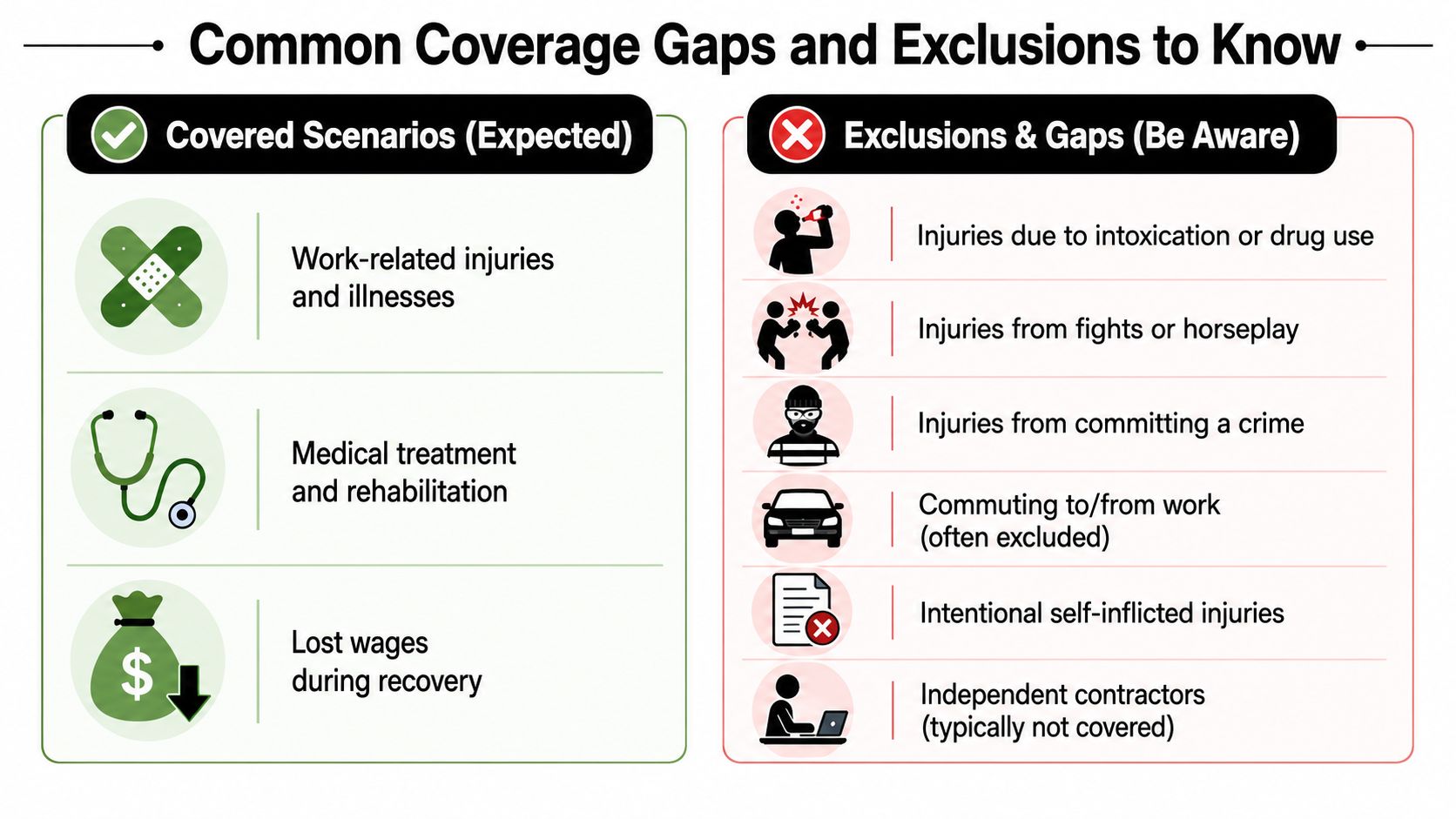
The gray areas matter more than most national overviews admit. A normal commute is the classic example. A frequently missed detail is that workers' comp often does not cover injuries during a regular trip to and from work. The same Illinois guidance that highlights this issue also notes that an out-of-state company doing any work in Illinois must carry coverage that includes Illinois, which shows how coverage follows work location, not just headquarters, as explained by the Illinois Workers' Compensation Commission insurance page.
Situations that are often excluded
Many claims questions come down to whether the employee was performing work duties when the injury happened. These situations often create pushback, denials, or disputes:
- Normal commuting: Driving from home to the regular workplace is often outside coverage.
- Horseplay or fighting: If the injury came from conduct outside ordinary job duties, expect scrutiny.
- Intoxication or drug-related incidents: Many states treat these claims differently or exclude them.
- Self-inflicted injuries: Intentional harm usually falls outside the system.
- Criminal conduct: If the worker was committing a crime at the time, coverage issues become serious quickly.
These aren't just technicalities. They are the boundaries of the safety net. Employers should know them before a claim arrives, not after.
The tricky cases owners ask about most
The harder questions usually involve work that doesn't happen in one obvious place.
Remote work. If an employee works from a home office and trips while carrying files to a workspace during the workday, the claim may look different from a slip while doing household chores. The issue is still job connection. Was the employee acting in the course and scope of employment at that moment?
Travel. A salesperson driving to meet a client may have a stronger work connection than an employee driving to the office for the morning shift. Business travel often raises fewer coverage problems than commuting, but facts still matter.
Independent contractors. Many small businesses make dangerous assumptions concerning this group. Workers' comp generally covers employees, not true independent contractors. But calling someone a contractor doesn't automatically make it so. If your day-to-day control, scheduling, supervision, and work relationship look like employment, misclassification can leave you exposed.
A certificate, a 1099, or a verbal agreement doesn't settle worker status by itself. State law and the actual working relationship matter.
Owners and family members. Some states have elective options, exemptions, or special treatment for business owners, officers, domestic workers, farm labor, or family-run operations. That's why broad internet advice often fails Southeast employers.
Here's the practical takeaway. Don't ask only, “Is this person on payroll?” Ask, “Where were they working, what were they doing, and which state's rules apply?” Those three questions do more to clarify a claim than generic online definitions ever will.
From Injury to Recovery The Workers Comp Claim Process
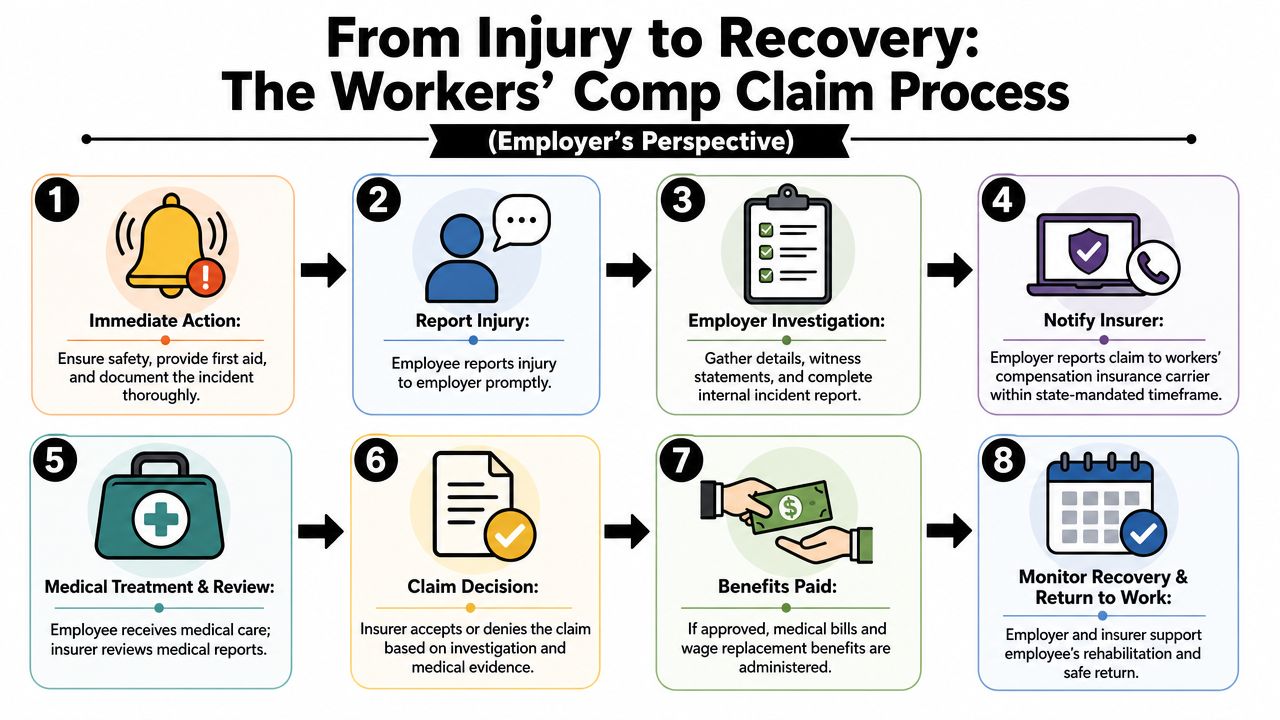
When an injury happens, speed matters. So does calm. The employer's job isn't to diagnose the claim on the spot. The employer's job is to respond in a way that protects the employee, preserves facts, and gets the claim into the system correctly.
That process is easier when you already know the sequence.
What to do on the day of the injury
Start with the employee's immediate condition. If the injury is serious, get emergency care. If it's less severe, follow your policy and state procedures for reporting and directing medical treatment.
Then document what happened while facts are fresh. Write down the date, time, location, task being performed, and names of any witnesses. If there's equipment involved, preserve the scene as much as practical and keep notes factual rather than speculative.
A simple employer checklist looks like this:
- Make the area safe: Prevent a second injury.
- Get medical attention: Don't delay care while debating coverage.
- Collect basic facts: Record who, what, when, and where.
- Notify supervisors or HR: Use your internal reporting chain.
- Report to the carrier promptly: Don't sit on the claim.
The worst first response is silence. Delayed reporting can complicate medical care, facts, and trust on all sides.
What happens after the report is filed
Once the claim reaches the carrier, an adjuster typically reviews the facts, medical information, and employment details. The insurer may request statements, payroll information, or job descriptions. Employers should respond promptly and keep records organized.
This stage is where a lot of frustration comes from. Owners assume filing the report ends their role. It doesn't. Your cooperation can affect how smoothly the claim moves, especially when there are questions about job duties, work restrictions, or whether modified work is available.
A strong return-to-work process often includes:
- Staying in contact: Check in with the employee without pressuring them.
- Reviewing restrictions carefully: Match tasks to medical limitations.
- Offering light duty when appropriate: Modified work can shorten disruption.
- Coordinating with the adjuster: Keep expectations aligned.
Some employees also ask whether they need a lawyer and how attorney fees work in a workers' comp claim. That's a legal and state-specific question, but if you want a consumer-friendly overview, this article on understanding workers' comp legal fees can help frame the issue.
Claims don't really end when a form gets filed. They end when the worker recovers, reaches a stable medical point, or transitions into a long-term benefit outcome under state law. The employers who handle claims best are usually the ones who treat the process as active case management rather than paperwork.
Navigating Workers Comp Rules in the Southeast
Generic articles usually let business owners down because workers' compensation is governed by state law, so the practical answer to “Do I need it?” changes depending on where your people work, how your company is structured, and who counts as an employee under that state's rules.
The broader system itself is state-based. The CDC notes that workers' comp systems are governed by state law, and most employers obtain coverage through private insurers or state-certified funds. The CDC background also highlights Texas as the well-known exception where many private employers may choose whether to carry coverage, while public employers must carry it. It further notes that IBISWorld estimates U.S. workers' compensation insurers generated $51.2 billion in revenue in 2025 after a 1.8% compound annual decline over the prior five years, and cites a long-term drop in workplace injury and illness rates from 10.9 incidents per 100 workers in 1972 to 2.4 per 100 workers in 2023, as summarized in the CDC overview of workers' compensation.
Why Southeast employers get tripped up
The Southeast has plenty of businesses with mixed operations. A company may have office staff in one state, drivers crossing state lines, field crews on temporary jobs, and part-time admin help working from home. That's where owners start relying on myths.
One common myth is that a single company policy automatically solves every state issue. Sometimes it does. Sometimes it needs endorsements, state-specific treatment, or a different setup based on where work is performed.
Another myth is that contractor-heavy businesses can avoid workers' comp questions altogether. In reality, businesses with subcontractors, seasonal labor, family workers, or owner-operators often need more careful review, not less.
If your employees cross state lines, your workers' comp question is no longer just “Do I have a policy?” It becomes “Does my policy match where my people actually work?”
If your business operates across the region, it helps to review your broader multi-state exposure, not just payroll totals. This overview of a multi-state insurance agency serving Florida, South Carolina, and North Carolina is relevant if your operation spans more than one Southeast jurisdiction.
A practical state-by-state checklist
I need to be careful here because state thresholds and exemptions change, and this article can't invent figures that aren't provided in verified data. What I can tell you with confidence is this:
- Alabama: Rules vary by worker type, and the state recognizes different thresholds and exemptions for groups such as domestic employees and farm laborers, according to the Alabama Department of Labor workers' compensation insurance guidance.
- Florida: Don't assume Florida follows the same trigger as nearby states. Construction and non-construction businesses may face different rules, and owner status can matter.
- Georgia: Small employers often assume they're too small to need coverage. That assumption can be dangerous if your worker count or business type triggers the requirement.
- North Carolina: Remote staff, part-time workers, and changing headcount can complicate the analysis quickly.
- South Carolina: Employers with seasonal or irregular staffing should verify how their worker count is measured.
- Tennessee: Businesses using family labor or mixed employee-contractor models should check classification carefully.
- Virginia: Multi-state employers often need to verify that Virginia exposure is handled correctly when employees travel or perform work there.
The point isn't to dodge specifics. The point is to avoid false confidence. State rules on who needs coverage vary sharply, and Alabama is a good example because it sets different thresholds and exemptions for certain worker groups. A one-size-fits-all answer to whether you need workers' comp is often wrong.
For Southeast businesses, the safest path is to verify four things in each state where work happens:
- Employee count rules: How that state counts workers for coverage purposes.
- Exemptions: Whether owners, domestic workers, or farm labor are treated differently.
- Out-of-state exposure: Whether temporary or recurring work in another state changes the requirement.
- Worker classification: Whether your “contractors” would be treated as employees under that state's framework.
That's the kind of local nuance national guides usually skip, and it's often the difference between being compliant and finding out too late that your policy setup had a gap.
Protect Your Business Today with the Right Coverage
A worker slips unloading a truck in Georgia, or a restaurant employee in Florida burns a hand during a busy lunch rush. In a moment like that, the question is no longer whether workers' comp matters. The important question is whether your policy is set up to respond the way you expect.
Workers' compensation works like a financial safety net for both sides of the employment relationship. It helps cover the employee's medical care and lost wages after a work-related injury or illness, and it helps protect the business from absorbing the full cost on its own. For many employers, it also supports the tradeoff built into workers' comp law: covered injuries are usually handled through the workers' compensation system rather than through a standard lawsuit.
That protection depends on fit.
A policy has to match how your business operates. Payroll matters, but so do job classifications, owner elections, subcontractor relationships, and the states where work happens. A roofing crew in South Carolina, a cleaning company with teams crossing from North Carolina into Virginia, and an office firm in Tennessee can all carry workers' comp, yet the risk profile and setup questions are very different.

Price matters, but price without fit can create expensive surprises later. A lower premium does not help much if the policy uses the wrong classifications, excludes a state where your employees travel for work, or leaves you scrambling when a claim needs to be reported fast. If you want a practical starting point on budgeting, this Florida workers' comp cost guide for small businesses can help you estimate what affects premium.
Southeast business owners should be especially careful here because state rules do not line up neatly. An employer with workers in Alabama and Georgia may face different threshold questions than a business operating only in North Carolina. A Florida company sending employees into another state for jobs may need to confirm how that exposure is handled. The safest approach is simple: review where work is performed, how each worker is classified, and whether your policy language matches those facts before an injury happens.
For businesses that want help comparing options, Select Insurance Group, Inc. is one available route in the Southeast. The agency works across Alabama, Florida, Georgia, North Carolina, South Carolina, Tennessee, and Virginia, and provides commercial insurance guidance for businesses operating in the region.
The main takeaway is practical. Workers' comp is not just paperwork for compliance. It is the plan you rely on when an ordinary workday suddenly turns into a medical bill, lost time, and a claim that needs to be handled correctly. The right policy gives your employee a path to care and gives your business a structured way to respond without guessing.