
If you're shopping for car insurance in Alabama right now, you're probably staring at a handful of quotes that don't line up, a stack of unfamiliar coverage terms, and one nagging question: am I getting a fair deal, or just the easiest one to buy?
That confusion is normal. A lot of Alabama drivers start with the price on the screen, then realize too late that one quote strips coverage down to the legal minimum, another bundles in options they didn't ask for, and a third comes from an agent who can only sell one company's policy. The result is frustration, not clarity.
A good Alabama auto insurance agency should do more than hand you a number. It should help you understand what you're buying, where the weak spots are, and whether your quote reflects the broader market or just one carrier's appetite for your profile. If you want a practical starting point, a statewide Alabama auto insurance quote page can help you see how the process is supposed to work when the goal is matching coverage to the driver, not forcing the driver into one preset box.
Table of Contents
- Navigating the Alabama Auto Insurance Maze
- Choosing Coverage Beyond the State Minimum
- Independent vs Captive Agents What Alabama Drivers Must Know
- Practical Steps to Secure Affordable Auto Insurance Rates
- Why Select Insurance Group is a Top Choice in Alabama
Navigating the Alabama Auto Insurance Maze
A common Alabama insurance story goes like this. A driver's renewal jumps, they call one office, get one quote, and feel pressured to decide on the spot. Then a friend says, "shop around," but that advice usually stops there.
The problem isn't that drivers don't know they should compare. It's that drivers often don't know how to compare quotes in a way that means something. If one quote has bare-bones liability, another includes collision, and another changes deductibles, you're not comparing price. You're comparing different products.
That's where many people get stuck. They aren't just buying a card for the glovebox. They're trying to protect their license, their vehicle, their paycheck, and their peace of mind after an accident.
A fair auto insurance quote isn't just a low number. It's the right coverage, from a carrier willing to price your risk reasonably, presented in a way you can actually compare.
In Alabama, that matters because your decision has consequences fast. If your policy doesn't meet the state's rules, the issue isn't abstract. It can affect your registration, your driving privileges, and what you owe after a wreck.
The three parts of 25 50 25
Alabama requires 25/50/25 liability coverage under its mandatory liability law. That means $25,000 for bodily injury per person, $50,000 for bodily injury per accident, and $25,000 for property damage. Drivers who don't carry at least that minimum can face civil penalties, including license and registration suspensions, as outlined in Alabama's mandatory car insurance rules.
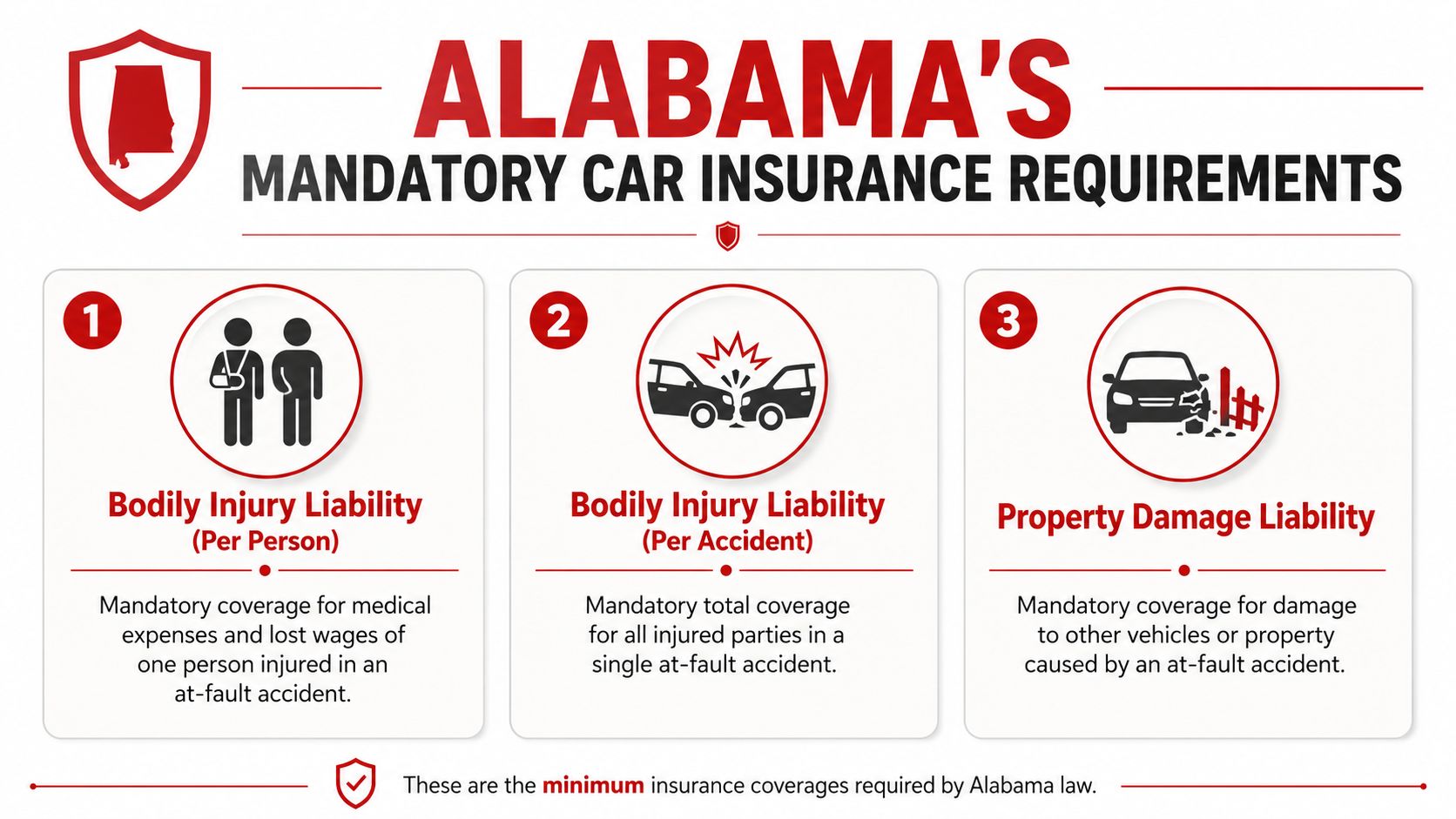
Think of 25/50/25 like a three-legged stool. Each leg handles a different part of damage you could cause in an at-fault accident:
- Injury to one person: The first number applies to one injured person.
- Injuries to everyone in the crash: The second number caps what the policy pays for all injured people together.
- Damage to someone else's property: The third number applies to the other driver's vehicle or other damaged property.
If you only remember one thing, remember this: liability coverage pays for damage you cause to others.
What the minimum actually does
That minimum keeps you legal. It doesn't mean it keeps you well protected.
If you rear-end another driver and damage a newer vehicle, your policy's property damage limit can get tested quickly. If several people are hurt, the bodily injury limit for the whole accident becomes the pressure point. Once policy limits are exhausted, the remaining cost doesn't disappear.
A lot of drivers hear "full coverage" and assume that means anything bad that happens is handled. That's not how it works. Coverage depends on the policy parts you bought, the deductibles you chose, and whether the loss fits the policy language.
Practical rule: Buy the minimum only if you've made that choice with full awareness of what you're leaving exposed.
When drivers understand Alabama's legal floor first, later decisions get much easier. You stop asking only, "What's the cheapest policy?" and start asking, "What problem would this policy leave me holding on my own?"
Choosing Coverage Beyond the State Minimum
Most claim problems don't start because a driver had no insurance at all. They start because the driver had only enough insurance to be legal.
In Alabama, full coverage is often still reasonably priced compared with many other states. The average cost of car insurance in Alabama is $1,376 per year for full coverage, which is 4.9% less than the national average, according to Alabama pricing data from The Zebra's state cost guide. That doesn't mean every driver should buy the same package, but it does mean broader protection is worth a close look.
Where minimum coverage falls short
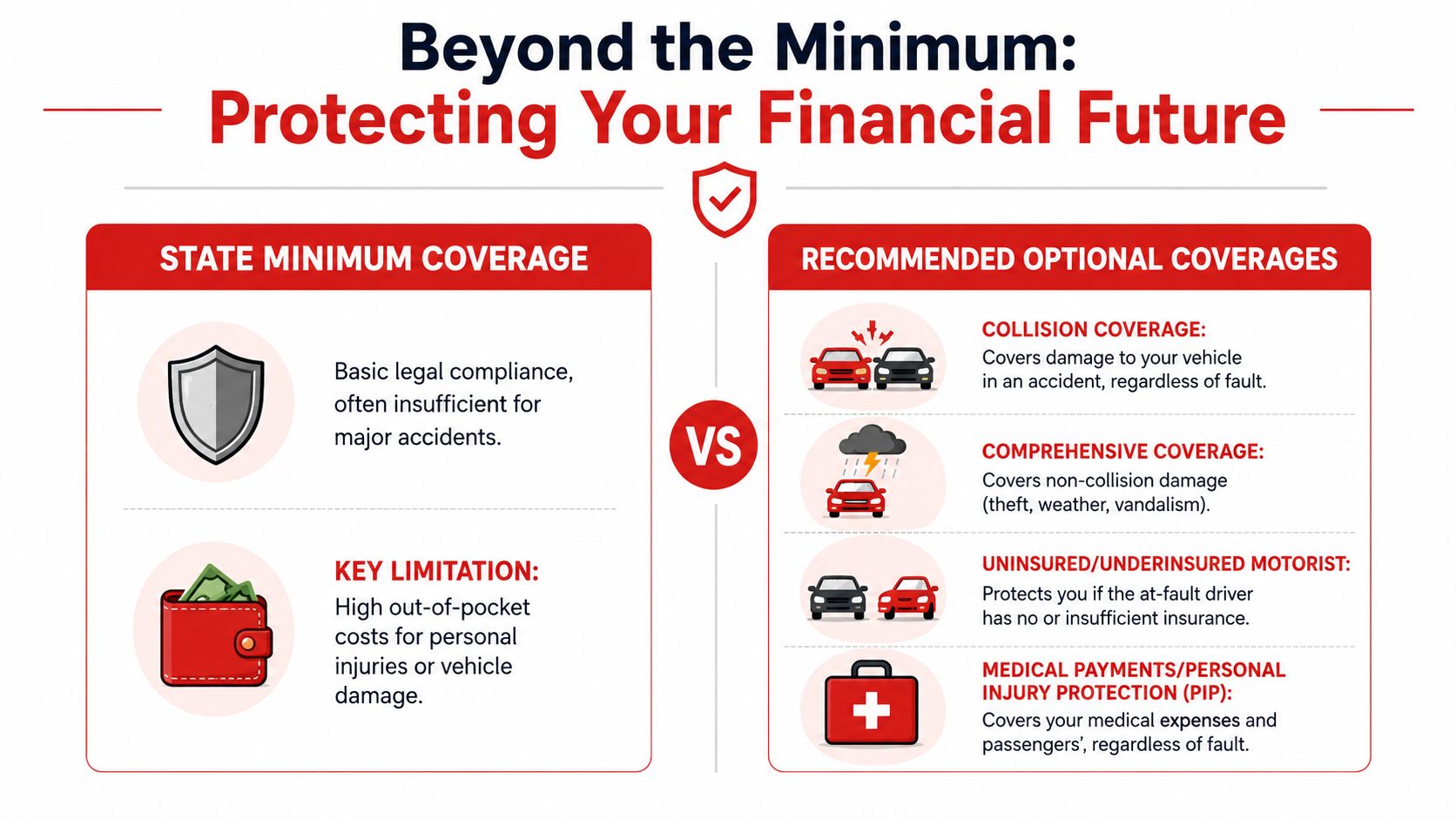
State minimum liability doesn't fix your own car after a collision. It doesn't help if a storm damages your vehicle. It doesn't automatically solve the problem when the at-fault driver has little or no coverage.
Those are real-world gaps, not technical fine print.
A practical way to think about it is by scenario:
| Situation | Coverage that usually matters |
|---|---|
| You hit another car and cause damage | Liability |
| You damage your own car in a crash | Collision |
| A tree falls on your parked car | Comprehensive |
| Someone with too little insurance hits you | Uninsured or underinsured motorist coverage |
| You need help with medical bills after an accident | Medical payments or similar optional protection |
The optional coverages that matter most
Collision covers damage to your vehicle from an accident, regardless of fault rules in the basic sense of vehicle repair under your policy terms.
This coverage handles non-collision losses such as theft, vandalism, weather, or falling objects. If a branch comes down during a storm and crushes your hood, that's the kind of event drivers usually expect this type of policy to address.
Uninsured and underinsured motorist coverage deserves special attention. Alabama drivers aren't all carrying the same level of protection, and some aren't carrying enough at all. If you want a plain-language explanation of why this matters in injury cases, this guide on protecting yourself with adequate auto insurance gives a useful consumer-level overview.
Medical payments coverage can also make sense for drivers who want help with immediate accident-related medical costs regardless of fault.
Minimum coverage protects your right to drive legally. Broader coverage protects your finances when the accident doesn't fit a best-case scenario.
The right package depends on the car you drive, what you could afford to replace out of pocket, and how much risk you want to keep personally.
Independent vs Captive Agents What Alabama Drivers Must Know
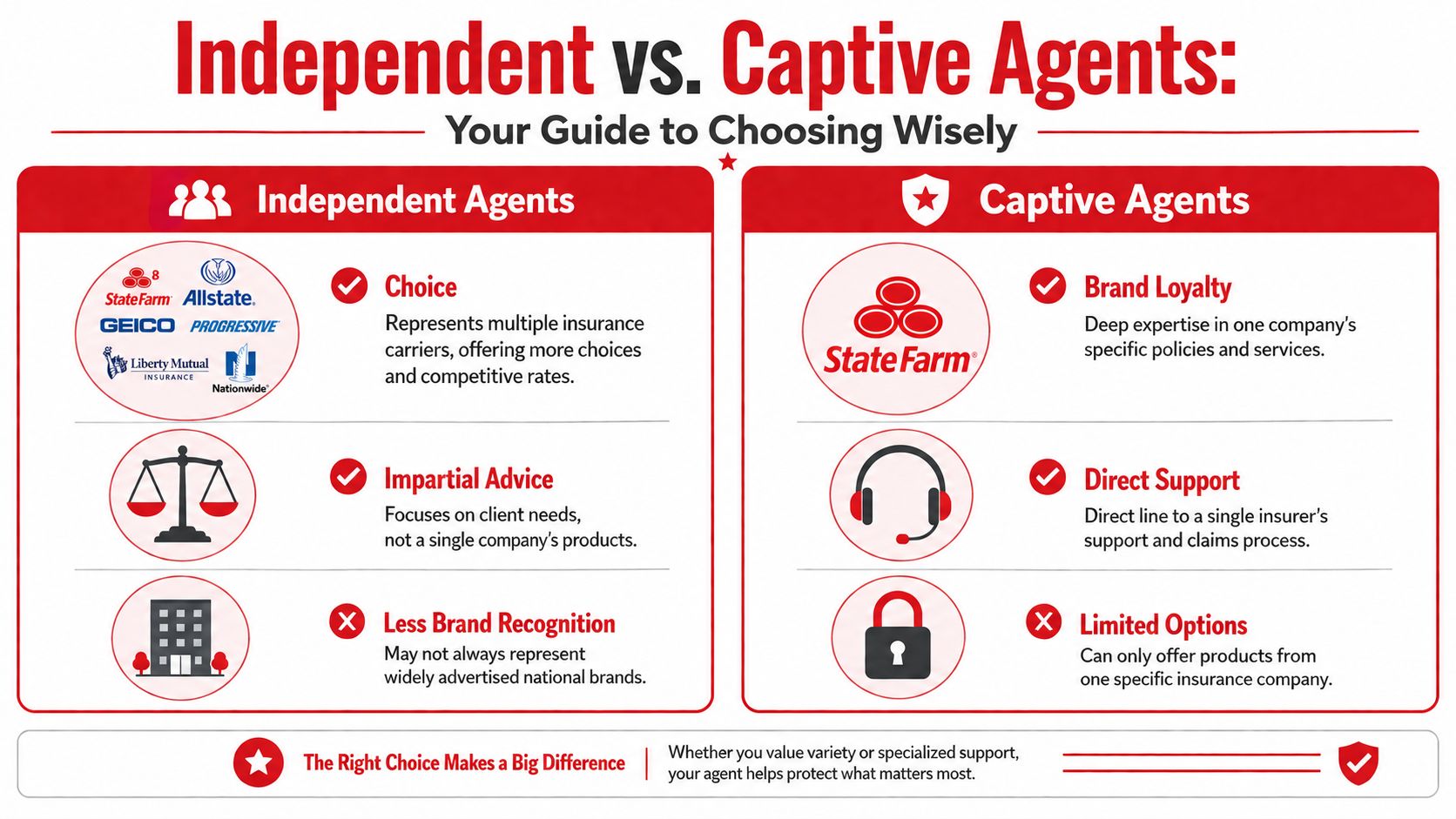
This is the part many drivers never hear clearly enough. Not every agency shops the market the same way. Some agents can offer only one insurer's products. Others can compare multiple carriers.
That difference isn't minor. It's structural.
Why agency structure matters in Alabama
Alabama has a large auto insurance market. In 2021, insurers wrote $3.9 billion in direct premiums for passenger auto coverage, and total automobile direct premiums reached $6,066,366,941, with auto representing 24% of all property and casualty premiums in the state, according to Alabama market share reporting summarized by Stacker's Alabama insurer market overview. The same source notes that the market is concentrated, with major groups holding significant share.
In a concentrated market, the old advice to "shop around" is incomplete unless you know who is doing the shopping. A captive agent can explain one company's policy well. What that agent can't do is tell you whether another carrier in the market would view your driving history, vehicle, zip code, or household differently.
An independent agency can compare across more than one carrier. In practice, that changes outcomes for drivers with clean records, teenage drivers on the policy, recent claims, or any profile that one insurer prices sharply while another prices more moderately.
The question every driver should ask
The Alabama Department of Insurance gives consumers direct advice on this point. It says to ask producers "how many companies they represent" before buying coverage, as noted in the state's auto smart shopping guidance.
That's one of the best consumer-protection questions you can ask because it gets to the heart of whether you're seeing the market or only one slice of it.
Use this short checklist when you call an Alabama auto insurance agency:
- Ask about carrier access: How many companies can you quote for my situation?
- Ask how the quote was built: Are liability limits, deductibles, and optional coverages identical across quotes?
- Ask about fit: Which carriers tend to be more competitive for my kind of vehicle or driving profile?
- Ask about service after purchase: Who helps if I need to change a vehicle, add a driver, or review coverage later?
For a broader explanation of how this model works, this overview of what an independent insurance agency is lays out the core distinction in practical terms.
As an example of why structure matters in any distribution business, even outside insurance, buyers often prefer specialists who represent a category rather than one house brand. The same logic shows up in other industries, including niche supplier networks like Distribute high-performance car wash foam guns, where access and fit can matter as much as the product itself.
Practical Steps to Secure Affordable Auto Insurance Rates
Low rates usually come from preparation, not luck. Drivers who get the most usable quotes tend to bring clean information, ask specific questions, and understand which parts of pricing they can influence.
Get your information ready before you shop
Before you call or request quotes, gather the basics in one place. That keeps the quote process consistent and reduces the chance that one estimate looks cheaper only because it was built on thinner information.
Have these details ready:
- Driver information: License details, driving history, and all household drivers who need to be disclosed.
- Vehicle information: VIN, garaging address, annual mileage, and how the vehicle is used.
- Current policy details: Liability limits, deductibles, and optional coverages on your present policy.
- Life changes: Recent move, new driver in the household, paid-off vehicle, or change in commute.
If one quote uses incomplete information, it may not hold up once underwriting reviews the file.
Ask better questions and you get better quotes
Discounts matter, but don't ask only, "What's your cheapest rate?" Ask whether bundling, multi-vehicle placement, student-related savings, or safe-driver factors apply. Then ask which changes would lower premium without stripping out protection you need.
Driving history carries a lot of weight. Alabama drivers with DUIs pay 46% more for car insurance than drivers with a clean record, based on Alabama cost data discussed earlier in the source material. That gap is a strong reminder that keeping a clean record doesn't just help at renewal time. It affects your options for years.
If your record isn't perfect, don't assume every carrier will respond the same way. That's often where broader market access helps most.
A few practical habits also make a difference:
- Choose deductibles intentionally. A higher deductible can lower premium, but only if you could comfortably handle that amount after a loss.
- Review old coverages on older cars. Some vehicles no longer justify paying for every optional coverage.
- Re-shop after major changes. Marriage, a move, a paid-off vehicle, or removing a youthful driver can all justify a fresh look.
- Keep documents accurate. Misstated garaging, mileage, or vehicle use can create claim trouble later.
Affordable insurance isn't about chasing the lowest number on one screen. It's about building a quote set that's consistent enough to compare and strong enough to trust.
Why Select Insurance Group is a Top Choice in Alabama
When drivers say they want a better insurance experience, they usually mean something simple. They want a real comparison, clear answers, and help that doesn't disappear after the policy is issued.
That's where a practical agency model matters more than branding language.
What a useful agency relationship looks like
One workable option is Select Insurance Group, Inc., an independent agency that compares quotes from multiple carriers and serves drivers who want help across personal and commercial lines. That matters for Alabama households with more than one car, drivers who need bilingual service, and people who want phone, text, and online support instead of a one-lane service model.
An agency becomes more useful when it can handle the ordinary tasks well. Adding a vehicle. Removing a driver. Reviewing deductibles. Explaining why one carrier priced a risk differently from another. Those aren't glamorous moments, but that's where trust is built.
Drivers who also spend time on the road outside Alabama may find it helpful to review resources related to safe-driving education and insurance savings in nearby states, such as Georgia defensive driving for insurance savings. The details differ by state, but the larger point is consistent: safer driving habits and informed policy review often work better than last-minute rate chasing.
When personal auto is not enough
Some Alabama drivers need more than a standard personal policy. If a vehicle is owned or operated for business use, the coverage question changes. In Alabama, commercial auto insurance is legally distinct from personal auto coverage, business-owned or operated vehicles need separate commercial coverage meeting the same minimum liability structure, and businesses with five or more employees must also carry workers' compensation insurance under the state's 2025 requirements, as explained in this summary of Alabama business insurance requirements.
That matters for contractors, delivery operations, family businesses, and anyone who assumes a personal auto policy will automatically stretch to business use.
If you want to understand how a multi-state independent agency approaches service and communication, Select also outlines its broader office model through its regional insurance office information. The important takeaway isn't the location. It's the operating style: multiple carrier access, ongoing support, and the ability to handle both everyday personal coverage and more specialized policies when life or business gets more complicated.
If you want help reviewing your current policy, comparing quotes across multiple carriers, or sorting out whether you need personal or commercial auto coverage, Select Insurance Group, Inc. is a practical place to start. Ask for a side-by-side quote review, confirm what coverages are being matched, and make sure the policy you choose is built for how you drive in Alabama.