
You don't usually start shopping for life insurance in Florida on a calm, tidy day. More often, it's after a parent's diagnosis, a new mortgage, a baby, or a long talk about who would have to cover the bills if something happened tomorrow. In that moment, the question isn't just “Do we need coverage?” It's how much, what kind, for how long, and who is allowed to own or benefit from the policy.
Florida adds its own layer to those decisions. The state has a large retiree population, and that changes the mix of policies people ask about, from term coverage for working families to final-expense protection for seniors. Nationally, LIMRA and Life Happens found in 2023 that 82% of Americans who bought life insurance did so for burial or final expenses, 68% for wealth transfer, 66% to supplement retirement income, and 60% for income replacement, which lines up with what Florida households tend to care about most in practice. Price also matters. Policygenius reported that in Florida, a healthy 35-year-old buying a $500,000, 20-year term policy paid an average of $26 per month for women and $31 per month for men based on 2023 data, and that kind of starting point is why term coverage is often the first stop.
Table of Contents
- What Life Insurance Looks Like for Florida Families Right Now
- The Four Policy Types Florida Buyers Actually Compare
- How Florida Regulates and Protects Life Insurance Buyers
- Calculating How Much Coverage You Actually Need
- What Life Insurance Costs in Florida and What Moves the Price
- The Buying Process From First Quote to Delivered Policy
- Insurable Interest, Senior Applicants, and How to Get Bilingual Quotes
What Life Insurance Looks Like for Florida Families Right Now
A common Florida call goes like this. A daughter is helping her mother sort out bills after a cancer diagnosis, and the family keeps circling the same problem. There's a mortgage, a few credit cards, some medical bills, and not much cash sitting idle. Everyone knows some coverage would help, but nobody wants to guess wrong and either overpay for insurance or leave too little behind.
That's the Florida life insurance market in one scene. The state's older population creates steady demand for retirement protection, burial coverage, and income replacement, while younger households still need clean, affordable term coverage to bridge the years until the kids are grown and the house is paid down. The buyer usually starts with four questions, and they're the right questions. How much coverage do we need? Which policy type fits the family? How long does the coverage need to last? And who will pay the premium month after month?
Practical rule: If the premium only works for six months, it doesn't really work. The policy has to fit the household budget on an ordinary month, not just a good one.
In Florida, those decisions also play out in a state with a lot of retiree households and a lot of mixed-age families. That means one family might need income replacement for a working spouse, while another is really trying to protect against final expenses and debt transfer. The same state can produce very different buying motives, and that's why the first conversation should always be about the family balance sheet, not a canned rule of thumb.
The rest of the buying process falls naturally out of those answers. Once the household knows whether it needs temporary protection, lifelong coverage, or a small final-expense policy, the quote search becomes much easier. Once it knows who can own the policy and who can be the beneficiary, the application goes smoother. And once it knows what assets already exist, the coverage target gets a lot more honest.
The Four Policy Types Florida Buyers Actually Compare
Most Florida shoppers end up comparing the same handful of products, even if they don't use the same names for them. Term life is the simplest to understand. It's like renting an apartment for a fixed period. You get the protection for a set number of years, then it ends if you don't renew or convert it. That's why term usually fits families with a clear time horizon, like a mortgage, young kids, or a business loan.
Whole life is closer to buying the building with a built-in savings component. It stays in force as long as the policy is kept up, and it can make sense for people who want permanent coverage and value the long view. The trade-off is cost. It's usually harder to fit into a budget, especially for households that really just need protection during the working years.
A quick side-by-side helps keep the decision grounded.
| Life Insurance Policy Types at a Glance | How Long It Lasts | Typical Use Case | Best For |
|---|---|---|---|
| Term life | Fixed period | Income replacement, mortgage protection, family needs | Working families and budget-focused buyers |
| Whole life | Lifelong if kept in force | Permanent protection, estate planning, long-term certainty | Buyers who want lifelong coverage |
| Final-expense coverage | Lifelong, usually smaller face amounts | Funeral and small end-of-life costs | Seniors and families focused on burial expenses |
| Guaranteed-issue coverage | Lifelong, with limited underwriting | Coverage for health-challenged applicants | Older buyers who may not qualify elsewhere |
| Universal life | Lifelong if funded properly | Flexible premiums and death benefit planning | Buyers who want adjustable permanent coverage |
| Group coverage | Tied to employment or membership | Basic protection at work | People who want simple supplemental coverage |
Final-expense and guaranteed-issue policies matter a lot in Florida because many older applicants are shopping for a more modest death benefit, not a large income-replacement policy. Universal life can fit some permanent planning situations, but it needs closer attention because flexibility cuts both ways. Group coverage is useful as a workplace benefit, but it rarely replaces a full individual policy.
A policy that sounds flexible on paper can still be unforgiving in real life if the funding assumptions are too optimistic.
For most households, the job is not to memorize product labels. It's to match the product to the actual obligation, then compare how long the coverage has to last and how much cash the family can keep paying without strain.
How Florida Regulates and Protects Life Insurance Buyers
Florida's life insurance market isn't a free-for-all. The Florida Office of Insurance Regulation uses a formal product-review process, which means policy forms, rates, and filing requirements are reviewed before products are marketed in the state. That matters because it affects what carriers can bring to market, how quickly they can file changes, and how much product design flexibility they have once they decide to compete in Florida. For buyers, the practical effect is simple. Not every policy idea gets to show up in your quote search.
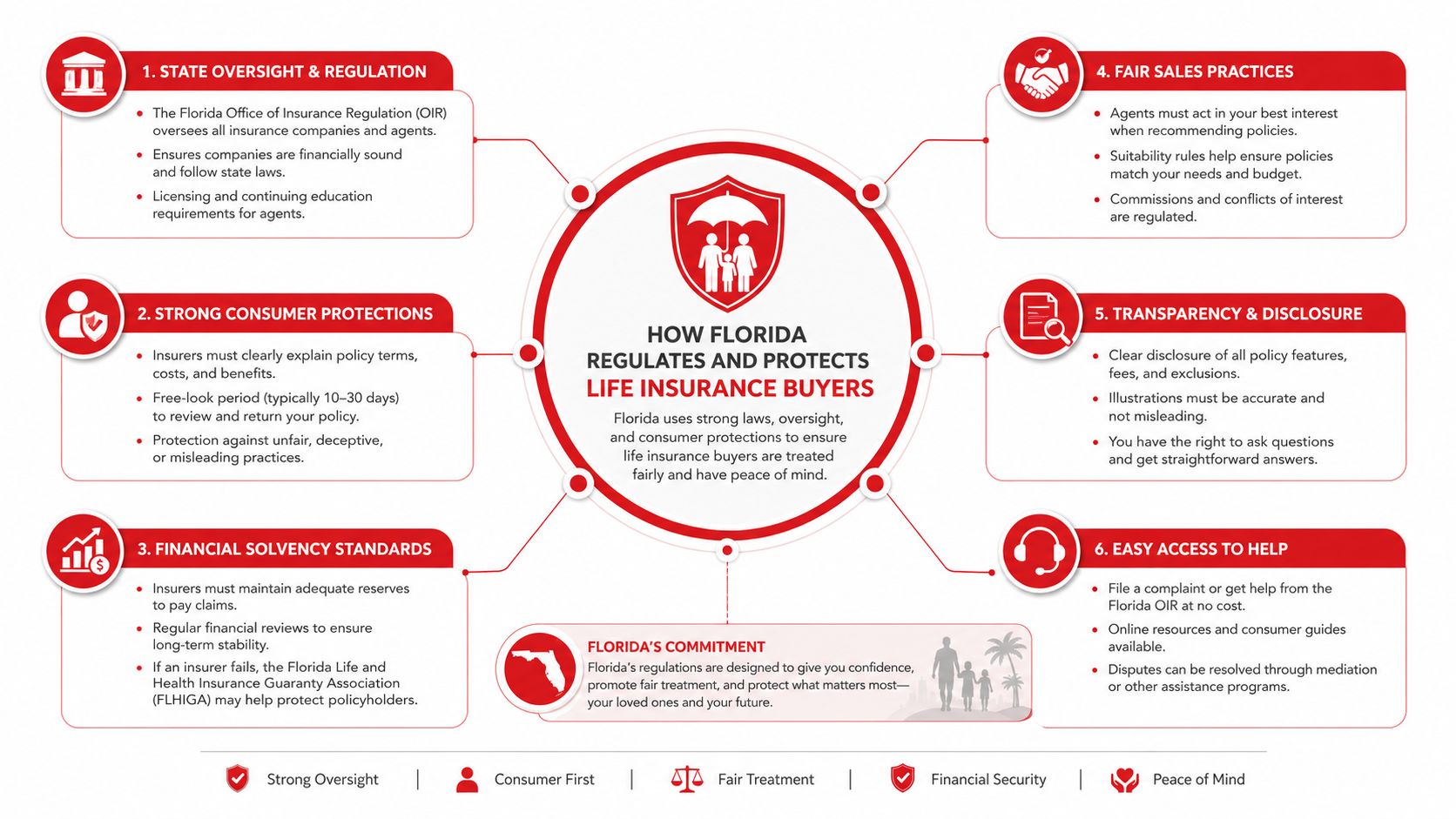
Florida also points consumers to the NAIC Life Insurance Policy Locator, which was launched nationwide in 2016. That service is especially useful in a state with a large aging population and real estate and probate needs, because families do lose track of policies and annuity contracts. If you're settling an estate, this is one of the first consumer tools worth knowing about. It won't find everything instantly, but it gives families a clean place to start instead of guessing which carrier may have issued coverage years ago.
For people who want help organizing broader documents alongside a policy search, a practical estate-planning software guide from remembers.life can help frame the paperwork side without turning the process into a legal maze. That kind of organization matters when beneficiaries need to prove who they are and what they're entitled to receive.
Florida's broader insurance environment is also large and active. The state's 2025 Health Insurance Market Report said premiums in that market reached $30.8 billion in 2024, up 19.2% from 2023. That figure is for health insurance, not life insurance, but it shows the scale of oversight and spending in Florida's wider life-and-health system.
The consumer lesson is straightforward. Keep your policy paperwork, beneficiary forms, and contact information current. Use the locator if you're helping with an estate. And understand that Florida's regulatory structure shapes what reaches the market, which is one reason a local, current quote search tends to work better than relying on old assumptions or stale internet advice.
Calculating How Much Coverage You Actually Need
The lazy shortcut is to say you need five to ten times your income. That's easy to repeat and hard to trust. A better answer is needs minus liquid assets. Start with what would have to be paid if you died, then subtract the cash, accounts, and other resources that are already available to handle those obligations.
For a Florida family, the list usually begins with funeral or cremation costs, final medical bills, outstanding debts, and either mortgage or rent obligations. Then add the everyday bills that would still show up for a surviving spouse or partner, things like groceries, utilities, childcare, transportation, and any ongoing household costs that don't disappear just because income does. If a household has reserves sitting in savings, retirement accounts, or another liquid source, that should reduce the amount of life insurance needed.
Simple framework: coverage need = obligations minus liquid assets.
A practical example helps. Suppose a 40-year-old parent has a mortgage, a car loan, credit card balances, and two children who'd still need support for several years. The policy target is not a guess, and it's not a rule of thumb. It's the amount required to cover those obligations after subtracting whatever cash and investments the family can already use. For a retiree on a fixed income, the calculation shifts. The big question is often not income replacement, but whether there's enough coverage to handle final expenses, medical bills, and any debt that might otherwise land on the spouse or estate.
That's why Florida shoppers should be careful with advice that sounds neat but skips the household balance sheet. A retiree and a young family may both live in the same ZIP code, but they don't need the same policy. A more complete needs calculation is also the best way to decide whether term coverage, final-expense coverage, or a smaller permanent policy makes sense.
For families trying to think this through with medical and estate paperwork in the background, a consumer resource like Z Audiology's insurance page can be useful for seeing how health coverage, long-term care questions, and benefit coordination often overlap in real life. Insurance decisions rarely live in separate boxes.
If you want a clean starting point for younger households, the internal guide at https://selectinsgrp.com/affordable-term-life-insurance-young-families/ lines up well with this framework because it focuses on a practical coverage target instead of a slogan. That's the right way to buy life insurance in Florida. Build the number from the actual need, then choose the shortest, cleanest policy that covers it.
What Life Insurance Costs in Florida and What Moves the Price
Florida pricing is easier to understand when you look at a real quote benchmark. Policygenius reported that in Florida, a healthy 35-year-old buying a $500,000, 20-year term policy paid an average of $26 per month for women and $31 per month for men based on 2023 data. Policygenius also described the roughly 19% male premium gap as mortality-risk pricing, which is how insurers price higher expected claims frequency rather than treating the sexes the same on a pure billing line.
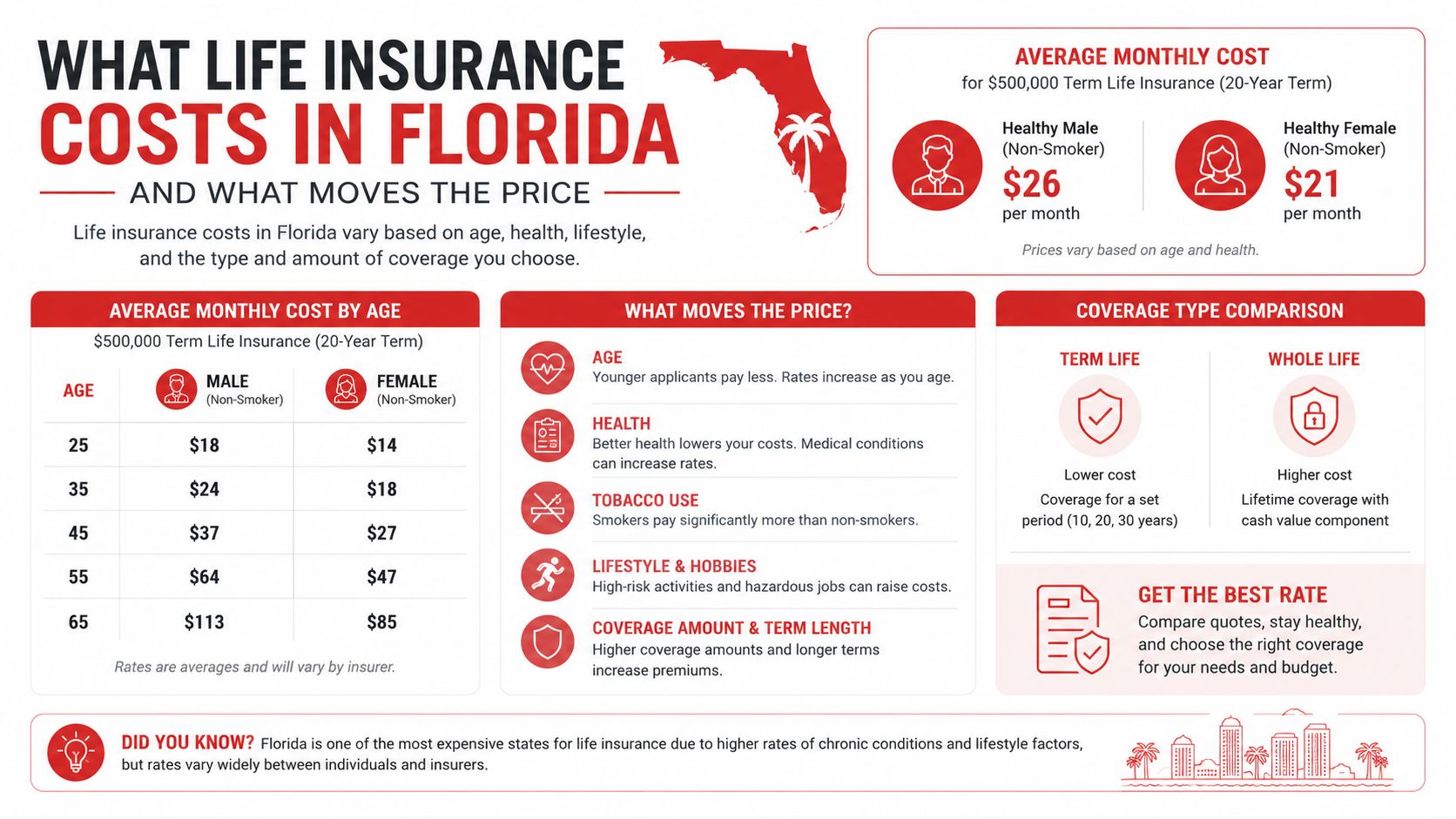
The price itself is only part of the story. Underwriting still drives the final number. Age, health history, tobacco use, driving record, build, occupation, and the amount of coverage requested all affect how the carrier classifies the risk. In Florida, carriers also think about how the applicant's life looks on paper. A clean family history, stable medical records, and straightforward finances usually help. A recent diagnosis, incomplete records, or a history that triggers extra review usually slows things down and can change the offer.
Florida-specific realities matter too. Older applicants often push the market toward final-expense or simplified policies because they don't want a long medical exam or a large face amount. Working families usually lean toward the cheapest term structure that covers the gap. The product choice changes the premium more than many anticipate.
A few habits usually help people get the cheapest realistic path to approval:
- Apply for the right amount: Overstating the need raises the price and can make underwriting harder than it needs to be.
- Keep the application consistent: Medical history, prescriptions, and beneficiary details should match the records the insurer is likely to verify.
- Choose term when the need is temporary: If the obligation ends in 20 years, don't pay for lifelong coverage you don't need.
- Don't hide health issues: A messy denial is worse than a clean rating, because it can make the next application harder.
- Request quotes before the family is rushed: Underwriting goes smoother when people aren't shopping in the middle of a crisis.
For Florida buyers, cheap and clean usually beat clever and complicated. The right quote is the one the carrier can approve on the terms you can live with, month after month.
The Buying Process From First Quote to Delivered Policy
The first real step is to decide the coverage number from the household need, not from a random online rule. After that, get quotes from multiple carriers so you can compare term length, policy type, and premium. That comparison matters because two policies can look similar at the top of the page and still behave very differently once underwriting starts.
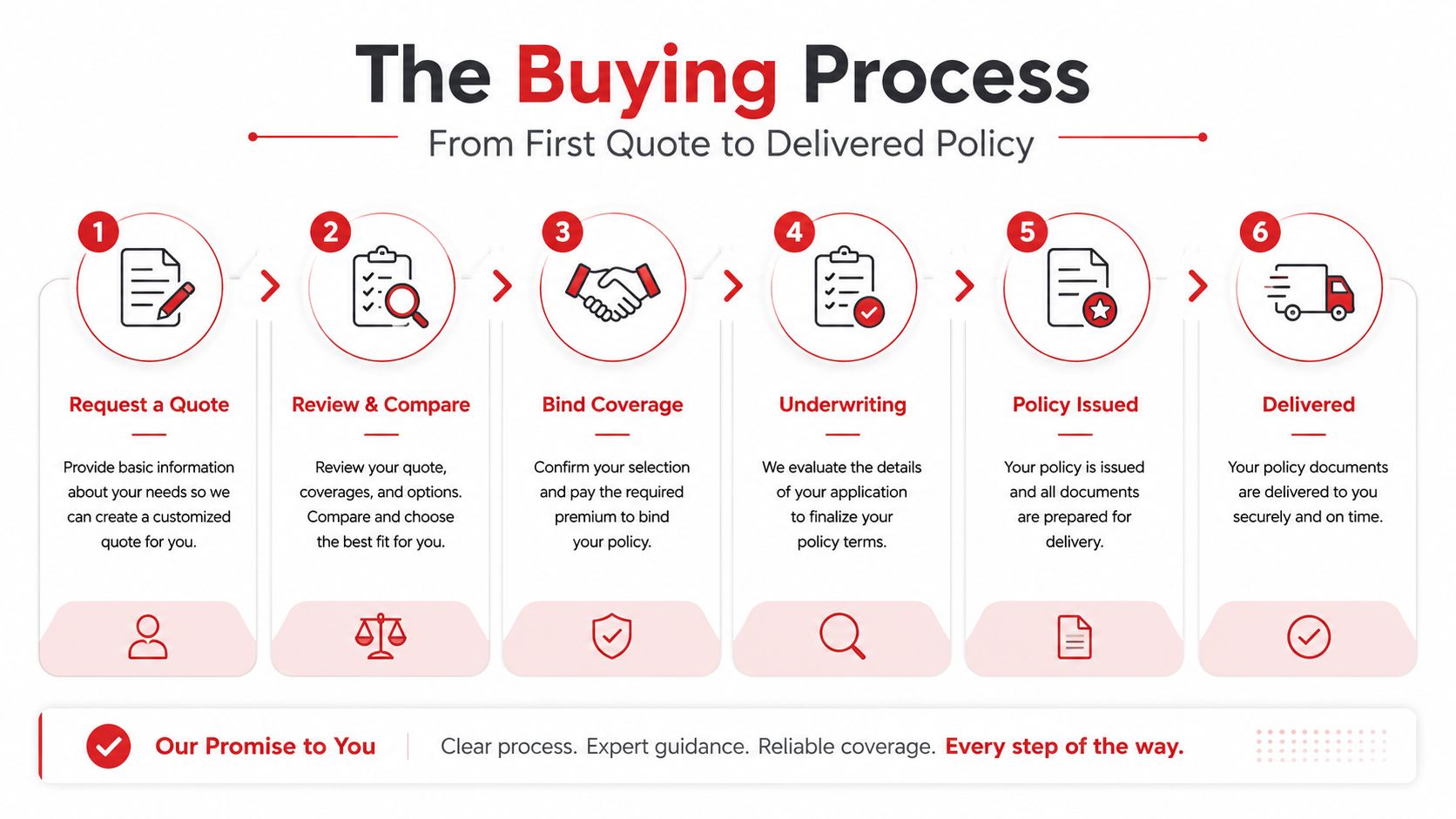
An independent agency can save time here because it can compare many carriers at once instead of sending you to one company's single menu. That's also where bilingual service matters for many Florida households, especially when one spouse is translating benefit language for the other. The internal guide at https://selectinsgrp.com/independent-insurance-agent-florida/ is a useful example of how an independent agent approach differs from going carrier by carrier on your own.
After the quote review, the carrier application starts. Some applicants are asked to complete a paramed exam, while others can qualify for a no-exam product depending on age, health, and coverage amount. Then underwriting begins. That's the part where the insurer checks the application, medical records if needed, and any other details required to make the offer. Once the policy is approved and issued, the buyer should review the beneficiary designation, premium schedule, and policy delivery documents before putting the file away.
The cleanest applications are usually the ones with the least surprise attached to them.
A Florida buyer should have a few documents ready before starting:
- Identification: A government ID for each proposed owner or insured.
- Beneficiary details: Full legal names, not nicknames.
- Medical basics: Doctor names, prescriptions, and recent diagnoses.
- Financial context: Mortgage, debts, and the coverage goal.
- Contact information: Current phone, email, and mailing address.
- Payment method: A way to set up premium payments without delay.
The smoother the file at the start, the fewer avoidable delays later. That matters whether you're buying a straightforward term policy or a more specialized no-exam option.
Insurable Interest, Senior Applicants, and How to Get Bilingual Quotes
Florida allows a person to insure their own life for the benefit of any beneficiary, but a third party needs an insurable interest that fits one of the state-recognized categories. Those categories include close family relationships, business partners, creditors, and key-person arrangements. That distinction sounds technical until you run into a blended family, an unmarried partner, or a small business that wants to protect the person who keeps the operation running. Then it becomes the whole issue.
For a blended family, the ownership and beneficiary structure should match the actual household relationship, not just the legal paperwork from years ago. For an unmarried partner, the insurable-interest question matters even more because assumptions can fall apart fast if the policy is structured carelessly. For a business owner, key-person coverage can be valid when the person insured is economically important to the business, but the details need to line up with Florida's accepted categories.
If the goal is to cover end-of-life costs for an older parent, families usually look at small-face-amount final-expense coverage, simplified issue, or guaranteed-issue products. For a clear consumer starting point on funeral-focused protection, insurance for end-of-life costs can be a helpful reference when you're comparing how that need is typically framed. The product choice matters more than the label. A senior applicant with a health history may do better with a graded-benefit policy than with a larger policy that's likely to be declined.
A few practical filters help seniors and higher-risk applicants avoid wasted time:
- Ask about final-expense first: If the need is burial or cremation, don't overshoot into a larger policy that adds cost without adding much value.
- Consider no-exam options carefully: They can be useful, but the benefit amount and price often reflect the limited underwriting.
- Check for graded benefits: Some policies limit full payout early on, so the timing matters.
- Keep premium payment simple: The best policy is the one that stays in force.
For readers who want help in Spanish as well as English, the internal page at https://selectinsgrp.com/bilingual-insurance-agent-florida/ is the right place to start, because language access matters when beneficiary choices, ownership rules, and senior products are being discussed. If you've made it this far, you already know the main decisions. Figure out the need, subtract the liquid assets, choose the right product, and make sure the ownership structure is legally clean.
If you want a straightforward Florida quote review from an independent agency that compares carriers, explains the trade-offs in plain English, and can help in English or Spanish, visit Select Insurance Group, Inc.. They work with Florida life insurance customers every day, and they can help you narrow the policy type, coverage amount, and application path without wasting time on the wrong fit.