
You're loading the Class A for snowbird season, checking the hitch on the travel trailer, or comparing quotes after a repair bill made you uneasy. In Florida, RV insurance isn't one clean category, it splits hard between motorized rigs and towables, and that split changes what you must buy, what's optional, and what pays after a storm. If you want the short version, the right policy here is less about ticking boxes and more about matching the rig, the storage plan, and the way you travel.
Table of Contents
- What Florida RV Insurance Really Covers
- Florida's Legal Split Between Motorized and Towable RVs
- How Much Florida RV Insurance Actually Costs
- Coverage Options Worth Knowing Inside and Out
- Hurricane, Wind, and Flood Risk in a Florida-Specific Way
- Part-Time Versus Full-Time RVer Coverage
- Discounts and Bundling Strategies That Actually Work in Florida
What Florida RV Insurance Really Covers
A retiree getting a Class A ready for snowbird season usually asks the same five questions first, what's required, what costs the most, what storms change, what saves money, and how fast can I get a real quote. In Florida, those answers are different enough from most states that generic RV advice falls apart fast.
| Question | Quick Answer |
|---|---|
| Florida's mandatory minimums | $10,000 PIP and $10,000 PDL for motorhomes, not towables, under Florida's motor-vehicle rules (Florida RV insurance legal split) |
| Typical cost spread | Florida RV premiums vary widely by class and use, from lower-cost towables to higher-cost motorhomes |
| Hurricane coverage trigger | The coverage that responds to storm damage is the part that matters, and timing matters before a named storm |
| Biggest money-saver | Comparing multiple carriers through an independent agency and matching coverage to actual use |
| Fastest way to get a real quote | Gather the VIN, garaging or storage address, usage pattern, and whether the rig is full-time or part-time |
A Florida RV policy is a contract built around three exposures, driving liability, physical damage, and the losses that show up when the rig is parked. That is why a motorhome, a fifth wheel, and a travel trailer do not belong in the same conversation, even if they all sit in the same campground.
Practical rule: if the unit has its own engine, Florida treats it like a motor vehicle first and an RV second. If it is towable, the towing vehicle carries the road liability while the trailer's own physical damage usually needs separate protection.
That is the part most buyers miss. They shop for “RV insurance Florida,” but what they really need is a policy built around whether the rig moves under its own power, where it sits in hurricane season, and whether it is used as a weekend toy or a home.
One more Florida-specific point. Storm timing matters. If a named storm is already on the board, do not expect to add storm protection and assume it will answer for that event. Get the policy in place before the weather turns, then make sure the storage address and usage details are correct so the carrier does not have a reason to narrow the claim later.
Florida's Legal Split Between Motorized and Towable RVs
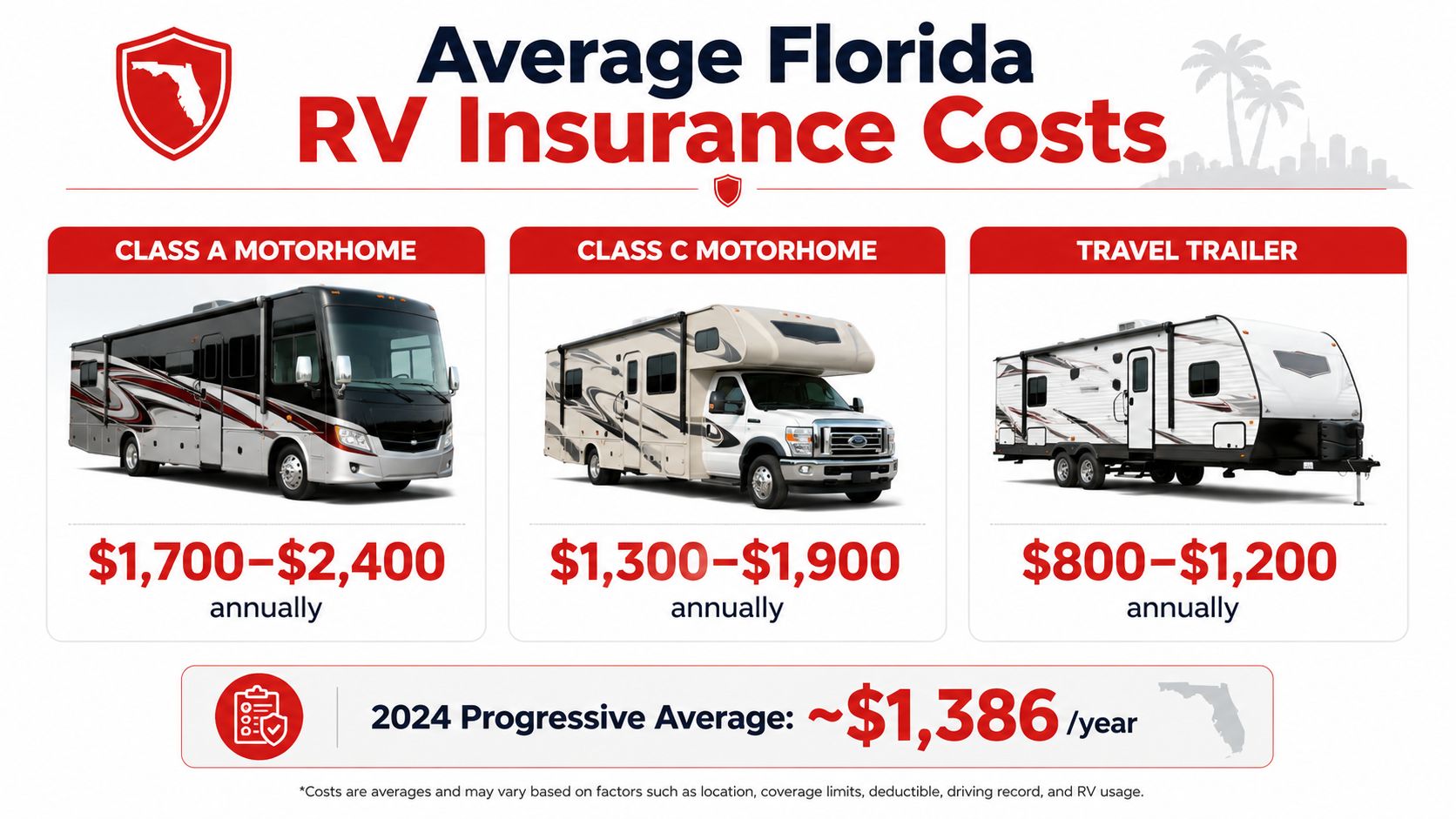
Florida draws a hard line between a rig that moves under its own power and one that depends on another vehicle. That split matters more than the badge on the side panel. A motorhome carries its own road risk. A towable unit depends on the tow vehicle while it is connected, then stands on its own once it is unhitched.
Motorhomes follow Florida auto-style minimums
Class A, Class B, and Class C coaches fall under Florida's motor-vehicle rules for the road. The state minimums are $10,000 in Personal Injury Protection (PIP) and $10,000 in Property Damage Liability (PDL). That is the legal floor, not a level I would call acceptable for anyone with meaningful assets or a high-value rig.
Florida treats motorhomes this way because they can hurt people and damage property under their own power. If you leave a coach underinsured, you are not just taking a coverage shortcut. You are setting yourself up for a compliance problem and a claim problem at the same time. For a motorized RV, start with the required minimums, then build well above them.
Towables are different
Travel trailers, fifth wheels, and similar towables usually do not need their own state-required RV liability policy when they are owned outright. That does not mean they are safely covered. It only means Florida does not force the same separate insurance structure that it applies to a motorhome.
If the trailer is financed, the lender often changes the picture. The lender usually wants protection on the collateral, even when the state does not require a separate policy.
The cleanest way to think about it is this. The tow vehicle handles the road liability while the trailer is attached, but the trailer's own physical damage is a separate issue when it is parked, stored, or sitting in a campground. That is where owners get caught. They assume the truck policy follows the trailer everywhere, then find out too late that it does not pay for the trailer itself. Towable owners should check the trailer's own damage protection, not just the truck coverage, before hurricane season starts and before the rig goes into storage.
How Much Florida RV Insurance Actually Costs
Florida RV insurance prices move around because carriers are pricing a specialty risk, not a standard auto policy. The quote changes with the rig's value, repair costs, storage exposure, mileage, and whether the RV functions like a second home. Two Florida owners can buy very different policies and both can be priced correctly.
The published averages show a real spread
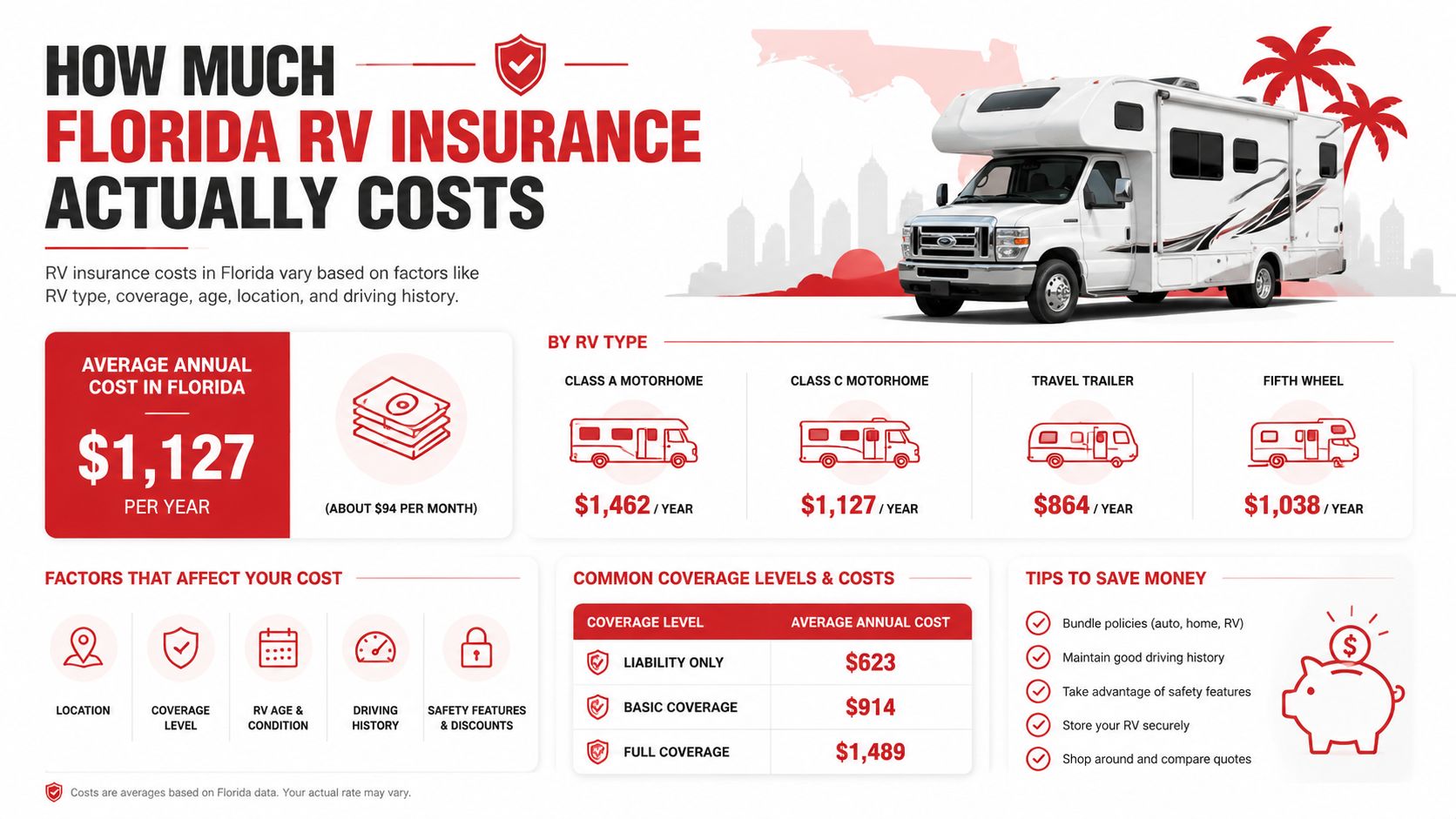
Market averages in Florida show a wide gap between motorized rigs and towables. Typical annual premiums often land around $900 to $3,800, depending on the rig and coverage level. Some market guidance places Class A motorhomes at $2,800 to $4,200, Class B motorhomes at $1,300 to $2,100, Class C motorhomes at $1,600 to $3,000, and travel trailers at $450 to $1,100 annually. For a general Florida benchmark, one published carrier summary reports average annual premiums of $1,386.04 for a motorhome and $841.16 for a travel trailer.
Those numbers point in the same direction. Smaller towables usually sit lower, and higher-value motorized rigs sit higher. That is the cost of replacing complex equipment, repairing larger bodies, and absorbing more road and weather exposure.
What pushes the quote up or down
Florida underwriters look at the rig, the owner, and how the RV lives between trips. Value, age, mileage, storage location, full-time versus part-time use, and the owner's driving record all matter.
- Higher-value rigs usually need more physical-damage protection.
- Full-time use changes the liability and personal-property picture.
- Secured storage usually looks better than an open driveway or exposed lot.
- Less annual use often supports a different pricing profile than constant travel.
The practical move is simple. Do not shop by monthly payment alone. Shop by the combination of coverage and usage, then use an independent agency like how to compare the best RV insurance companies to line up quotes across multiple carriers so you can see who prices your exact risk cleanly instead of selling you a stripped-down version.
Coverage Options Worth Knowing Inside and Out
A strong RV policy isn't one coverage. It's a stack of protections that answer different questions after a loss. If the rig hits another vehicle, that's liability. If a tree limb crushes the roof, that's physical damage. If a laptop, bike, or camera disappears from the cabin, that's a different part of the policy altogether.
The coverages that matter most
Liability pays for injuries or property damage you cause to others while driving or, in some cases, while the rig is parked under covered conditions. Collision pays when the RV hits something or is hit and the policy says the crash is covered. Full coverage handles non-collision losses like theft, fire, vandalism, wind, and similar risks, which is the part Florida owners need to understand before hurricane season.
Uninsured motorist helps when another driver causes damage and lacks enough coverage. Medical payments can help with certain medical costs after an accident. Personal effects covers items inside the RV, while vacation liability helps when the rig is parked and functioning like a campsite residence. Roadside assistance is worth attention because an RV breakdown is not a normal passenger-car tow.
Agreed value versus actual cash value
This is the part that separates a decent policy from a bad one. Agreed value means the insurer and owner settle on a pre-set amount, which protects you from the worst of depreciation. Actual cash value means the insurer pays what the rig was worth right before the loss, depreciation included.
That difference matters most for newer or higher-value motorhomes. A total loss under actual cash value can leave you short when you're trying to replace a rig in a hurry, especially after a storm or fire. If the policy language gives you the option, I'd push hard for the valuation method that reduces the gap between payout and replacement cost.
Bottom line: don't buy a quote until you know exactly which parts pay for driving losses, campsite losses, and the belongings you leave inside the coach.
For a deeper checklist of what to compare line by line, this RV coverage guide from Select Insurance Group is a useful place to sanity-check the structure of a quote before you bind it.
Hurricane, Wind, and Flood Risk in a Florida-Specific Way
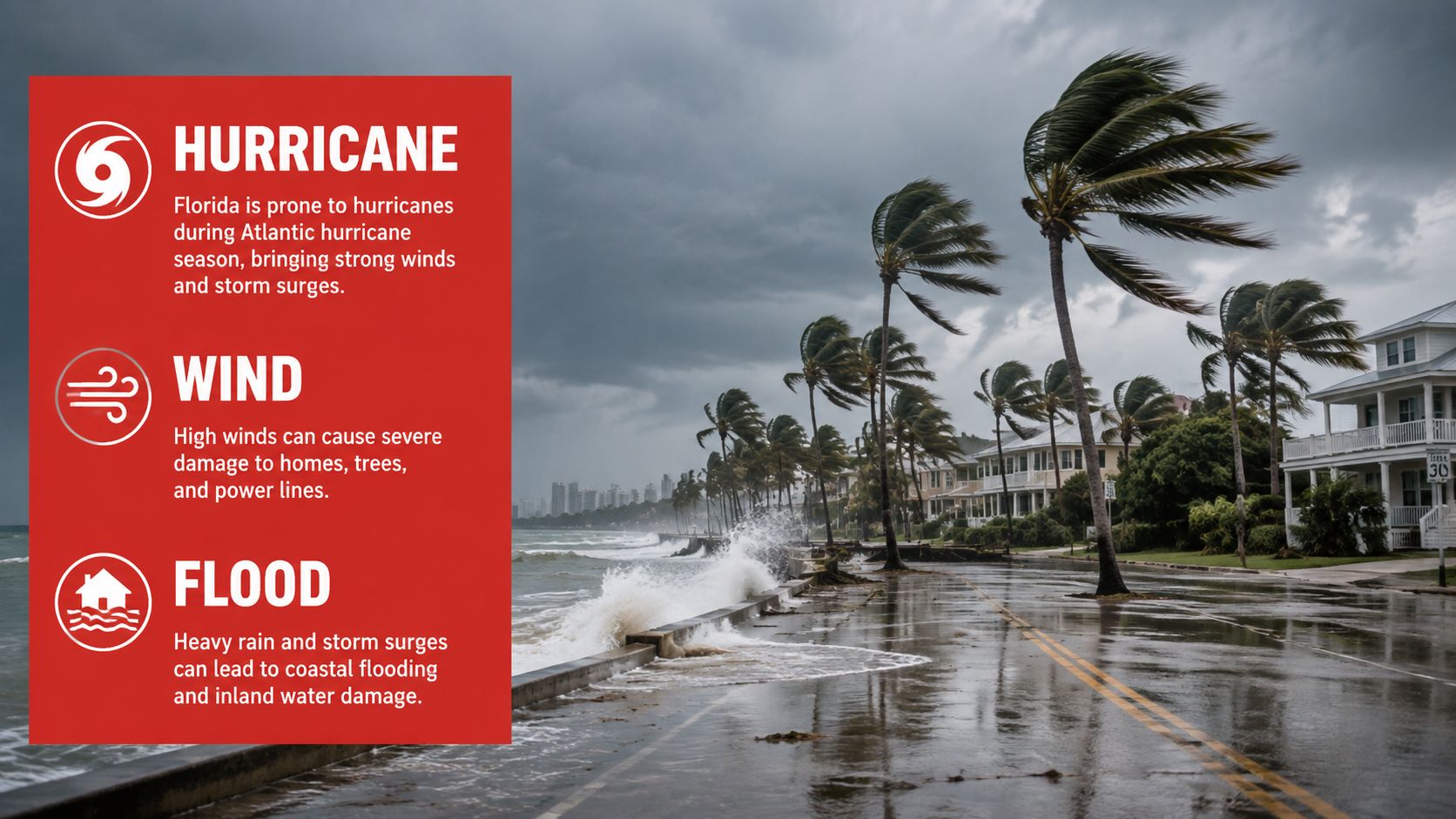
Florida RV owners face a question the rest of the country rarely has to answer. What happens when a named storm arrives and the rig is sitting still? The answer turns on three things, the storage location, the policy language that handles storm damage, and whether the insurer treats the loss as wind, flood, or total loss.
Storm damage coverage is the part owners ignore
The coverage that handles non-collision losses is the part that responds to hurricane damage, and it needs to be in force before a storm is named if you expect a claim to be paid. That timing rule is where owners get burned. Waiting until the forecast looks bad usually means the carrier has already locked the door.
Storage matters just as much. A rig in a secured facility sits in a different risk bucket than one left in an open lot or exposed driveway. Wind, debris, and theft exposure change with where the RV sits, so the garaging address should match the way you store it during storm season.
Flood is a separate problem
A standard RV policy usually does not handle rising-water losses by itself. If you live near the coast, in a low-lying neighborhood, or anywhere that floods after heavy rain, you need separate flood protection. Review a dedicated flood option through this flood insurance resource from Select Insurance Group if your storage spot or travel pattern puts you in that zone.
Practical rule: wind and falling debris fall under storm damage coverage, while rising water requires separate flood protection. Keep them apart, because insurers do.
The payout method matters after a total loss too. Actual cash value can leave you short when you try to replace a rig in Florida after a storm. Owners who keep an expensive coach in the state should press for agreed-value coverage, especially if the RV is part of a long-term travel plan.
If you are still deciding whether a rig should be parked in a lot, on private land, or somewhere that can handle full-time use, find RV-friendly land at Dollar Land Store and compare that setup against your insurance needs before hurricane season hardens your storage choice.
Part-Time Versus Full-Time RVer Coverage
A weekend camper and a full-time snowbird are not buying the same insurance problem. The first is covering a recreational asset. The second is replacing pieces of homeowner-style protection inside a vehicle that also has road exposure.
Part-time use keeps the policy simpler
If you use the RV for trips, vacations, and seasonal travel, and you keep a permanent home elsewhere, a standard recreational RV policy usually fits. That setup focuses on the rig itself, the driving risk, and the belongings you carry for travel.
The carrier will ask how often you use it, where it's garaged, whether anyone lives in it full time, and whether you've added the usual extras like roadside help or personal effects. Answer those questions cleanly. If you understate use, you can end up with the wrong rating basis and the wrong coverage fit.
Full-time use changes the job of the policy
Full-timers need a different structure. Most carriers treat full-time RV use as living in the rig as a primary residence for more than six months a year, which is when a full-timer endorsement becomes the right conversation. That endorsement adds more homeowners-style protection for personal liability, personal property, and loss assessment.
If you're shopping land for full-time RV living, a practical starting point is find RV-friendly land at Dollar Land Store, then make sure the insurance follows how you'll live there.
Don't buy a recreational policy and hope it behaves like a residence policy. If the RV is your home, the insurance needs to admit that.
Full-timers also need to ask about pets, attached accessories, and detached items like awnings or satellite dishes. Those details sound minor until a storm, campsite incident, or theft claim forces a coverage review. If your coach is your address, your policy has to cover more than the engine and the body panels.
For snowbirds trying to pin this down, this Florida full-coverage RV resource is a helpful reference point before you quote the policy structure.
Discounts and Bundling Strategies That Actually Work in Florida
Most discount advice is noise. The best savings come from matching your profile to carriers that price Florida RV risk well, then stacking the discounts that fit your behavior instead of chasing every gimmick in the quote screen.
Start with the discounts that insurers really use
Ask for multi-policy bundling if you already insure a car or home. Ask about an RV safety course discount if you've completed one. Ask for paid-in-full, paperless, low-mileage, seasonal-use, and storage discounts if those descriptions fit your pattern.
Storage discounts matter more in Florida than in a lot of states because where the rig sits during storm season changes how carriers read the risk. A secured facility usually looks better than a driveway, and a clearly defined off-season storage pattern is easier for an insurer to rate than vague “we use it sometimes” language.
Why an independent agency can actually lower the premium
An independent agency can quote the RV, the auto, and the home across 20 to 40 carriers at once, which gives you a real comparison instead of a single-company sales pitch. That matters because the cheapest RV quote isn't always the cheapest overall package once the auto and home lines are considered together. In Florida, the bundle has to be optimized across carriers, not just within one.
That's where an agency like Select Insurance Group, Inc. can be useful, because it places RV coverage alongside other lines and compares multiple carriers instead of forcing one menu.
Ask for the quote by discount name. Don't say you want it “as low as possible.” Say you want bundling, safety course, paid-in-full, paperless, low-mileage, seasonal-use, and secured-storage pricing checked one by one.
Loyalty isn't a strategy by itself. If your carrier hasn't changed the structure of the quote in years, you're probably paying for habit, not value. Shop the policy, not the logo, and make them prove the price works for Florida RV exposure.
If you want a straight answer on your own rig, Select Insurance Group, Inc. can compare Florida RV options, check the motorized or towable rules, and quote the coverage that fits how you use the coach. Get a free quote, make the storm-season decisions now, and stop guessing about what's required versus what's optional.