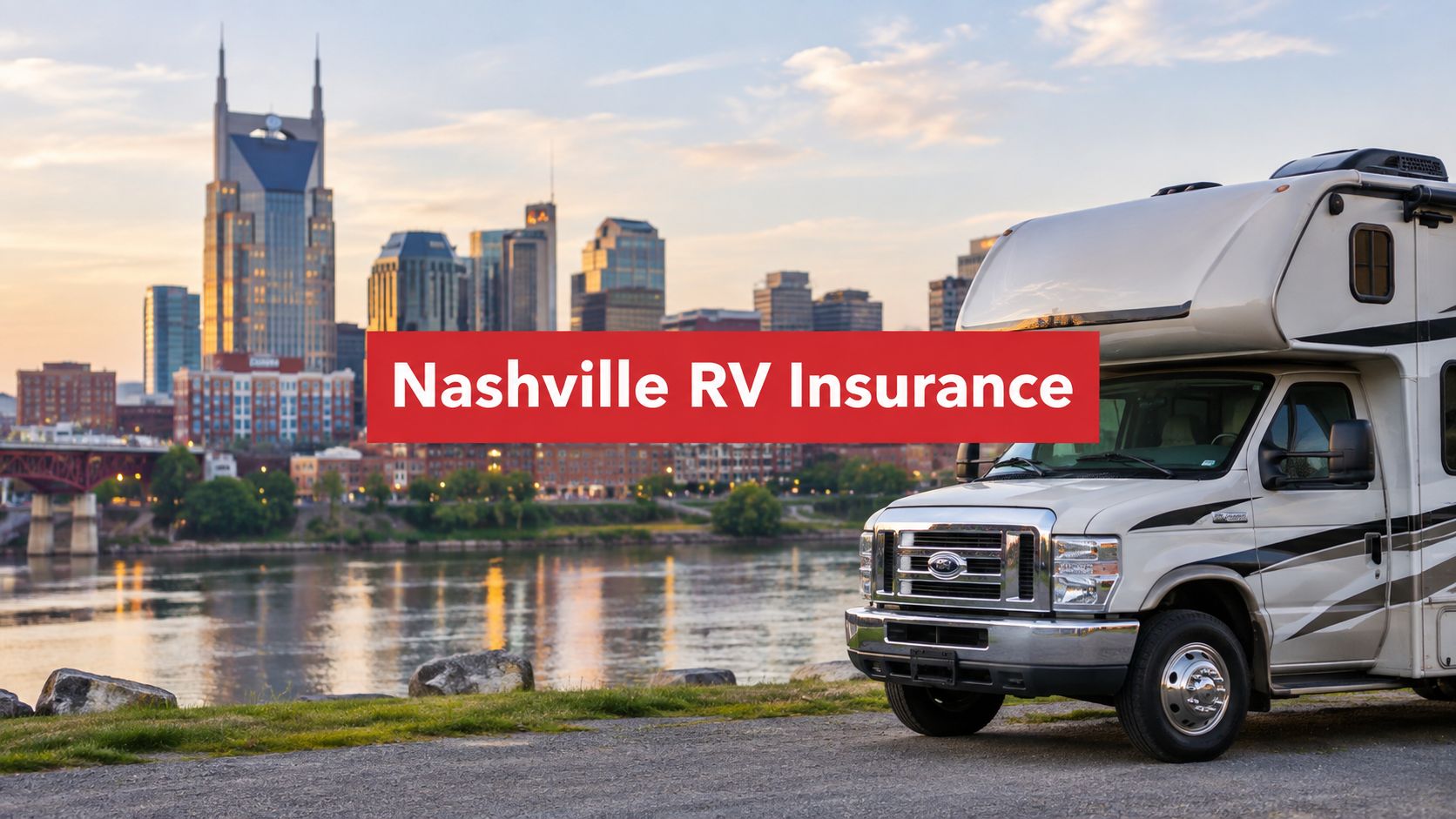

You're checking the weather before a weekend trip from Nashville, loading chairs and camping gear into the RV, and wondering whether the policy you already have will handle a collision, a hailstorm, or damage to the trailer sitting in storage. That uncertainty is common because an RV combines two exposures: it's a vehicle on the road and, at times, a temporary home at a campground or lake.
Nashville recreational vehicle insurance becomes easier to understand once you separate those risks. A motorhome needs auto-style liability because it drives itself. A travel trailer needs protection for its own physical damage, while liability usually follows the vehicle towing it. Your valuation method, storage routine, belongings, and travel pattern then determine whether a claim settlement matches the true cost of replacing what you own.
Nashville owners may use an RV for short trips to Percy Priest Lake, visits across Middle Tennessee, or longer journeys beyond the state. Each pattern changes the questions you should ask. A full-timer needs a different liability conversation from a family that stores its camper for much of the year, and a high-value motorhome needs more careful valuation than a basic utility trailer.
Weather and storage matter, too. Parked RVs can face hail, wind, theft, vandalism, and glass damage even when nobody is driving them. Owners preparing for colder conditions can also benefit from SwiftJet's freeze protection guide, especially when winterizing plumbing and protecting equipment from freezing temperatures.
Table of Contents
- Introduction to Nashville RV Life and Why Insurance Matters
- Tennessee Requirements and How They Apply in Nashville
- Understanding RV Policy Types and Key Endorsements
- What Determines Your RV Insurance Cost in Nashville
- Smart Ways to Lower Your Premium Without Losing Protection
- How to Get a Quote and Compare Carriers Step by Step
- Your Next Steps to Confident RV Coverage in Nashville
Introduction to Nashville RV Life and Why Insurance Matters
A motorhome parked at home can still face road-related risks. A travel trailer in a storage lot remains a valuable physical asset. Treating either one like a larger car can leave coverage gaps.
The clearest comparison is a home on wheels. The “wheels” side covers driving, collisions, liability, and roadside breakdowns. The “home” side covers belongings, attached equipment, temporary living arrangements, and damage from weather or theft while parked.
Practical rule: Identify the RV's class and use pattern before requesting a premium quote. Those details determine what needs protection.
National ownership shows why RV coverage is its own specialty. Industry sources cited in market reports place U.S. RV-owning households at more than 11 million. Estimates put the U.S. RV insurance market at roughly $9.72 billion in 2023, according to U.S. RV insurance market size data. The figure does not set your Nashville premium, but it helps explain why insurers separate motorhomes, travel trailers, fifth wheels, and campers into distinct coverage categories.
Nashville operates within Tennessee's broader vehicle-insurance system. National Association of Insurance Commissioners data referenced by Tennessee vehicle-registration resources shows Tennessee direct premium written for automobile insurance rising from $36,337 million in 2014 to $61,993 million in 2024, an increase of about 70.6%. That larger system gives insurers experience assessing drivers, vehicle use, storage routines, and claims.
Your motorhome and a towable trailer create different starting points. A motorhome needs liability protection because it drives itself. A trailer's liability generally connects to the towing vehicle, while the trailer's own physical damage needs separate attention. Valuation method and seasonal use can then change the claim result. Replacement-cost treatment, actual-cash-value settlement, deductibles, contents limits, and storage terms should match how you use and maintain the RV.
The goal is a policy that fits the RV, not every available endorsement. Before choosing, confirm what happens during storage, travel, and a covered loss.
Tennessee Requirements and How They Apply in Nashville
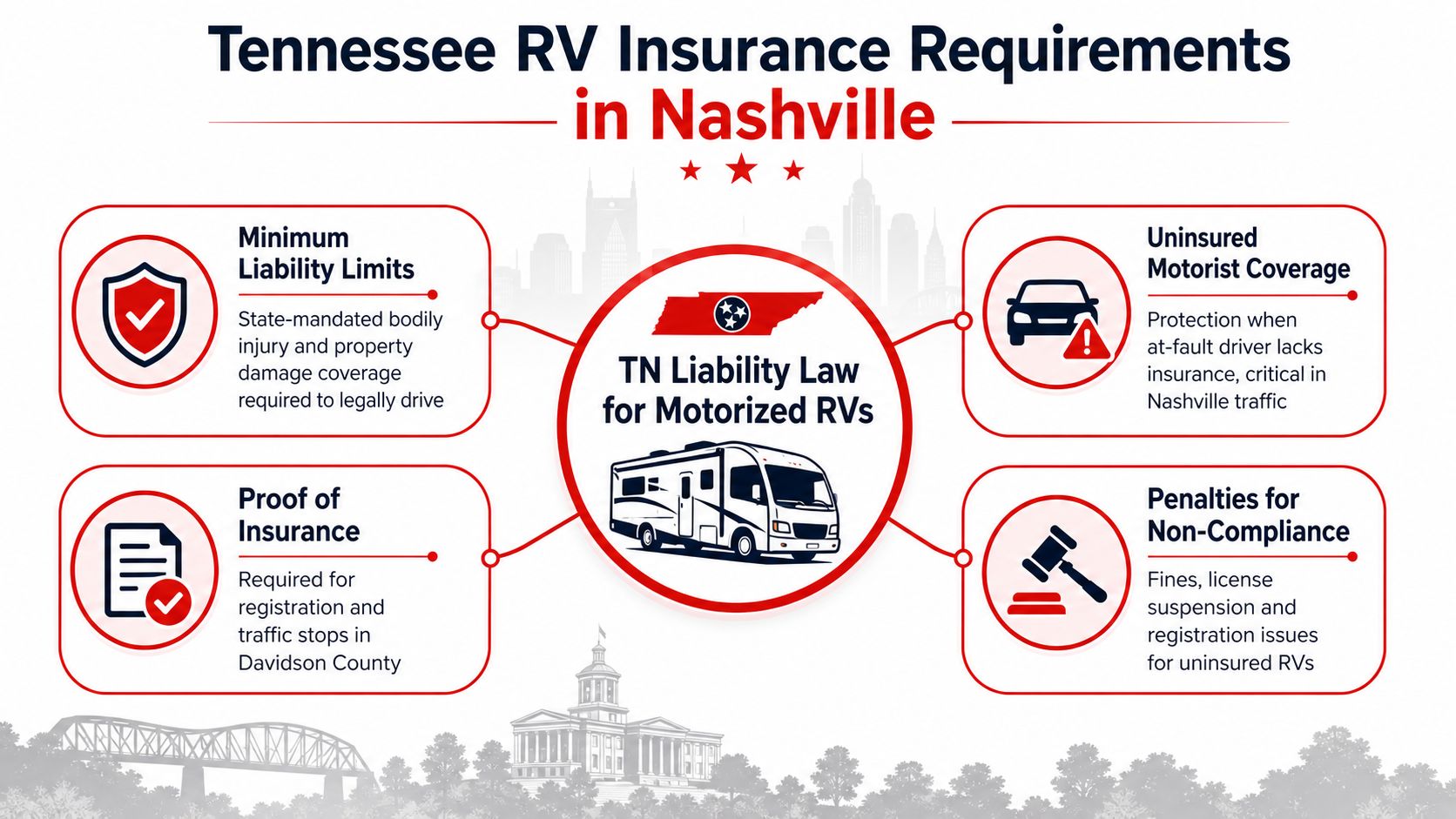
Tennessee's minimum liability framework is the starting point for motorized RVs used in Nashville and Davidson County. The required limits are:
- $25,000 for bodily injury to one person.
- $50,000 for bodily injury in one accident.
- $25,000 for property damage.
The Davidson County framework is summarized in the Nashville motor-vehicle insurance requirements. These are liability limits, meaning they address injuries or property damage you cause to other people. They don't automatically repair your motorhome or replace your belongings.
Motorhomes follow the vehicle-first model
A Class A, B, or C motorhome is self-propelled. Because it drives under its own power, its insurance structure generally begins with an auto-style policy. Liability protects you if the motorhome causes covered injury or property damage, while collision and other-than-collision address damage to the motorhome itself.
Uninsured and underinsured motorist coverage deserves careful attention. It can help when another driver causes a loss but has no insurance or insufficient limits, subject to the policy terms. Nashville traffic creates plenty of interaction with other vehicles, so don't treat this coverage as an administrative detail.
Proof of insurance also matters for registration and traffic stops. Tennessee maintains vehicle-registration information and active-registration resources through its vehicle title and registration services. Before driving, confirm that the motorhome is properly insured, registered, and documented.
Towable RVs create a different gap
A travel trailer, fifth wheel, or camper isn't self-propelled. While it's being towed, the towing vehicle's liability generally addresses damage you cause to others, but that doesn't mean the trailer itself is protected against every loss. The trailer needs its own physical-damage coverage for collision, theft, hail, wind, vandalism, and similar risks.
That distinction is easy to miss. If a trailer breaks loose and causes damage, liability questions may involve the towing vehicle and policy terms. If hail damages the trailer while it's parked, the towing vehicle's liability coverage won't repair the trailer. Owners looking for a Tennessee-specific starting point can review RV insurance options in Tennessee.
Understanding RV Policy Types and Key Endorsements
RV coverage works best as a set of layers rather than one oversized policy. The base structure depends on whether the unit has an engine, but the right endorsements depend on what happens inside and around it.
Motorhome and towable coverage are not interchangeable
A motorhome combines the vehicle and living space in one unit. Its policy usually needs liability for driving, physical-damage coverage for the motorhome, and options that address the equipment and contents carried inside.
A travel trailer or camper is different. The towing vehicle handles the driving exposure, while the trailer's policy should address damage to the trailer itself. This is why a buyer who says, “My truck is insured,” may still have an uncovered trailer loss.
The main physical-damage choices are straightforward:
- Collision helps address damage from an impact or rollover, subject to the deductible and policy terms.
- Other-Than-Collision addresses non-collision losses such as theft, hail, wind, vandalism, and certain glass damage.
- Liability addresses covered injury or property damage you cause to others.
- Roadside assistance can help with breakdown-related towing or emergency services, depending on the plan.
A Nashville hailstorm illustrates the difference. If your parked camper's roof is damaged, liability won't respond because you didn't injure another person or damage another person's property. Another applicable physical-damage coverage is the layer that matters.
Endorsements should follow your lifestyle
Vacation liability can be useful when you're parked and using the RV as a temporary residence. It addresses certain liability exposures around the campsite, such as an accident involving your living area, subject to exclusions and limits.
Personal effects coverage focuses on belongings inside the RV. Think cookware, outdoor equipment, clothing, electronics, and travel supplies. Don't assume every item has the same limit or that your homeowners policy automatically provides enough protection away from home.
Emergency expense coverage may help with lodging or transportation after a covered loss makes the RV unusable. Roadside assistance is most relevant when a mechanical problem interrupts travel. Full-timer coverage deserves special attention if the RV functions as your primary residence because ordinary vacation use and full-time living create different liability and contents needs.
What Determines Your RV Insurance Cost in Nashville
A motorhome and a towable trailer can sit in the same Nashville storage lot yet receive different quotes. The motorhome combines the RV and driving risk in one vehicle. A trailer's liability exposure often depends more on the tow vehicle, while its physical damage still depends on the trailer's value, equipment, and storage conditions. That distinction helps explain why two owners with similar-looking campers may pay different premiums.
The main pricing variables
| Cost Factor | How It Affects Your Premium |
|---|---|
| Vehicle class and value | Larger, newer, or more expensive RVs generally expose the insurer to greater repair or replacement costs. |
| Driving record | Violations, accidents, and claims history can affect how the insurer evaluates driving risk. |
| Usage and mileage | Frequent travel and longer trips create more road exposure than occasional recreational use. |
| Storage location | Secure, covered, or private storage may be viewed differently from open storage or street parking. |
| Deductible | A higher deductible can reduce premium, but you pay more after a covered loss. |
| Coverage limits | Higher liability, contents, and specialty limits usually increase the premium. |
| Valuation method | ACV, replacement, and agreed-value structures create different settlement expectations and pricing. |
A motorhome used for long trips may carry more driving exposure than a trailer used for occasional weekend travel. Seasonal use matters too. An RV stored through part of the year can still face theft, hail, wind, or vandalism while parked, even when it is not accumulating mileage.
Valuation determines what a total loss means
Actual cash value, or ACV, pays the unit's market value at the time of loss after depreciation. The settlement may reflect the model, floor plan, mileage, equipment, condition, and regional market. A unit purchased at a higher price can therefore settle for less after age, wear, and changing market conditions.
Replacement-cost or agreed-value structures may preserve more purchasing power by reducing or removing depreciation from the settlement calculation, depending on the policy. They may fit a newer motorhome or a heavily equipped camper, but the stated value and policy terms need careful review.
Nashville-area owners should pay attention to storage conditions in Middle Tennessee, where hail can damage a roof even while the RV is parked. Photograph the roof before storm season and retain those images with the policy records. This creates a clearer reference for the RV's condition if a covered loss occurs, without repeating the full document checklist used during quote comparisons.
For broader shopping context, readers comparing how location changes RV pricing can compare RV insurance rates Utah. That comparison is not a Nashville quote, but it shows why state, usage, vehicle type, and coverage design affect pricing.
The towing vehicle and RV should also fit together as one household transportation plan. Review Nashville auto insurance information when considering how the auto policy and RV policy coordinate, particularly for a towable trailer.
Smart Ways to Lower Your Premium Without Losing Protection
Lowering the premium doesn't mean removing the coverage most likely to matter. Start by identifying discounts and usage adjustments, then test deductible and limit changes against your ability to pay after a loss.
Look for savings that preserve the core policy
- Bundle policies: Ask whether combining RV coverage with auto or home insurance creates a multi-policy discount. Review the combined limits, because a lower total bill isn't useful if the RV remains underinsured.
- Protect your driving record: A clean history can support safer-risk pricing. If another household member drives the motorhome, their record may matter too.
- Ask about an approved safety course: Some insurers offer credits after a qualifying RV driver-safety course. Confirm eligibility before paying for a class.
- Use security equipment: Anti-theft devices, backup cameras, and other safety features may help with underwriting or discounts. Tell the insurer what's installed and keep documentation.
- Choose a higher deductible carefully: This can reduce the premium, but only choose an amount you could comfortably pay after a covered loss.
- Match the policy to seasonal use: If the RV spends part of the year stored, ask whether the policy can reflect its use without removing protection for parked theft, hail, wind, or vandalism.
Storage is not the same as no risk
An RV that isn't being driven can still be exposed. Severe convective storm losses in the United States exceeded $45 billion for a third straight year in 2025, according to RV insurance market trend information. That context makes parked-RV protection important, particularly for hail and wind exposure.
Seasonal adjustments should change the right parts of the policy. Reducing road-use assumptions may make sense when the unit is stored, but cutting liability coverage or personal-property limits can create a serious gap. Ask specifically how storage status affects liability, physical damage, contents, and emergency expenses.
Coverage check: Save on usage where the policy allows it. Don't remove the protection that responds while the RV is sitting unattended.
How to Get a Quote and Compare Carriers Step by Step
A quote becomes useful only when every insurer is pricing the same vehicle, limits, valuation method, and use pattern. Gather your information before you start so the comparison doesn't become a series of incomplete estimates.
Begin with the RV profile
Write down the year, make, model, vehicle class, identification details, purchase price, current loan information, and major upgrades. For a trailer, include the towing vehicle details separately. Note whether the RV is used for weekend travel, extended trips, full-time living, or occasional storage.
Prepare your driving history, expected mileage, primary storage address, regular destinations, and the names of household drivers. Be accurate about use. A policy written for occasional recreation may not fit full-time occupancy or commercial activity.
Compare the policy, not just the premium
Ask each agency or carrier to show the same categories:
- Liability limits for the motorized unit or towing arrangement.
- Uninsured and underinsured motorist options.
- Collision and other-than-collision deductibles.
- ACV, replacement, or agreed-value settlement method.
- Personal effects, attached equipment, and emergency expense limits.
- Vacation liability or full-timer coverage where appropriate.
- Roadside assistance and towing terms.
- Storage, seasonal-use, exclusions, and permissive-driver conditions.
A quote with a lower price may contain lower limits, a higher deductible, ACV instead of an agreed-value structure, or fewer endorsements. Put the declarations pages and coverage summaries side by side, then ask the agent to explain every difference.
Organize documents before binding
Purchase records, upgrade invoices, photos, appraisals, and equipment lists can support the insured value. Keep copies in a secure digital location and with your physical records. If the RV has custom improvements, identify them before the policy begins rather than trying to add them after a loss.
An independent agency can request options from multiple carriers and help translate differences. Select Insurance Group's RV insurance resources provide a starting point for reviewing policy features, carrier comparisons, and quote questions. Before binding, confirm the effective date, payment arrangement, required documents, and whether coverage applies during transit, storage, and campground use.
Your Next Steps to Confident RV Coverage in Nashville
A sound Nashville RV insurance decision follows a simple order.
First, identify the unit. A self-propelled motorhome needs its own auto-style liability structure. A towable trailer needs separate attention to physical damage because the towing vehicle's liability doesn't automatically repair the trailer.
Next, choose the settlement approach. ACV can leave you absorbing depreciation, while replacement or agreed-value options may offer stronger protection when the policy terms and documentation support them. Then set liability, contents, roadside, vacation, emergency-expense, and full-timer options according to how you use the RV.
Before accepting a quote, ask:
- Is the vehicle correctly classified?
- Are liability and uninsured motorist limits sufficient for your situation?
- Does coverage apply while the RV is stored?
- Are hail, wind, theft, vandalism, and glass losses addressed?
- How are total losses valued?
- Are upgrades, accessories, and personal belongings listed adequately?
- Does seasonal use change any limits or exclusions?
- Can the deductible be paid comfortably after a claim?
Tennessee consumers also benefit from reviewing claims documents carefully. The state reported more than $7.9 million returned to Tennesseans so far in 2025, a figure cited in the same industry context as coverage disputes and claims activity (RV insurance market trends). Keep your policy, photos, receipts, and claim communications organized so you can explain the loss and the RV's condition clearly.
Request a free, no-obligation comparison before your next trip or storage period. A conversation with an independent agent can help you test coverage differences rather than choosing based on a single premium.
Select Insurance Group, Inc. can compare RV coverage options for Nashville motorhomes, travel trailers, fifth wheels, and related roadside needs. Visit Select Insurance Group, Inc. to request a free, no-obligation quote and discuss valuation, seasonal use, liability, and physical-damage protection with a bilingual specialist.