
A Memphis homeowner can do everything right, pay the mortgage on time, maintain the roof, and still discover a serious coverage gap after a heavy storm. A family near the Wolf River or another low-lying area may see water collecting around the property, while a neighbor in a different ZIP code receives a very different renewal price. The reason is simple but easy to miss: Memphis home insurance is shaped by address-specific flood exposure, rebuilding costs, weather risk, and policy details, not just the age or appearance of the house.
A useful policy should protect the structure, belongings, finances, and daily life of the people who live there. It should also make clear what requires separate protection, especially flood damage and certain forms of sewer or drain backup. For additional roofing and home-maintenance context, homeowners can browse homeowners insurance tag for practical guidance related to property protection.
This guide explains the major coverage parts, the reasons Memphis premiums vary, the difference between standard insurance and flood protection, optional endorsements, quote comparison, savings decisions, and the claims process. Use the checklists as you review your current policy or request a new quote, and consider a local comparison agency when you want help matching coverage rather than chasing the lowest price.
Table of Contents
- Introduction to Memphis Home Insurance Essentials
- What Memphis Home Insurance Covers and What It Excludes
- How Much Memphis Home Insurance Costs and Why Prices Vary
- Flood and Sewer Backup Risks Every Memphis Homeowner Should Understand
- Optional Endorsements and Add Ons Worth Considering in Memphis
- How to Compare Quotes and Lower Your Premium in Memphis
- Filing a Claim and Choosing the Right Local Agent in Memphis
Introduction to Memphis Home Insurance Essentials
A Shelby County family might start with a routine question: “How much should we budget for home insurance?” Then the details emerge. Their property may sit near a floodplain, the roof may be older than expected, and the mortgage company may ask for separate flood coverage. A standard online estimate can miss those distinctions because insurers evaluate the individual property, not merely the city name.
Memphis has a meaningful flood exposure that deserves attention before a homeowner compares premiums. One recent flood-risk report estimates that 21,332 Memphis properties could face flooding over the next 30 years, representing 9% of properties in the city. The same report places Shelby County in the Top 5% of counties nationally for flood exposure, with a directional annual NFIP premium of about $2,198 and an estimated average historical flood claim of $80,028. These figures come from Memphis homeowners insurance and flood-risk pricing information.
Those numbers don't mean every Memphis household will pay the same amount or experience a flood. They do show why a generic state average can be a poor planning tool. Standard homeowners insurance typically excludes flood damage, so a household may need both a home policy and separate flood protection.
What this guide helps you decide
You'll learn how to:
- Separate core coverage from exclusions: Understand what protects the house, belongings, liability, and living arrangements.
- Read local pricing correctly: Compare annual premiums, monthly costs, deductibles, dwelling limits, and endorsements on equal terms.
- Assess water exposure: Look beyond a simple flood-zone label and consider drainage, nearby waterways, basements, and sewer backup.
- Shop with purpose: Ask each insurer the same questions before accepting a lower quote.
- Prepare for a claim: Document damage, prevent further loss, and communicate clearly with the adjuster.
The goal isn't to make every policy identical. The goal is to help you see which differences matter before a storm, plumbing failure, or flood turns a small coverage misunderstanding into a large financial problem.
What Memphis Home Insurance Covers and What It Excludes
Think of a homeowners policy as a set of protective layers around the household. The first layer is the dwelling, which covers the insured structure when a covered cause of loss damages the roof, walls, foundation, or built-in systems. The next layer includes other structures, such as a detached garage, shed, or fence, subject to the policy's terms and limits.
A third layer protects personal property, including furniture, clothing, appliances, and electronics. The policy may pay based on replacement cost or actual cash value. Replacement cost generally focuses on what it takes to replace an item with a comparable new item, while actual cash value accounts for depreciation. That distinction can change the amount you receive after a claim.
The people layer
Home insurance also protects the household from financial responsibility in certain liability situations. If a visitor suffers an injury and the homeowner is legally responsible, liability coverage may help with covered damages and defense costs. Loss of use, sometimes called additional living expenses, can help pay eligible extra living costs if a covered loss makes the home uninhabitable.
Your deductible is the amount you pay before the insurer contributes to a covered claim. A higher deductible may reduce the premium, but only choose one you could comfortably pay after a major storm or property loss.
The exclusion that surprises Memphis homeowners
Standard homeowners policies don't cover flood damage. That exclusion applies to water entering from river overflow, flash flooding, or other conditions that meet the policy's definition of flood. A policy can cover certain sudden plumbing leaks or storm-related damage while excluding flood water, so the source and cause matter.
Sewer backup is another area that needs careful reading. A drain or sump backup may require a specific endorsement, and the available protection can have its own limit, deductible, and exclusions. Homeowners researching water-loss decisions may also find context in this guide to filing a water damage claim in Florida, although Memphis policyholders still need to follow their own policy wording and local claims process.
Core concept: Your home policy protects against covered causes of loss. It isn't a universal water-damage policy, and flood protection usually must be purchased separately.
How Much Memphis Home Insurance Costs and Why Prices Vary
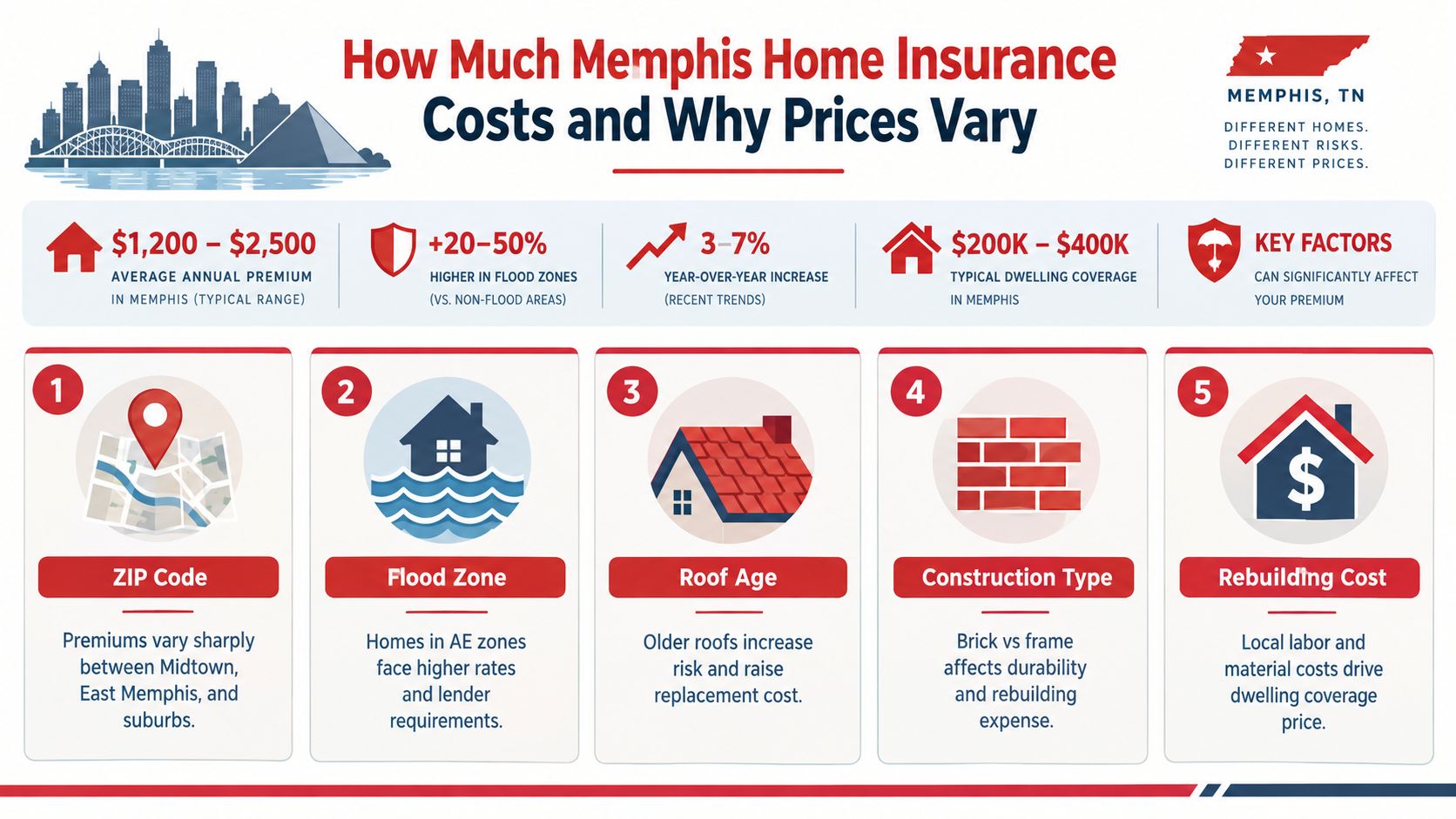
Memphis premiums vary because insurers price the property's expected exposure and the cost of repairing or rebuilding it. Market summaries place average annual homeowners premiums in Memphis around $2,197 to $3,931, depending on coverage assumptions, according to local Memphis home insurance cost estimates. Another analysis puts the city average near $298 per month, compared with about $254 per month statewide, while a separate city comparison places Memphis near $2,197 per year, roughly 5% above the Tennessee average in that dataset. These aren't interchangeable quotes. They reflect different assumptions, policy limits, and rating methods.
ZIP code can also change the result. One Memphis comparison identifies 38118 as the city's most expensive ZIP code, with an average annual premium of $2,488 in that analysis, as reported in Memphis homeowners insurance pricing by ZIP code.
What creates the spread
Two nearby homes can receive different prices because of:
- Flood-zone status: A property in a higher-risk mapped zone may require separate flood insurance and face a different total insurance budget.
- Roof age and condition: Older roofing can increase expected repair costs or affect eligibility and settlement terms.
- Construction type: Brick, frame, masonry details, and other building characteristics influence durability and rebuilding assumptions.
- Rebuilding cost: The dwelling limit should reflect the cost to rebuild, not just the home's market value.
- Deductible structure: A lower premium may come with a higher out-of-pocket amount or special storm deductible.
- Claims and property history: Insurers may evaluate prior losses associated with the household or property.
A monthly figure is convenient for budgeting, but an annual premium makes carrier comparisons easier. Always ask what the quote includes, then compare the dwelling limit, personal-property basis, liability limit, deductible, exclusions, and endorsements.
Read the quote, not just the price
A low quote may reflect less dwelling coverage, actual cash value settlement for certain property, a larger deductible, or no sewer backup protection. A higher quote may include broader terms or limits that better fit the home. If you want to review available Tennessee coverage options, see Tennessee home insurance and use the same coverage assumptions when requesting comparisons.
Flood and Sewer Backup Risks Every Memphis Homeowner Should Understand
Flood risk is often the most important local question because it can affect both the need for coverage and the total annual budget. Memphis sits within a region influenced by the Mississippi River, the Wolf River, drainage systems, and heavy rainfall. Shelby County's flood exposure means a property's location can matter more than small differences in cosmetic condition when insurers and lenders evaluate risk.
A FEMA flood-zone designation helps identify mapped exposure, but it doesn't tell the whole story. Homes in AE or A zones often face lender-required flood coverage when a federally backed mortgage is involved. A property outside those zones may still experience water damage from intense rainfall, surface drainage, or nearby drainage channels.
Standard coverage compared with flood protection
| Situation | Standard homeowners policy | Separate flood policy | Possible sewer backup endorsement |
|---|---|---|---|
| Wind damages shingles | May apply, subject to terms | Usually not the purpose of flood coverage | Not usually relevant |
| River overflow enters the home | Typically excluded | Designed for covered flood loss | Not a substitute |
| Flash flooding damages contents | Typically excluded | May provide applicable contents protection | Not a substitute |
| Drain or sewer backs up | May require an endorsement | Generally not the main solution | May apply, subject to limits |
| Water enters after a covered plumbing failure | May apply, subject to cause and exclusions | Usually not the main solution | Depends on the endorsement |
The distinction matters because standard policies exclude flood everywhere, not only in mapped high-risk zones. Independent coverage explanations note that roughly 25% of NFIP claims come from moderate- or low-risk zones, according to Memphis flood and homeowners insurance guidance. A zone map should inform your decision, not end it.
Assess the address, not only the neighborhood
Ask for an address-specific flood determination and discuss drainage history, basement or crawl-space exposure, nearby waterways, and prior water losses. Sewer lines and older neighborhood infrastructure can create separate concerns, so homeowners may benefit from reviewing information about common sewer problems in Memphis.
A home doesn't need to sit in a visibly flooded area for water coverage to deserve a closer look.
A small change in location can alter mapped risk, lender requirements, and flood pricing. One directional report estimates standard NFIP premiums in Memphis around $1,985 to $2,198 annually, while another gives an estimate near $1,128 in a less exposed ZIP code. The same reporting cites historical Shelby County flood claims around $58,292 to $80,028, reinforcing why homeowners should evaluate both probability and potential severity. See Memphis flood-risk pricing by location for that location-specific context.
Optional Endorsements and Add Ons Worth Considering in Memphis
Endorsements let you adapt a standard policy to the home's actual weak points. They don't all solve the same problem. Flood insurance addresses a different category of water loss than sewer backup coverage, while ordinance or law protection responds to rebuilding requirements that may not have existed when an older home was constructed.
Use the table as a conversation starter, then ask which options are available for the property and whether each has a separate limit or deductible.
Memphis Home Insurance Endorsements at a Glance
| Endorsement | What It Adds | Best For in Memphis |
|---|---|---|
| Separate flood insurance | Protection for qualifying flood damage excluded from standard home insurance | Homes near mapped flood areas, waterways, low-lying land, or properties with broader water exposure concerns |
| Sewer or drain backup | Coverage for eligible water backup through drains, sewers, or sump systems | Homes with basements, finished lower levels, aging drainage connections, or valuable belongings stored below grade |
| Replacement cost on contents | A stronger basis for replacing eligible personal property than depreciated settlement | Households with furniture, appliances, electronics, and clothing that would cost more to replace than their current value |
| Ordinance or law | Helps address increased rebuilding costs caused by current building codes | Older Memphis homes that may need electrical, plumbing, roof, or structural updates after a covered loss |
| Scheduled valuable items | Separate protection and clearer valuation for selected high-value belongings | Owners of jewelry, collectibles, art, instruments, or other items with standard sublimits |
| Increased dwelling or extended rebuilding protection | Adds room when rebuilding costs exceed the initial estimate, subject to policy terms | Homes with specialized finishes, detached features, or difficult reconstruction conditions |
Match protection to the property
Start with the home's physical profile. A finished basement raises different concerns from a slab foundation. An older house may need ordinance or law protection, while a newer property may place more emphasis on contents and liability limits. Proximity to the Wolf River or Mississippi River floodplains can justify a separate flood discussion even when the standard policy appears affordable.
Don't assume a sewer endorsement replaces flood insurance. The cause of water entry determines which policy may respond, and some endorsements have strict definitions. Ask for examples in writing, such as whether groundwater, surface water, sump overflow, or a backed-up municipal line is covered.
How to Compare Quotes and Lower Your Premium in Memphis
Shopping works best when every insurer receives the same information. Otherwise, the cheapest quote may provide less protection. Build a one-page comparison sheet before you request prices.

The like-for-like checklist
- Confirm the dwelling amount. Ask how the insurer calculated the rebuild limit and whether special features, detached structures, and local labor costs are included.
- Compare deductibles. Check the ordinary deductible and any separate wind, hail, or named-storm provisions. A lower annual price can shift more cost to you after a loss.
- List every endorsement. Put flood, sewer backup, contents replacement cost, ordinance or law, and valuable-items protection in separate columns.
- Match liability and contents limits. A quote with lower personal-property or liability protection isn't equivalent to one with broader limits.
- Request the same discounts. Ask each carrier about bundling, protective devices, roof updates, claims history, and payment options.
For a structured comparison across multiple carriers, homeowners can review 40 carrier insurance quotes. Select Insurance Group, Inc. states that it compares instant quotes from 20 to 40 carriers, according to the publisher information provided for this guide. That can reduce the work of contacting companies individually, but you should still verify that the quotes use matching limits and deductibles.
Reduce cost without stripping protection
A newer roof may improve insurability and may qualify for a discount, but replace roofing based on condition and professional advice, not solely for a promised premium reduction. Security systems and monitored alarms may also affect pricing where an insurer offers a qualifying credit. Bundling home and auto policies can simplify billing and may reduce the combined cost.
A higher deductible can lower the premium, but it turns a larger share of a covered loss into your responsibility. Keep enough emergency savings for that amount, and don't remove flood or sewer protection to make the monthly figure look smaller.
Comparison rule: The right quote is the one you can compare accurately and afford to use after a loss.
Filing a Claim and Choosing the Right Local Agent in Memphis
Water and storm claims feel chaotic because the homeowner is dealing with damage and decisions at the same time. A simple sequence helps protect the property and preserve useful evidence.
What to do after damage
- Protect people first: Leave unsafe areas and address electrical, structural, or contamination hazards through qualified help.
- Prevent additional damage: Take reasonable temporary steps, such as covering a damaged opening, but don't make permanent repairs before the insurer gives direction.
- Document conditions: Photograph and video each affected room, item, surface, and exterior area before moving or discarding anything.
- Report promptly: Contact the insurer or agent, explain what happened, and ask what records, receipts, and forms are required.
- Keep a claim file: Save estimates, invoices, temporary-living receipts, correspondence, and notes from every conversation.
- Meet the adjuster: Point out visible and concealed concerns, provide your documentation, and ask what the policy covers before authorizing major work.
The cause of loss matters. A wind-damaged roof, a failed supply line, a sewer backup, and floodwater may fall under different coverage rules. Don't guess which policy applies based only on the appearance of the water.
Choose an agent who explains the gaps
An independent agency can help compare available policies from multiple insurers rather than presenting only one company's offering. Learn more about what an independent insurance agency does and ask any agent:
- Address-specific questions: How does the property's ZIP code and flood designation affect the quote?
- Coverage questions: What is excluded, and which water or sewer endorsements are available?
- Claims questions: Who helps coordinate communication after a storm or water loss?
- Service questions: Are bilingual support, digital documents, payments, and policy updates available?
- Review questions: Will someone recheck limits when the roof, renovations, or household possessions change?
Before binding coverage, verify the dwelling limit, deductible, flood arrangement, sewer backup limit, liability protection, and loss-of-use terms. A clear policy review today is easier than reconstructing coverage after water has already entered the home.
Select Insurance Group, Inc. can help Memphis homeowners compare home insurance and related flood or supplemental coverage with the property's address, limits, and risks in view. Visit Select Insurance Group, Inc. to request a quote and discuss coverage options with a local, bilingual team.