
A Memphis business owner usually doesn't call an insurance agent on a quiet afternoon. The call comes after a delivery vehicle is hit on I-240, a customer falls in a restaurant, or a warehouse loses power and spoiled inventory fills the dumpster. By then, the question isn't whether insurance exists. It's whether the policy can keep payroll, rent, vendors, and customers moving.
That's the practical purpose of Memphis commercial insurance. It should protect cash flow, satisfy Tennessee requirements, and respond to the way your business operates. A policy assembled from generic assumptions can leave serious gaps for logistics companies, contractors, retailers, restaurants, manufacturers, and professional offices.
Table of Contents
- Why Memphis Businesses Need the Right Commercial Coverage
- The Core Coverage Lines Every Memphis Owner Should Understand
- Tennessee Rules and Local Risks That Shape Your Policy
- What Really Drives Your Commercial Insurance Price
- How to Shop, Compare, and Buy Memphis Commercial Insurance
- Coverage Checklists for Retail, Contractors, Trucking, and Fleets
- Bilingual Service and Your Next Step to a Memphis Quote
Why Memphis Businesses Need the Right Commercial Coverage
A Poplar Avenue retailer once treated business interruption coverage as an optional add-on. Then a failed walk-in freezer shut down operations for weeks. The owner lost sales, paid continuing expenses, and used operating reserves to keep employees and suppliers afloat. The physical repair was only one part of the problem. The bigger damage came from the income that disappeared while the business couldn't trade normally.
That's why commercial insurance should be viewed as cash-flow protection, not merely a certificate to file with a landlord or customer. Property insurance may repair a building or replace equipment, but it won't automatically replace the revenue you lose during a covered shutdown. Business income coverage must be evaluated against the time it would take to repair, replace, clean, restock, and reopen.
Memphis creates concentrated commercial exposures
Memphis has a strong concentration of trucking, warehousing, distribution, food service, manufacturing, and small-business activity. Those operations create overlapping risks. A warehouse may need property, equipment breakdown, business income, workers' compensation, commercial auto, cargo-related protection, and liability coverage. A restaurant may need property and liability protection, but its greatest financial threat could be a prolonged closure after a covered loss.
A delivery truck collision can produce vehicle damage, bodily injury allegations, cargo complications, and a lawsuit. A customer slipping on a wet floor in Midtown can turn a routine day into a liability claim. A fire in a Binghampton commercial building can damage machinery, inventory, tenant improvements, and records at the same time.
Practical rule: Buy coverage around the event that would interrupt your business, not around the policy name that sounds familiar.
Underinsurance is often a continuity problem
A profitable business can still fail after one uninsured or underinsured event. If the property limit doesn't reflect current rebuilding costs, the owner may face a funding gap. If the business income limit ends before operations resume, the policy may stop paying while fixed expenses continue. If commercial auto limits are too low, the company's assets and future earnings may become part of the recovery discussion.
Before binding a policy, identify the loss that would hurt most. For a retailer, it may be a prolonged closure and inventory loss. For a contractor, it may be an injury claim combined with damaged equipment. For a fleet, it may be a severe auto liability claim that exceeds the underlying limit. Your coverage stack should answer that threat first.
The Core Coverage Lines Every Memphis Owner Should Understand
Commercial policies become easier to evaluate when you connect each line to a real operating problem. Don't start with a package name. Start with what can go wrong, who could demand payment, and which assets or revenue streams need protection.
Liability and property form the foundation
General liability is the shield for third-party bodily injury, property damage, and certain related claims. If a customer slips on a wet floor at a Midtown restaurant, this is the coverage you'd expect to respond to the liability allegation, subject to the policy terms, limits, and exclusions.
Commercial property protects business premises and covered property against insured causes of loss. Think of a Shelby County manufacturing shop after an electrical fire damages the building, machinery, stock, and furnishings. The limit should reflect realistic replacement needs, not an outdated purchase price or tax assessment.
A Business Owner's Policy, often called a BOP, combines common property and liability protections for eligible smaller businesses. It can suit a Crosstown retail store that needs a practical starting package, although business income, equipment, cyber, flood, and specialized exposures still require careful review.
Match the policy to how people and vehicles move
Commercial auto applies to vehicles used for business, including delivery vans, service vehicles, and trucks traveling Memphis routes and regional corridors such as I-240 and I-40. Personal auto insurance isn't a substitute when the vehicle ownership, use, drivers, or loading activities belong to the business.
Workers' compensation is the medical and wage-replacement backstop for an employee injured while working. An East Memphis warehouse employee hurt in a forklift incident presents a very different occupational exposure from an office employee, so payroll, job duties, safety practices, and classification all matter.
Cyber liability addresses selected costs and liabilities tied to events such as ransomware, unauthorized access, or compromised business information. An East Memphis medical billing firm may need to examine notification, restoration, business interruption, and third-party liability concerns rather than assuming a standard property policy will handle them.
Finally, umbrella liability adds excess protection above scheduled underlying policies. It matters when a tractor-trailer lawsuit or serious premises claim exceeds the primary auto or general liability limit.
Core commercial coverage lines at a glance
| Coverage Line | Memphis Scenario It Solves | What It Pays For |
|---|---|---|
| General liability | Customer injury at a restaurant or store | Covered third-party injury, property damage, and defense obligations |
| Commercial property | Fire damages a manufacturing shop | Covered building, equipment, inventory, and improvements |
| Business Owner's Policy | Small retail operation needs a bundled foundation | Eligible property and liability protections |
| Commercial auto | Delivery van collision on a Memphis route | Covered vehicle liability and selected physical damage |
| Workers' compensation | Warehouse employee suffers a work injury | Covered medical care and wage-related benefits |
| Cyber liability | Ransomware disrupts a billing office | Selected response, recovery, interruption, and liability costs |
| Umbrella | Severe claim exceeds an underlying limit | Covered excess liability above scheduled policies |
Not every Memphis owner needs every line. The right program depends on your lease, contracts, payroll, vehicles, inventory, property location, customer data, and subcontractor arrangements.
Tennessee Rules and Local Risks That Shape Your Policy
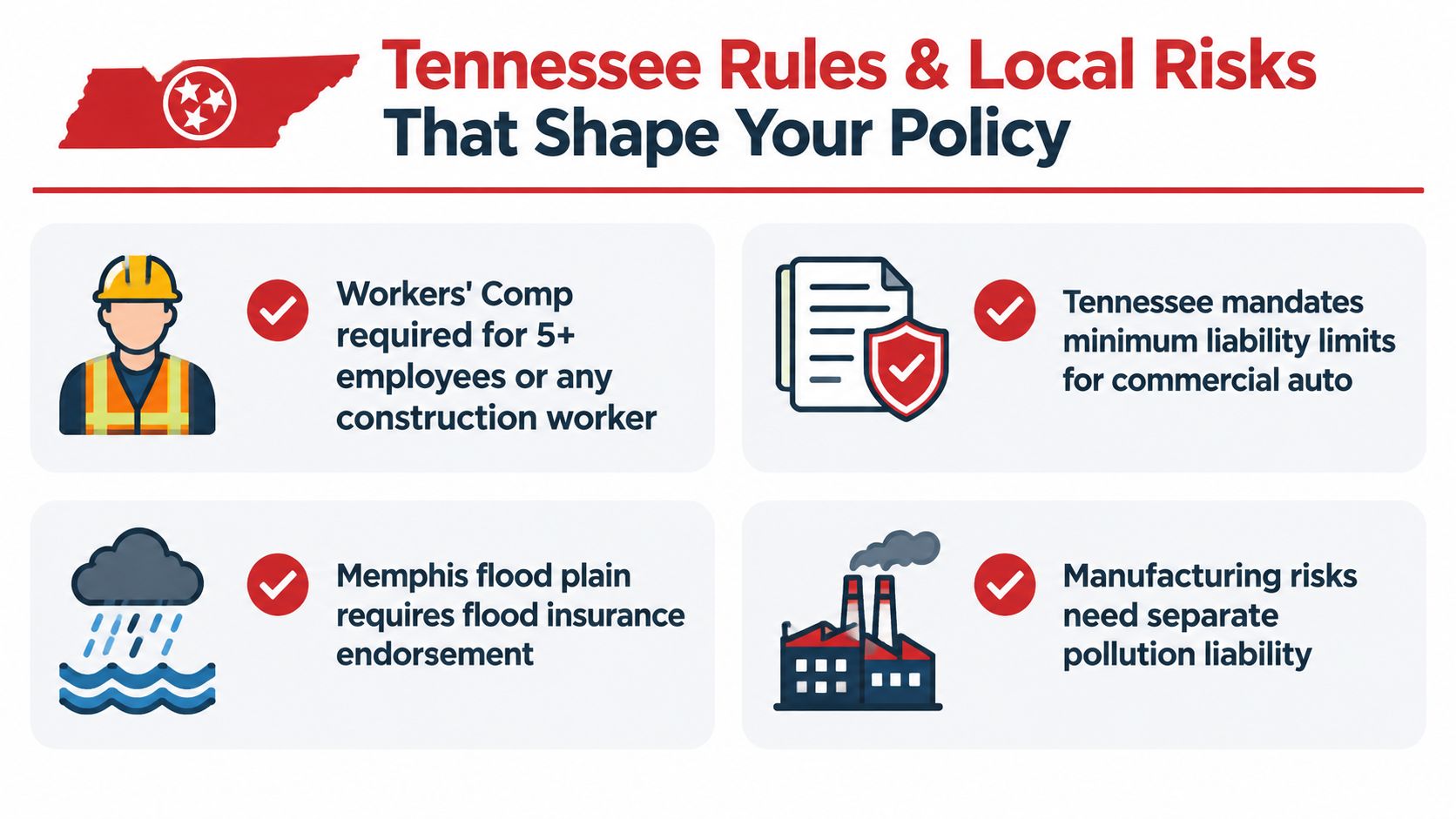
Tennessee rules can change the coverage decision before an insurer reviews the account. Construction services providers must carry workers' compensation with one or more employees, while most non-construction employers generally reach the requirement at five or more employees, subject to applicable exceptions and executive considerations. Review the state's workers' compensation rate and benefit materials before you set up payroll, subcontractor, or field-worker classifications.
A Memphis company should classify its actual work, not just its office function. A business that sells, delivers, installs, and repairs may expose employees to field labor, driving, tools, and job-site hazards. Misclassification can lead to compliance problems, audit disputes, and an inaccurate premium.
Flood deserves a separate decision
Businesses near the Mississippi River corridor should not assume standard commercial property protection covers flood. Under the NFIP General Property form, commercial flood protection has a ceiling of $500,000 for the building and $500,000 for contents, as documented in the Memphis airport's FY 2025 annual financial report. Those limits can sit well below the replacement value, inventory concentration, equipment exposure, and downtime risk of a warehouse or distribution operation.
Flood can disrupt more than the building. Surface water may affect storage yards, access roads, suppliers, employees, and transportation routes. Ask whether the policy addresses direct property damage, business income, contingent business interruption, waiting periods, and exclusions that could delay recovery.
Catastrophe data now gets local
Tennessee requires formal catastrophe-data reporting after major events, including Hurricane Helene, with claims reporting requested at the ZIP-code level. The state's insurance bulletins and regulatory notices explain why accurate claim-location and loss-category records matter.
Insurers may review local loss concentration, rebuilding progress, and loss development when adjusting property terms. Your address, construction type, roof condition, protection systems, flood exposure, and claims documentation can influence renewal discussions. Before binding, verify the workers' compensation trigger, confirm property and flood assumptions, and keep location-level records for every claim.
Business owners weighing funding alongside risk can find Tennessee business grants to support a broader cash-flow plan. For an independent review of Tennessee requirements and carrier options, use Tennessee commercial insurance guidance.
What Really Drives Your Commercial Insurance Price
Carriers price Memphis commercial accounts from operating facts, not from a single statewide average. The most influential inputs usually include classification, payroll, claims history, location, vehicle exposure, and carrier appetite. Your job is to present those facts accurately and place the account with insurers that understand the risk.
Workers' compensation illustrates the point. Tennessee approved an overall voluntary-market loss-cost decrease of 3.6% for 2025 and 2.0% for 2026, according to the state's 2025 workers' compensation rate announcement. Those statewide changes don't guarantee a lower premium for a Memphis contractor, fleet, or higher-hazard trade. Class code, payroll mix, claims history, experience modification, and safety controls still drive the account.
Compare the levers that actually matter
A 38103 storefront and a 38118 logistics operation may receive different property and liability treatment because their buildings, contents, traffic, security, loading activity, and catastrophe characteristics differ. A contractor's payroll audit can also move the final premium sharply if actual wages, subcontractor costs, or job duties differ from the application.
Credit may be considered in some commercial underwriting, but it shouldn't distract from the controllable basics. Accurate applications, continuous coverage, documented safety procedures, clean loss runs, driver controls, and sensible deductibles usually matter more to the quality of the submission.
| Pricing Driver | Direction It Moves the Quote | Memphis-Specific Note | Lever You Control |
|---|---|---|---|
| Class code and payroll | Higher or lower | Field labor and warehouse duties can change the risk category | Classify work accurately and track payroll by function |
| Claims history | Often raises renewal pressure | A liability loss can affect future underwriting discussions | Report early, correct hazards, and document prevention |
| Location and building | Varies by site conditions | ZIP-level catastrophe information can affect property terms | Improve roofs, protection systems, and documentation |
| Vehicle use and drivers | Rises with heavier or broader exposure | Freight routes and delivery frequency affect account details | Control hiring, maintenance, training, and vehicle use |
| Deductible selection | Higher deductible can reduce premium, but increases retained loss | Cash reserves must support the selected retention | Choose a deductible the business can actually absorb |
| Carrier appetite | Can improve or restrict terms | Independent placement may reveal different underwriting fits | Submit complete information to multiple suitable markets |
Telematics and driver-management records may help a Memphis hauler demonstrate disciplined fleet operations, but they don't replace accurate vehicle schedules or honest driver information. The strongest quote is usually the one built from a complete account, not the one produced from the shortest application.
How to Shop, Compare, and Buy Memphis Commercial Insurance
Treat the purchase as a repeatable operating process. An office manager should be able to assemble the submission, identify missing documents, and compare proposals without relying on the owner's memory.
Build the account before requesting quotes
- Build a one-page risk inventory. List locations, leases, equipment, inventory, employees, payroll, vehicles, drivers, subcontractors, annual revenue, and services.
- Pull last year's loss runs. Request the carrier records early. Note open claims, reserves, corrective actions, and any losses that were denied or closed.
- Decide between monoline and package coverage. A BOP may fit an eligible small operation. A larger fleet, contractor, or manufacturer may need separate policies and specialty endorsements.
- Request several suitable quotes. Ask an independent agent to approach markets that actively write your type of Memphis account. More quotes aren't useful if the submissions are incomplete or sent to carriers with no appetite for the risk.
Compare terms, not just premiums
- Read limits, deductibles, and exclusions side by side. A lower price may reflect narrower business income protection, a higher deductible, a restrictive valuation basis, or an excluded operation.
- Ask about credits and bundles. Discuss safety programs, protective devices, fleet controls, payroll practices, and account structure. Don't assume a credit exists until the carrier confirms it.
- Review the application for accuracy. Check vehicle ownership, driver lists, subcontractor use, employee duties, building occupancy, roof details, and revenue. Errors can create audit and claim problems.
- Purchase and file certificates correctly. Photograph equipment and keep serial records for inland marine scheduling. For commercial auto, maintain current vehicle and authority records where applicable.
- Schedule an annual review. Revisit limits, payroll, revenue, locations, vehicles, contracts, equipment, and new services before renewal. Use a structured review rather than automatically accepting the prior program.
If the business is also evaluating financing, a GoSBA Loans broker guide for buyers can help clarify questions to raise with a financing professional. For a broader multi-carrier comparison, review commercial insurance quote options. Bind coverage only after checking the declarations pages, endorsements, cancellation provisions, payment terms, and certificates required by customers or landlords.
Coverage Checklists for Retail, Contractors, Trucking, and Fleets
A retail store, a contractor, and a trucking company can all be profitable Memphis businesses, but they don't share the same claim pattern. The right program follows the operation, not the industry label printed on a brochure.
Retail operations
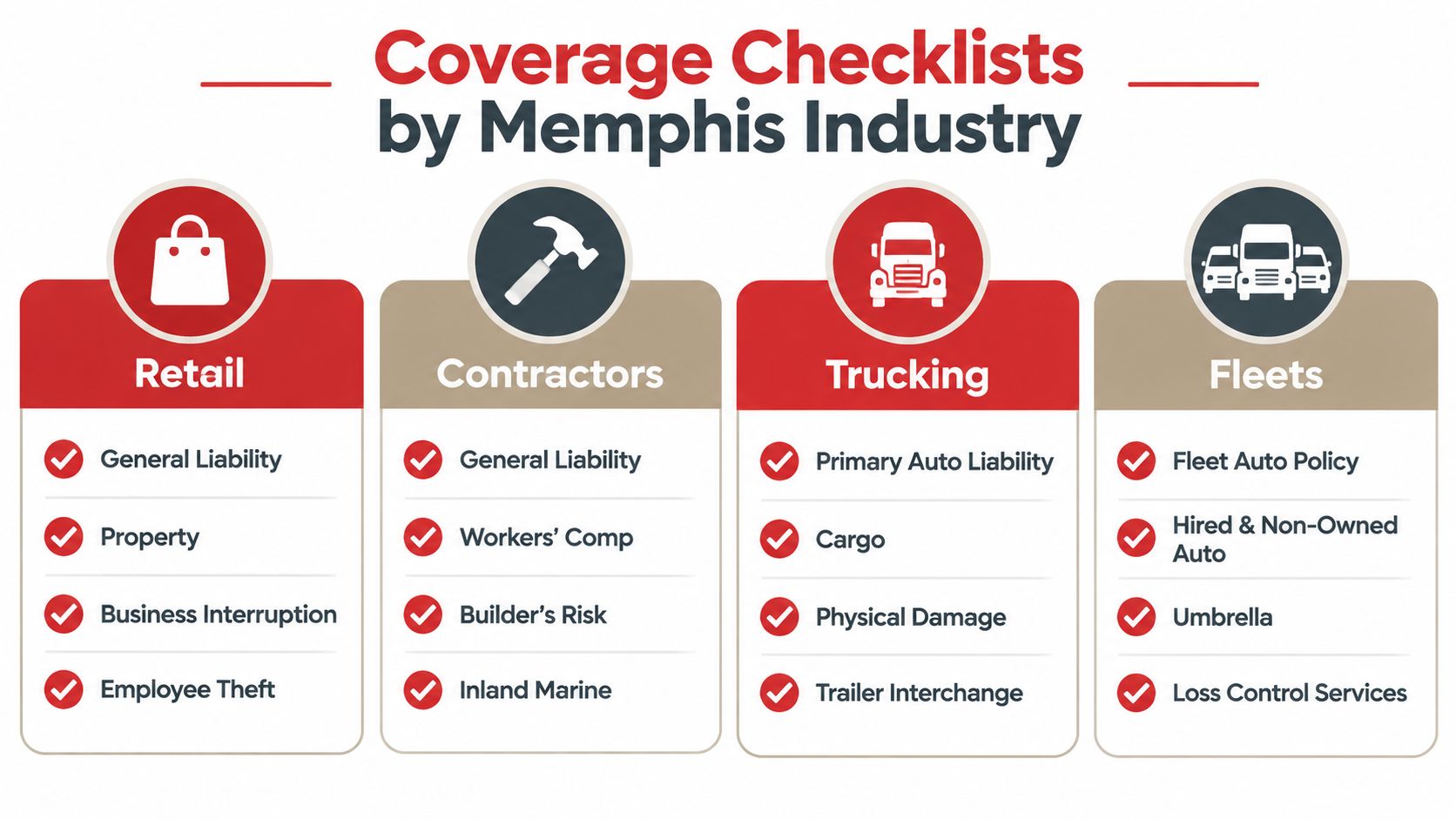
For an Overton Square or Wolfchase retailer, start with:
- General liability: Responds to customer injury allegations, such as a fall near an entrance.
- Commercial property: Protects the building interest, stock, fixtures, and improvements where covered.
- Business interruption: Replaces eligible lost income and continuing expenses after a covered shutdown.
- Employee dishonesty: Addresses selected losses caused by employee theft, subject to conditions and exclusions.
- Cyber liability: Worth reviewing if the store accepts customer information or relies on connected payment and inventory systems.
Contractors
A Shelby County contractor should evaluate:
- General liability: Include the operations and contractual exposures that match actual work.
- Workers' compensation: Classify employees by duties and maintain accurate payroll records.
- Builder's risk: Protects covered construction property during a project.
- Inland marine: Covers mobile tools, equipment, and materials away from the main premises.
- Contractual requirements: Check additional insured, waiver, primary wording, and certificate obligations before work begins.
For a contractor-specific review, use commercial insurance for contractors.
Trucking and fleet operations
A regional or long-haul trucking business typically needs primary commercial auto liability, cargo protection, physical damage coverage, and trailer interchange where applicable. Owner-operators may also need occupational accident or non-trucking liability depending on their business structure and contractual arrangements.
Fleet operators should add a disciplined review of hired and non-owned auto, umbrella protection, garage keepers exposure where vehicles are stored or serviced, deductibles, driver controls, maintenance records, and loss-control services. A vehicle schedule that omits temporary units or newly acquired vehicles can create an avoidable coverage problem.
Bilingual Service and Your Next Step to a Memphis Quote
Independent service matters in Memphis because one business may combine local deliveries, warehouse work, field labor, interstate freight, and customer-facing premises. A single captive market may not fit all of those pieces. An independent agency can compare multiple carrier appetites and identify whether the account belongs in a package, separate lines, or a specialty placement.
That flexibility becomes more useful when the account includes a contractor, a fleet operator, and a Downtown retailer under related ownership. The agent can examine general liability, commercial property, business interruption, workers' compensation, commercial auto, trucking, and professional liability without treating each exposure as an isolated purchase.
Bilingual support is operationally important, not decorative. A Spanish-speaking account manager can help with certificate requests, midterm changes, driver questions, payroll updates, and claims triage when a supervisor is at a jobsite or a driver is outside Memphis. Clear communication helps the agency receive accurate information, and accurate information supports better classification and policy maintenance.
Select Insurance Group, Inc. provides commercial insurance solutions including general liability, workers' compensation, commercial property, commercial auto, business interruption, professional liability, and trucking coverage. Gather your recent revenue, payroll, vehicle list, locations, operations description, and loss runs before requesting a comparison. That preparation gives an agent enough context to identify gaps instead of just returning a price.
Select Insurance Group, Inc. compares commercial coverage options for Memphis businesses, including general liability, workers' compensation, commercial property, commercial auto, and trucking insurance. Visit Select Insurance Group, Inc. to submit your information and request a comparative quote for your operation.