
The most popular advice about Murfreesboro auto insurance is also the advice I'd challenge first: buy Tennessee's minimum limits and choose the lowest monthly price. That approach makes the policy legal, but legality isn't the same as protection. Tennessee requires 25/50/25 liability limits, while the state's estimated uninsured-driver rate was 21.3% in 2023, compared with a reported 15.4% U.S. average (Tennessee uninsured-driver data).
Your route matters, too. Murfreesboro's 2026 High Injury Network covers about 18% of the city's roadway system yet accounts for approximately 84% of fatal and serious-injury crashes over the preceding five years (Murfreesboro High Injury Network information). A citywide average can't tell you whether your daily commute repeatedly crosses higher-severity corridors.
The right question isn't, “What's the cheapest policy?” It's, “What policy leaves my household with the smallest realistic financial exposure after a serious crash?”
Table of Contents
- Why the Cheapest Quote in Murfreesboro Can Still Cost You
- Tennessee Coverage Rules and What Each Type Actually Pays For
- What Murfreesboro Drivers Actually Pay and Why
- Discounts That Actually Stack for Tennessee Drivers
- How Murfreesboro's Roads and Crashes Should Shape Your Policy
- Comparing Quotes and Switching Without Losing Coverage
- Why Uninsured Motorist Coverage Is Not an Upsell in Rutherford County
- Recap and When to Revisit Your Murfreesboro Policy
Why the Cheapest Quote in Murfreesboro Can Still Cost You
The cheapest Murfreesboro auto insurance quote can leave you paying the largest bill after a serious crash. Tennessee's 25/50/25 minimum liability limits provide $25,000 for bodily injury or death to one person, $50,000 per crash for bodily injury or death to multiple people, and $25,000 for property damage (Tennessee Department of Commerce and Insurance auto guidance). These limits satisfy the state's financial-responsibility requirement. They do not guarantee enough insurance for the damage you cause.
Several injured people can quickly exhaust the bodily-injury limit. A newer vehicle can also produce a property-damage claim above $25,000. Tennessee uses a fault-based system, so the driver responsible for a collision may face claims for damages beyond the policy limits.
The uninsured-driver rate makes minimum coverage an even weaker financial choice. Tennessee's estimated uninsured-driver rate was 21.3% in 2023, compared with a reported 15.4% U.S. average. If the other driver has no insurance or carries inadequate limits, your own policy may become the practical source of recovery. Tennessee does not require uninsured or underinsured motorist coverage, yet rejecting it can leave you relying on health insurance, savings, or the other driver's ability to pay.
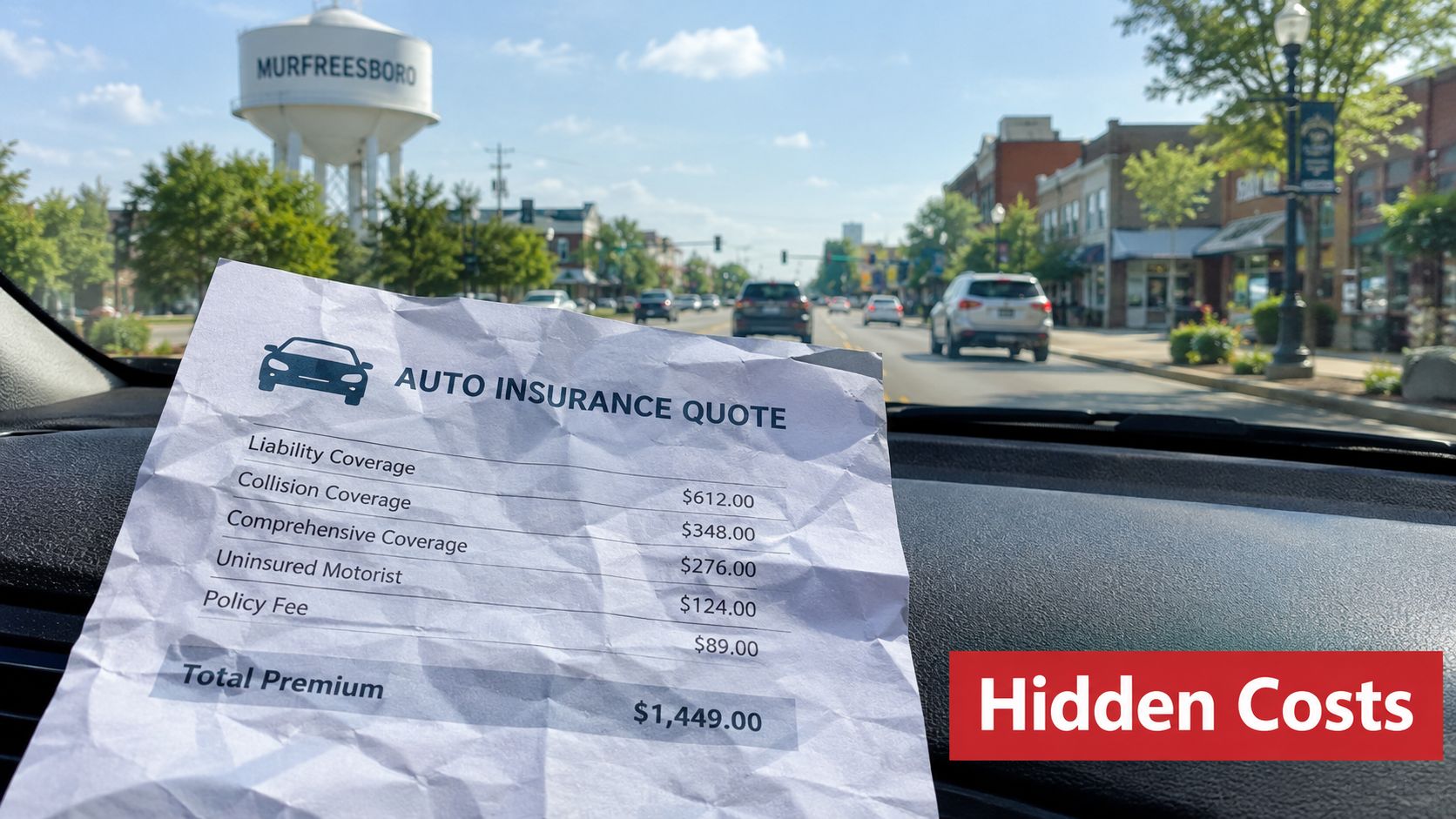
Route exposure changes the decision
Murfreesboro reported 5,753 total crashes in 2025, a 2.1% decline from 2024, yet the city's overall count does not remove concentrated risk on particular routes (Murfreesboro High Injury Network information). The city's 2026 High Injury Network identifies corridors associated with a disproportionate share of severe crashes.
Your driving pattern matters. Short neighborhood trips present a different exposure from a commute through high-injury corridors, busy commercial areas, or regional connections. Your route will not automatically set the premium, but it should influence the limits, uninsured-motorist protection, collision coverage, and deductible you select.
Practical rule: Size your coverage to the crash you can't comfortably pay for out of savings.
The price comparison trap
Two quotes are not equivalent when one uses state minimum limits, a high deductible, and no uninsured-motorist protection, while the other provides higher limits and lower out-of-pocket costs. A lower premium may mean less insurance.
Treat 25/50/25 as a legal floor, not a financial target. Ask for higher liability limits and stronger protection, then compare the added cost with what you could owe after an injury, an uninsured-driver collision, or damage to your own vehicle.
Tennessee Coverage Rules and What Each Type Actually Pays For
A quote page becomes easier to evaluate when every line has a job. Start with the coverage that protects other people, then examine what protects you and your vehicle.
Liability handles damage you cause
Liability coverage pays for injuries, deaths, and property damage for which you're legally responsible, subject to the policy limits. In a collision on a busy Murfreesboro commercial road, your liability coverage could respond to another driver's medical treatment, lost income, or vehicle damage.
The state minimum is 25/50/25, but higher limits can reduce the chance that one serious claim reaches your personal assets. Ask for a quote using substantially higher limits, commonly written as 100/300/100, and compare the difference rather than assuming the minimum is adequate.
Collision and comprehensive protect your vehicle
Collision coverage generally pays for damage to your vehicle after a crash, whether you hit another vehicle, a fixed object, or lose control. Your deductible applies, so the right deductible depends on the amount you could pay from savings after a covered loss.
Full coverage handles non-collision damage, such as theft, vandalism, storm damage, or an animal strike. Tennessee law doesn't require collision or full coverage, but a lender or leasing company may require both. If you own an older vehicle outright, compare the vehicle's value with the premium and deductible. If replacing the vehicle would disrupt your finances, dropping physical-damage coverage deserves careful thought.
Uninsured motorist coverage fills a structural gap
Uninsured and underinsured motorist coverage can respond when the at-fault driver lacks insurance or doesn't carry enough to cover your injuries. It can be especially important after a hit-and-run in a grocery-store parking lot or a serious collision where the other driver's limits are quickly exhausted.
Tennessee doesn't require this coverage, but the state's uninsured-driver rate gives it practical importance. Ask whether the coverage applies to bodily injury, property damage, or both, and understand how your selections interact with deductibles and other insurance.
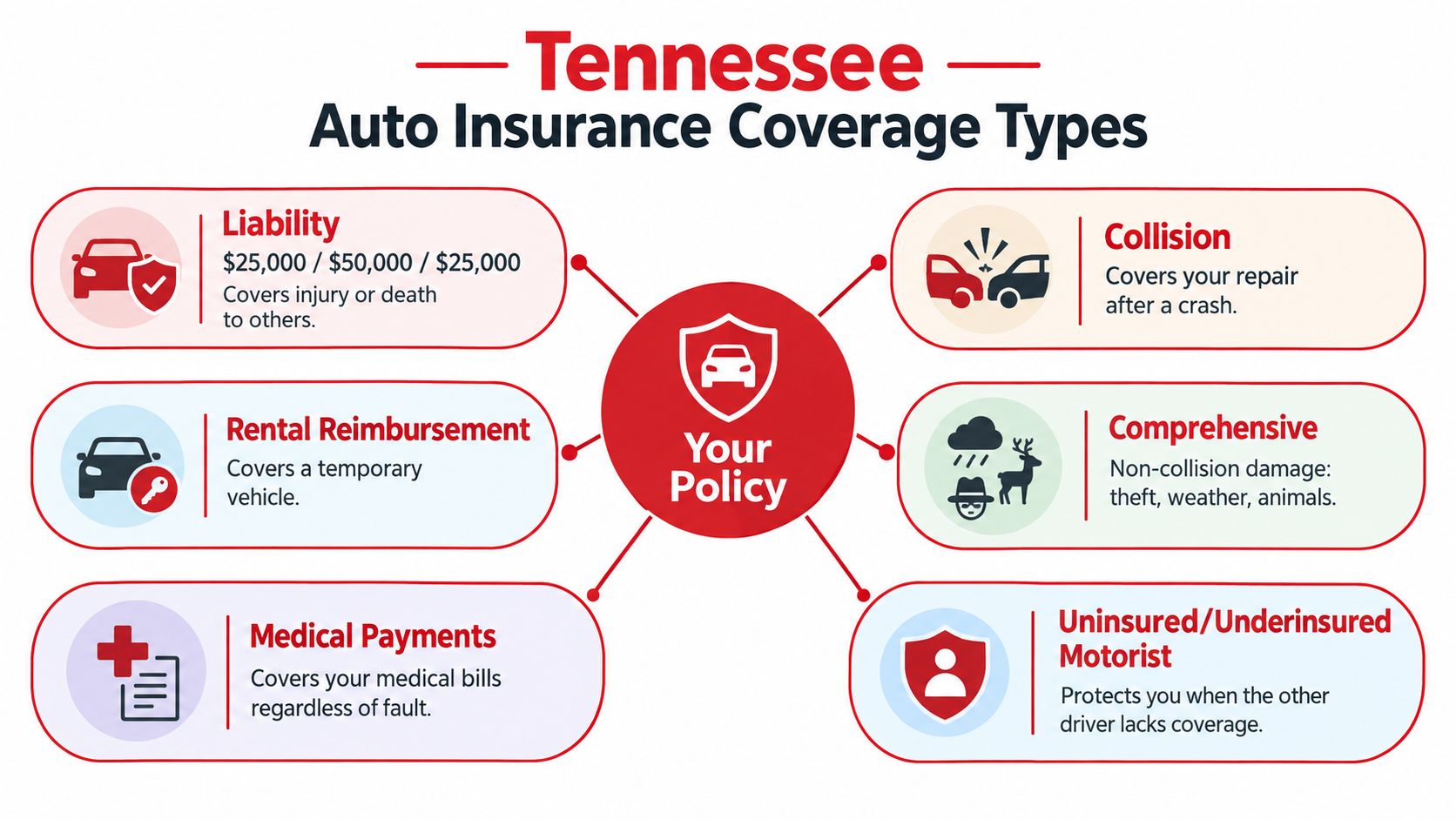
Medical payments coverage can help with covered medical expenses regardless of fault, subject to its limit. Rental reimbursement can help pay for a temporary vehicle while your covered vehicle is being repaired after a qualifying claim. Neither replaces a sound liability and uninsured-motorist strategy.
For a quote review, use Tennessee insurance quote assistance to compare the actual coverage choices, not just the headline premium.
What Murfreesboro Drivers Actually Pay and Why
The cheapest Murfreesboro quote can hide the largest financial exposure. A statewide benchmark based on National Association of Insurance Commissioners data puts the average annual premium at $1,061, or about $88 per month. Within that benchmark, liability-only coverage averages approximately $489 annually, while physical-damage coverage adds about $573.
A separate city-level model reports average Murfreesboro quotes of $73 per month for liability-only insurance and $142 per month for full coverage. Those figures are modeled city estimates, not promises for every driver. Use them to frame a quote, not to choose limits blindly.
Reference Premium Ranges for Murfreesboro Drivers
| Coverage Level | Statewide NAIC Estimate | Murfreesboro City Estimate | Typical Driver Inputs to Watch |
|---|---|---|---|
| Liability-only | About $489 annually | About $73 monthly | Limits, driving history, ZIP code, mileage, insurer |
| Full coverage | About $1,062 annually ($489 liability + $573 physical damage) | About $142 monthly | Vehicle value, collision and other-than-collision deductibles, claims, mileage |
| Broad comparison point | About $1,061 annually, or about $88 monthly | City model varies by coverage | Coverage level, driver profile, vehicle, location, insurer |
The city model shows a difference of roughly $69 per month between liability-only and full coverage. That gap reflects the added protection in that model, not a universal Murfreesboro rate. Your vehicle, limits, record, and location can shift the result substantially.
What drives your actual quote
Insurers price claims experience, repair costs, theft exposure, driving history, age, ZIP code, annual mileage, vehicle type, deductibles, selected limits, and credit-related rating factors where permitted. A nearby driver with the same vehicle can receive a different premium because the garaging address, claims record, or coverage choices differ.
Murfreesboro drivers should also judge the cheapest premium against local injury exposure and Tennessee's 21.3% uninsured-driver rate. A low liability limit may save money today while leaving you responsible for medical bills or property losses after a severe crash.
Compare the inputs before comparing premiums. Confirm liability limits, uninsured-motorist limits, collision and other-than-collision deductibles, rental coverage, and vehicle usage. For a regional reference, review Nashville auto insurance guidance, while remembering that a Nashville estimate is not a Murfreesboro quote.
Treat averages as reference points only. The declarations page and complete quote determine what you buy.
Discounts That Actually Stack for Tennessee Drivers
Drivers often ask for “the discount,” as if one checkbox will solve the pricing problem. The better approach is to ask for every discount category that matches your household, then verify that the carrier applied each one correctly.
Start with behavior and household structure. A clean driving record may qualify for a safe-driver discount. Combining auto with renters or homeowners coverage may create a multi-policy discount, and insuring more than one vehicle may qualify for multi-vehicle pricing. These discounts can interact differently by carrier, so ask the agent to quote the bundle rather than assuming it will appear automatically.
Build the discount review in a logical order
- Driving record: Ask whether your tickets, accidents, and claims history qualify for safe-driver pricing.
- Household policies: Check multi-policy eligibility if you insure a home or rental property.
- Vehicles: Ask about multi-vehicle treatment when more than one car belongs in the household.
- Usage: Telematics or usage-based programs may evaluate driving behavior, mileage, or both. Make sure you understand the program before enrolling.
- Student status: A qualifying student may be eligible for a good-student discount, subject to carrier rules.
- Military and veteran status: Ask directly. Eligibility rules vary, and agents don't always know your status unless you mention it.
- Payment and documents: Paperless delivery, automatic payments, and paid-in-full billing may reduce administrative or payment-related charges.
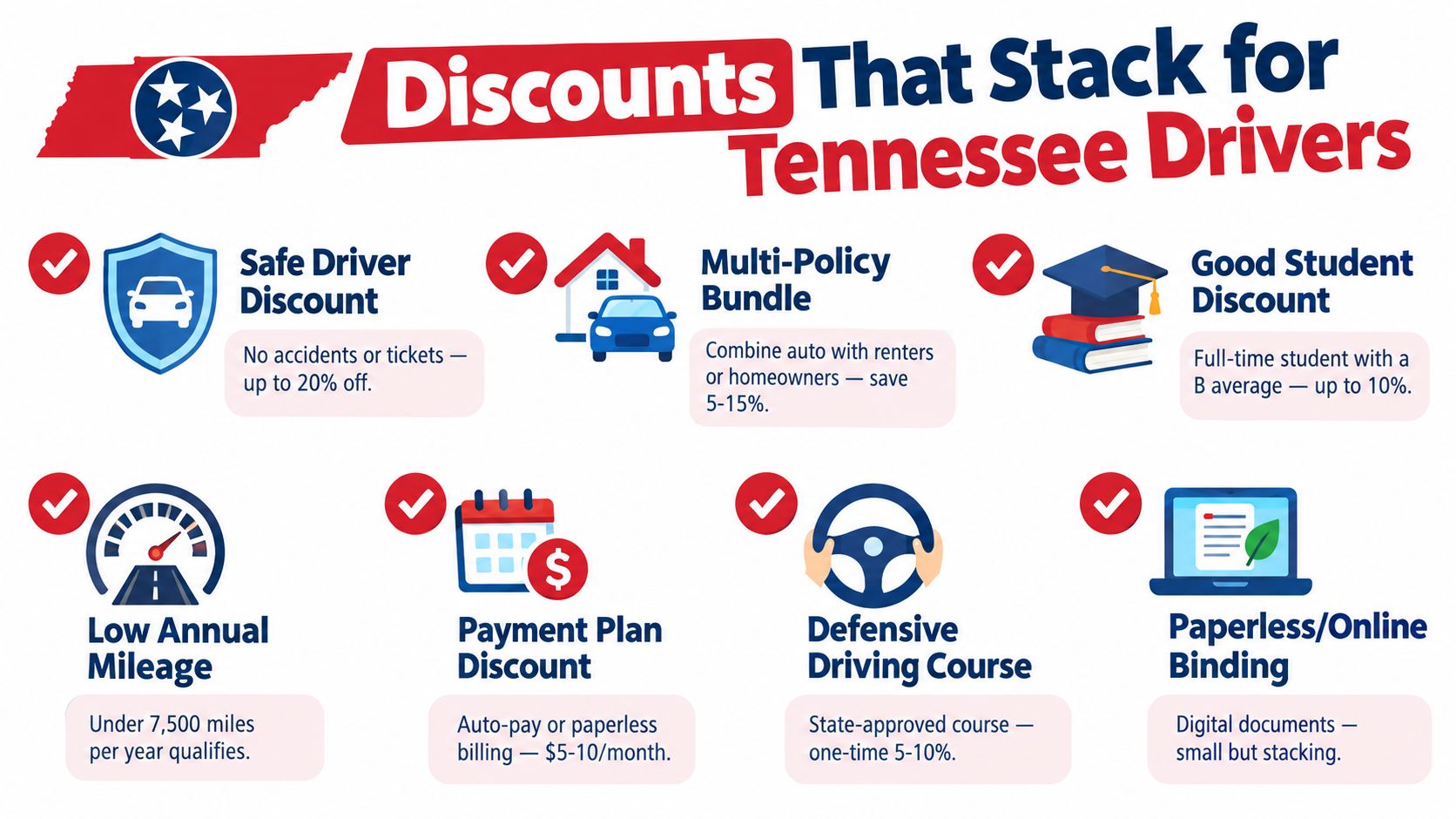
Ask for the checklist, not a vague promise
A good quote conversation should identify which discounts were applied, which weren't available, and what documentation would be needed. That might include proof of student status, military affiliation, defensive-driving completion, household policies, or payment selection.
Don't accept a discount if it changes the protection in a way you don't understand. A usage-based program may affect privacy or pricing, while paid-in-full billing may require more money upfront. The cheapest payment schedule isn't always the easiest one to maintain.
The practical order is simple: establish accurate driver and vehicle information, apply household and behavior discounts, check special eligibility categories, then review payment and document options. Discounts should lower the cost of appropriate coverage, not persuade you to remove coverage you need.
How Murfreesboro's Roads and Crashes Should Shape Your Policy
Match protection to severity, not just frequency. Murfreesboro's 2026 High Injury Network identifies a concentrated risk pattern: about 18% of the roadway system accounts for approximately 84% of fatal and serious-injury crashes over the preceding five years. The city's High Injury Network information gives drivers a practical reason to evaluate coverage by route, not only by citywide averages.
If your daily commute repeatedly uses those corridors, prioritize liability limits that can protect your assets after a serious injury claim. The road does not set your premium by itself, but your regular exposure should influence how much financial risk you are willing to retain.
A lower-risk residential driving pattern may justify a different discussion, but it does not eliminate severe-crash exposure. Ask your agent to compare the cost of stronger limits against the amount you could personally afford to lose.
Match coverage to the likely loss
Murfreesboro recorded 5,753 crashes in 2025, a 2.1% decline from 2024, according to the same city information. A year-over-year decrease does not make high-injury corridors interchangeable with quiet neighborhood streets.
I would review bodily injury liability first, then uninsured and underinsured motorist coverage. Tennessee's uninsured-driver rate is 21.3%, so cutting this protection to chase the lowest quote leaves a serious gap. Collision and other-than-collision coverage deserve priority when a vehicle is financed, leased, valuable, or difficult to replace. Choose deductibles you can pay without delaying repairs.
Use crash documentation after an incident
Murfreesboro directs involved parties to its online traffic crash reports information. Reports from the Murfreesboro Police Department, Tennessee Highway Patrol, and other agencies generally become available within seven business days. Insurers and business entities can request access through a business account.
Tennessee's Department of Safety maintains TITAN as the state repository for law-enforcement crash and surveillance reports, organized by county, crash type, month, and contributing factors. After an incident, check the report for the date, fault details, VIN or plate information, and claim narrative. Then request a policy review.
A move, vehicle change, major mileage change, or at-fault incident also warrants a review. Your policy should reflect how you drive now, not how you drove when it began.
Comparing Quotes and Switching Without Losing Coverage
A fair quote comparison starts before you contact an agency. Gather your current declarations page, vehicle identification number, garaging address, estimated annual mileage, recent coverage-lapse information, driver details, and any changes such as a new vehicle, move, teen driver, or altered commute.
The declarations page is especially important because it shows the limits and deductibles currently protecting you. Without it, a new quote can look cheaper only because it removes coverage or reduces limits.
Use the same shape for every quote
Compare each offer using matching:
- Liability limits: Keep bodily-injury and property-damage limits consistent.
- Uninsured protection: Compare the same uninsured and underinsured motorist selections.
- Physical-damage deductibles: A lower deductible usually changes the premium, so don't compare different deductible levels.
- Vehicle details: Confirm the same vehicle, ownership status, garaging address, usage, and mileage.
- Optional protections: Check rental reimbursement, roadside assistance, gap coverage, and medical payments separately.
If an independent agency such as Select Insurance Group, Inc. is handling the process, its stated approach is to compare quotes from 20 to 40 carriers, provide bilingual assistance, and help customers evaluate personal and commercial coverage. The value of that process is comparison discipline. The quote only helps if the limits and deductibles are aligned.
Switch in the right order
Request the new policy first. Confirm the effective date, payment status, vehicle list, drivers, limits, and deductibles. Then cancel the old policy after the new coverage is active, keeping confirmation of both transactions.
Never create a gap because the old policy's renewal date is inconvenient. A lapse can affect future underwriting, and an uninsured day leaves you personally exposed. If you're unsure about the timing, use this guide to switching auto insurance companies and ask the new agent to coordinate the effective and cancellation dates.
Insurance shopping often happens alongside broader household planning. If you're reviewing financial protection generally, a resource on comparing term life quotes can help you separate premium comparisons from the underlying protection each policy provides.
Why Uninsured Motorist Coverage Is Not an Upsell in Rutherford County
Rutherford County's 2026 High Injury Network makes injury severity part of the coverage decision. A collision on one of those higher-risk corridors can create medical bills, lost income, and lasting limitations that exceed the at-fault driver's liability limits. Tennessee's uninsured-driver rate was 21.3% in 2023, according to this Tennessee uninsured-driver data. In practical terms, roughly one in five drivers may leave you seeking payment from your own policy after a crash.
Consider a $50,000 bodily-injury claim caused by a driver carrying Tennessee's 25/50 minimum liability limits. The other driver's policy could pay only $25,000 for one injured person, leaving a $25,000 shortfall. Your underinsured-motorist limit is the coverage that may address that gap, subject to the policy terms.
What UM and UIM can do
Uninsured-motorist coverage applies when the at-fault driver has no liability insurance. Underinsured-motorist coverage applies when that driver has insurance, but the available limit cannot cover the injuries and losses covered by your policy.
Health insurance can pay covered treatment, yet it may not replace lost income or address every cost tied to an auto injury. Collision coverage can repair or replace your vehicle after a covered crash, subject to its deductible. It does not provide the same bodily-injury protection as UM/UIM. Liability coverage pays for injuries and damage you cause. UM/UIM protects you when another driver causes the crash and lacks sufficient insurance.
Ask four direct questions before declining it: Does the coverage apply to bodily injury? Is property-damage protection available? Which limits can you select? Does a deductible apply? Compare the premium difference with the amount you would have to fund yourself after a serious collision.
Stacking may increase the protection available across eligible vehicles or policies, but availability depends on the policy and Tennessee-specific circumstances. Review this A-1 Driving School on stacked coverage and ask your agent whether stacking applies to your policy.
In a county where one in five drivers is uninsured, declining UM coverage means self-insuring against strangers.
Recap and When to Revisit Your Murfreesboro Policy
Before binding or renewing, confirm your liability limits, ask whether 100/300/100 is appropriate, compare uninsured-motorist limits, and evaluate collision and other deductible options against your savings. Compare equivalent coverage across insurers, and document route changes that increase your exposure.
Review the policy after a vehicle change, new commute, added teen driver, move within or outside Rutherford County, coverage lapse, or at-fault incident. Auto insurance isn't a one-time purchase. It's a recurring decision tied to how your household drives and what it can afford to lose.
Select Insurance Group, Inc. compares auto coverage options across multiple carriers, including liability, collision, uninsured and underinsured motorist, rental reimbursement, and related protections. Visit Select Insurance Group, Inc. for a Murfreesboro quote review and help comparing limits, deductibles, and coverage without creating a gap.