
You're heading across Knoxville on I-40, moving through downtown traffic, or helping a student insure a first car near UT. The practical questions are usually the same: What coverage does Tennessee require, what protection do you need, and how can you avoid paying for a quote that doesn't fit your situation?
Knoxville auto insurance is often priced below national averages, but that doesn't mean every driver receives a low premium. Published figures vary because insurers and data providers use different driver profiles, coverage assumptions, and rating methods. The useful comparison isn't one headline average. It's several quotes built from the same information.
This guide starts with Tennessee's legal baseline, then explains Knoxville pricing, coverage choices, rating factors, and a repeatable shopping process. If you want local help while comparing options, you can review Tennessee auto insurance coverage and prepare for a more informed conversation with a licensed agent.
Table of Contents
- Introduction to Knoxville Auto Insurance Essentials
- Tennessee Minimum Coverage and Local Laws Explained
- What Knoxville Drivers Actually Pay Right Now
- Coverage Options Every Knoxville Driver Should Understand
- What Affects Your Premium in Knoxville
- How to Compare Quotes and Lower Your Premium
- Your Next Steps to Affordable Protection in Knoxville
Introduction to Knoxville Auto Insurance Essentials
You are buying your first policy after moving across Knoxville, adding a vehicle to the household, or replacing coverage after a lapse. Three questions should guide the decision: What does Tennessee require, what could a serious crash cost you, and are you comparing quotes with the same protection?
A state-minimum policy can satisfy the law at a lower price, but its protection is limited. Higher liability limits can reduce the amount you might pay yourself after a costly claim. Collision coverage can help repair or replace your vehicle after a covered crash, while uninsured motorist coverage can help when the at-fault driver lacks enough insurance. The suitable mix depends on your vehicle's value, savings, driving habits, and ability to absorb an unexpected bill.
Knoxville often appears below national cost benchmarks, yet the spread between quotes can matter more than the average. One published analysis places Knoxville at about $36 per month for minimum coverage and $122 per month for full coverage, while another reports $60 and $128. These figures use different assumptions, so they are not promises of what you will pay. MarketWatch's Knoxville auto insurance analysis illustrates why the cheapest headline rate may not match your vehicle, record, limits, or deductible.
The decision path for a first-time buyer
Use four checks before choosing a policy:
- Legal layer: Confirm that the policy meets Tennessee's required liability limits.
- Protection layer: Decide whether higher liability limits, collision coverage, and uninsured motorist coverage fit your financial risk.
- Pricing layer: Request quotes with identical limits, deductibles, vehicle details, and driver information. Otherwise, you may compare a basic policy with a broader one and mistake lower protection for a better price.
- Review layer: Recheck the policy after changes to your vehicle, household, commute, or driving record.
For the legal baseline and coverage details, review Tennessee auto insurance coverage. A quote becomes useful only when you know exactly what each dollar buys.
Tennessee Minimum Coverage and Local Laws Explained
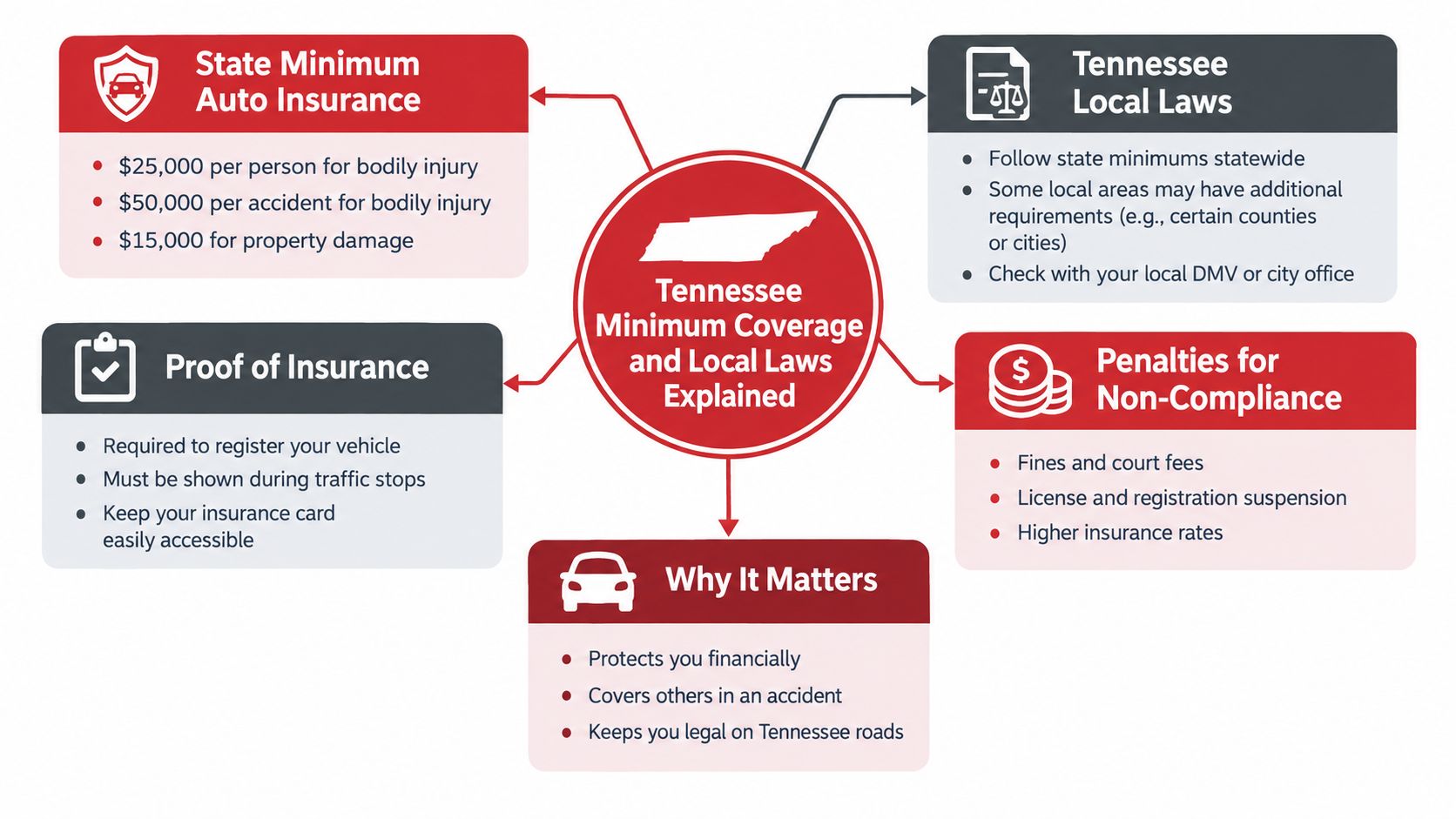
Suppose you cause a collision on a Knoxville road. Tennessee's minimum policy determines how much your insurer can pay for the other driver's injuries and damaged property. The state uses split-limit liability coverage. As of 2026, every registered vehicle must carry at least 25/50/25 liability coverage: $25,000 for bodily injury to one person, $50,000 for bodily injury in one accident, and $25,000 for property damage in one accident. See the state requirement summary in Tennessee insurance requirements.
The three numbers work like separate buckets. The first pays covered bodily injury claims for one injured person, up to its limit. The second caps covered bodily injury payments for everyone injured in the same accident. The third pays for damage you cause to another person's vehicle or property.
Why the property-damage limit changed
Senate Bill 504 increased Tennessee's property-damage minimum from $15,000 to $25,000 for split-limit policies issued or renewed after December 31, 2022. Knoxville shoppers comparing state-minimum policies in 2026 therefore face a higher legal floor than drivers did before 2023.
Meeting the legal floor does not guarantee enough financial protection. A newer vehicle, several damaged vehicles, or a serious injury can produce costs above the policy limits. If the insurer reaches those limits, the driver responsible for the crash may still face eligible losses personally.
Minimum coverage is a floor, not a recommendation
Driving without required insurance can create legal and financial problems, including difficulty proving financial responsibility after a crash. Keep proof of insurance available, and verify that the policy lists the correct vehicle, drivers, and effective dates.
Coverage limits also matter when you compare quotes. A lower premium may reflect lower protection, so request Tennessee insurance quotes with matching liability limits and deductibles. Tennessee insurance quotes can help you begin that comparison with a licensed professional.
If another driver's insurer proposes a settlement after declaring your vehicle a total loss, the first figure may not be the last. Reviewing how to dispute a lowball offer can help you identify valuation questions and gather supporting documentation before responding.
What Knoxville Drivers Actually Pay Right Now
A first-time Knoxville buyer may see one low monthly figure online and expect that number on the final quote. Knoxville is generally a lower-cost large Tennessee market than national averages, but the average is only a starting point. A 2026 data model places the city at approximately $36 per month, or $436 per year, for minimum coverage, and $122 per month, or $1,467 per year, for full coverage. Those figures are described as roughly 30% below the national minimum-coverage average and 27% below the national full-coverage average. The cited Knoxville market data provides that market benchmark.
A separate 2026 source gives Knoxville averages of $60 per month for minimum coverage and $128 per month for full coverage. That gap is large enough to change a shopper's expectations. It does not mean one figure is automatically wrong. Each model may use different drivers, vehicles, limits, deductibles, and definitions of full coverage.
Knoxville average premiums vs national benchmarks
| Coverage level | Knoxville Model A | Knoxville Model B | National average |
|---|---|---|---|
| Minimum coverage | About $36 per month, $436 per year | About $60 per month | About 30% higher than Model A |
| Full coverage | About $122 per month, $1,467 per year | About $128 per month | About 27% higher than Model A |
Use the table to understand the range, not to forecast your personal bill. Comparing insurance averages is like comparing grocery receipts without knowing what each cart contains. A clean-record homeowner with one vehicle may receive a very different quote from a young driver, a high-mileage commuter, or someone with a recent violation.
How to use an average correctly
Treat published figures as a map of the market. Your quote is the route for your specific situation. If it comes in higher, check the details before assuming the price is unreasonable:
- Are the liability limits identical?
- Does each quote include collision and other coverage, rather than different protection?
- Are the deductibles the same?
- Does one quote include uninsured motorist coverage or another optional protection?
- Did both applications list every driver, vehicle, mileage detail, and claim consistently?
One 2026 Knoxville benchmark cited elsewhere estimates about $541 per year for state-minimum coverage, $624 per year for higher-limit liability-only coverage, and $2,025 per year for full coverage. The spread shows why coverage design matters. A cheaper headline rate may reflect less protection, while a higher quote may include limits or features the lower quote leaves out. The Knoxville cost benchmark adds context, but only a quote built from matching information can provide an apples-to-apples comparison.
Coverage Options Every Knoxville Driver Should Understand
Liability coverage protects other people when you're responsible for a covered accident. It doesn't generally repair your own car. That distinction is the first major dividing line between a minimum policy and broader protection.
Collision coverage addresses damage to your vehicle from a crash with another vehicle or object, subject to your deductible and policy terms. If you finance or lease the car, the lender may require it. If you own an older vehicle outright, compare the potential claim payment with the premium and deductible before deciding.
Full coverage handles covered non-collision losses, such as theft, vandalism, falling objects, or weather-related damage. A Knoxville driver may value it after storm debris damages a parked car, or after a vehicle is stolen. It also usually carries a separate deductible, so confirm the amount rather than assuming collision and full coverage use the same one.
Match coverage to the financial risk
Uninsured and underinsured motorist coverage can help when the at-fault driver has no insurance or insufficient limits. It's worth discussing how the coverage applies to injuries and, where available, vehicle damage. The details matter, including whether limits can be stacked, what exclusions apply, and how the deductible works.
SR-22 isn't a separate type of protection. It's a financial-responsibility filing commonly required after certain driving violations. If Tennessee requires one for you, ask how long the filing must remain active and make sure a lapse doesn't create a new compliance issue.
Protection principle: Modestly increasing liability limits can raise the premium, but it can also reduce your exposure when medical bills, vehicle repairs, and legal claims exceed Tennessee's minimum limits.
A higher limit doesn't eliminate every risk, and optional coverage doesn't cover every event. Read the declarations page and ask about exclusions. Your agent should be able to explain what happens in practical terms, such as a collision with an underinsured driver, theft from a parking area, or storm damage while your car is parked downtown.
What Affects Your Premium in Knoxville
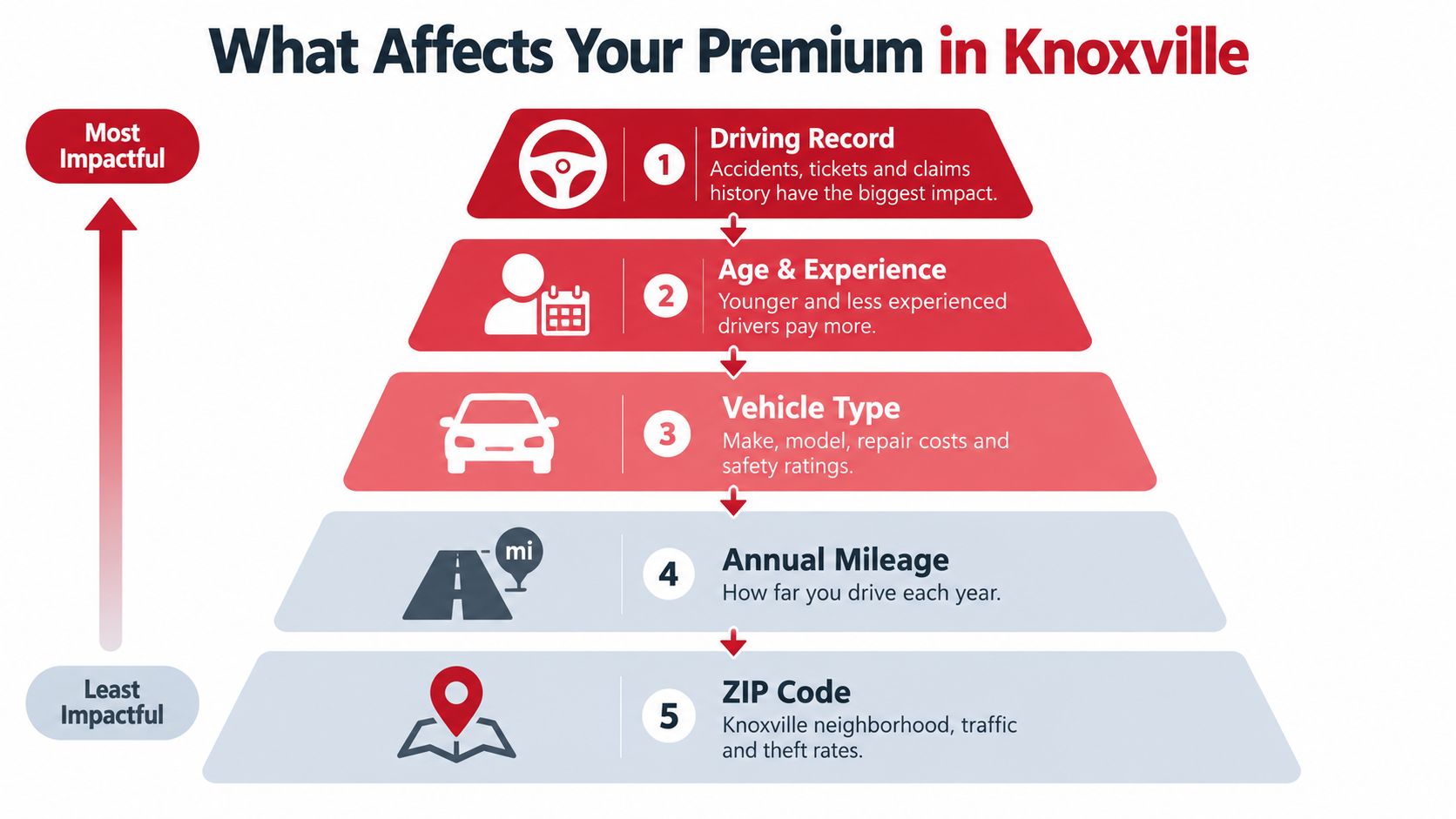
Two drivers can live close to each other and still receive different premiums. Insurers evaluate the person, vehicle, coverage selection, and policy history together. The same Knoxville address doesn't create the same risk profile for a student, a daily commuter, and a retired driver.
Your driving record often has a strong effect because violations, at-fault crashes, and claims can signal different future risk. Age and experience also matter. A younger or less experienced driver may face a different price from an older driver with a long clean record, even when they insure the same vehicle.
The car itself changes the calculation. Repair costs, replacement parts, safety equipment, theft exposure, and the vehicle's overall value can influence the price. Annual mileage matters because more time on the road creates more opportunities for a collision. Be accurate, though. Understating mileage can create problems if the information later conflicts with the facts of a claim.
Local details and policy history
ZIP code can affect pricing within Knox County because insurers may evaluate traffic patterns, claims experience, theft exposure, and other local characteristics. That doesn't mean one neighborhood is automatically expensive or inexpensive for every driver. It means your exact address belongs in the quote.
Where permitted, insurers may also use a credit-based insurance score as one rating input. Prior coverage history can matter as well, particularly when a driver has had a gap or cannot document continuous insurance. Ask how the carrier treats your specific circumstances instead of guessing from a general rule.
The carrier fit can matter more than the city average
The cheapest insurer for one profile may not be the cheapest for another. Young drivers, homeowners, high-mileage commuters, and drivers with prior violations can receive very different results because insurers segment risk and assign different weight to the details.
That's why the better question isn't “Who is cheapest in Knoxville?” Ask, “Which carrier prices my exact profile fairly while providing the protection I need?” Request quotes with the same information and examine the coverage line by line.
How to Compare Quotes and Lower Your Premium
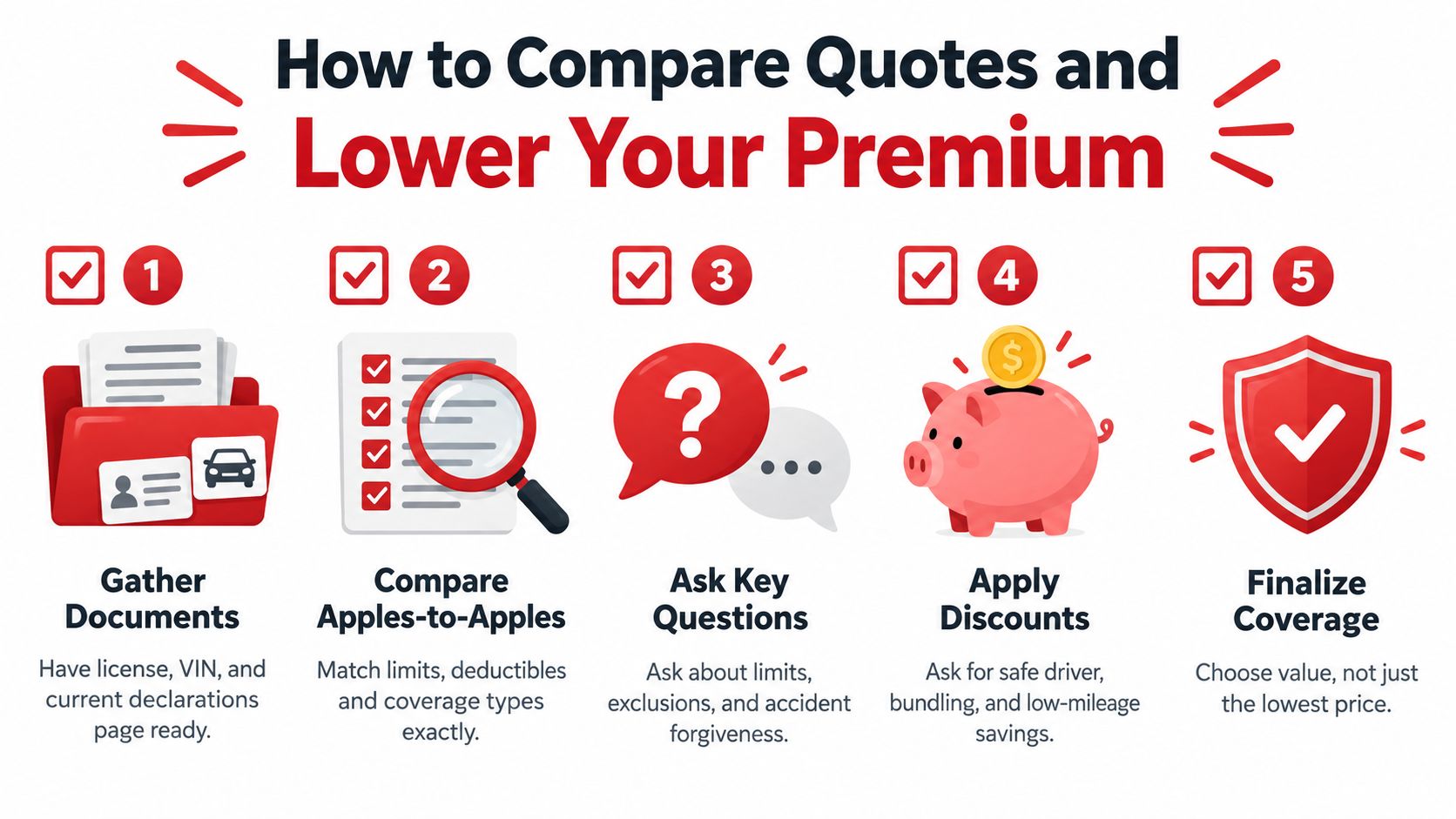
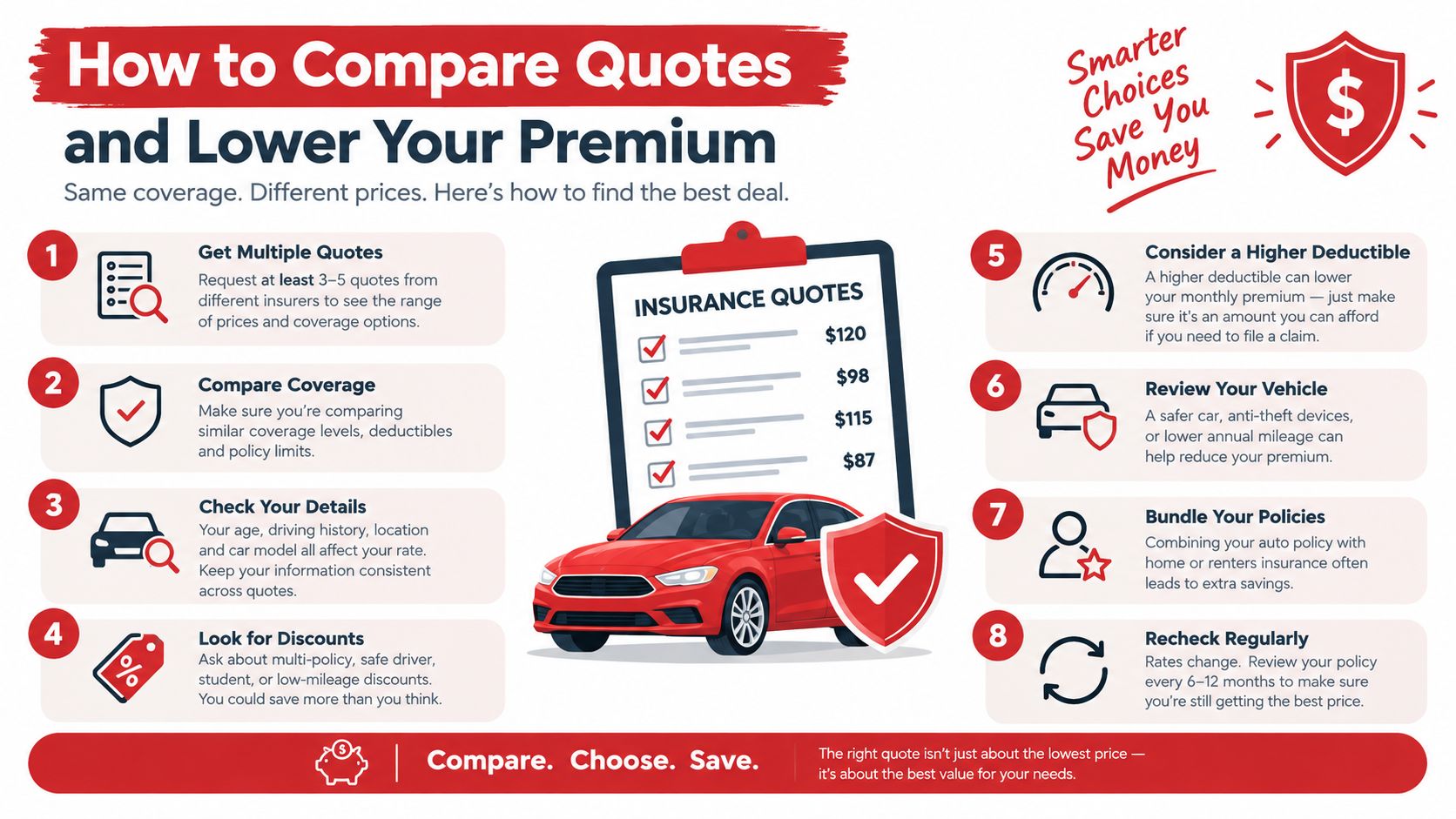
Start with accurate documents. Have your driver's license information, vehicle identification number, current declarations page, garaging address, driver list, loan or lease details, and approximate annual mileage available. A quote becomes useful only when the underlying information is complete and consistent.
Then set a comparison standard before requesting prices. Use the same liability limits, uninsured motorist selections, collision and collision deductibles, rental coverage, roadside assistance, and vehicle details for every quote. If one quote omits a coverage, it may look cheaper because it provides less protection.
Questions that expose the real difference
Ask each agent or insurer:
- What are the exact liability limits? Confirm the per-person, per-accident, and property-damage amounts.
- Which deductibles apply? A lower premium may come with a deductible you couldn't comfortably pay after a loss.
- What is excluded? Ask about vehicle use, permissive drivers, custom equipment, rental reimbursement, and claim conditions.
- Which discounts apply today? Request an explanation, not just a label.
- What would change the price? Ask whether mileage, household drivers, vehicle storage, or payment arrangements affect the quote.
Potential savings may come from safe-driver programs, good-student eligibility, defensive-driving courses, bundling home and auto, low-mileage use, vehicle safety features, or payment method. Eligibility varies, so ask the carrier to confirm the requirements and whether the discount remains active at renewal.
Lower the price without stripping protection
Raising a deductible can reduce the premium, but only choose an amount you could pay after a covered loss. Removing collision may make sense for some older vehicles, yet the decision should account for your ability to replace or repair the car yourself.
Keep insurance continuous when possible, review listed drivers, remove vehicles you no longer own, and report major life changes promptly. If you're changing insurers, use a documented process for switching auto insurance companies so the new policy begins before the old one ends.
An independent agency can request comparable quotes from multiple carriers, which is useful when carrier appetite differs by driver profile. Select Insurance Group, Inc. states that its licensed bilingual specialists compare quotes across 20 to 40 carriers, and its Tennessee service includes Knoxville drivers. Treat that service as a comparison resource, then choose based on coverage, exclusions, service, and price together.
Your Next Steps to Affordable Protection in Knoxville
A low Knoxville quote can look attractive until a claim reveals what it leaves you paying yourself. Start with Tennessee's required liability coverage, then decide whether higher limits fit your assets and income. Review collision, uninsured and underinsured motorist coverage, and collision and other-than-collision deductibles alongside your vehicle's value, savings, commute, and household drivers.
Request multiple quotes with identical driver, vehicle, address, mileage, and coverage information. Keep each quote summary or declarations page. A lower premium may come from smaller limits, larger deductibles, or missing protections, so compare the policy's total protection, not only its monthly payment.
Questions that clarify the differences
Ask whether each quote includes the same limits, deductibles, listed drivers, rental coverage, and claim assistance. A young driver, homeowner, high-mileage commuter, or driver with a prior violation may receive better results from a different carrier search than a standard-risk shopper. Bilingual specialists can explain policy terms, and secure tools may help with documents, payments, updates, and claims support.
Review coverage after a move, new vehicle, added driver, mileage change, paid-off loan, or improved driving record. Knoxville may offer below-average pricing, but quote differences matter more than the headline average. Select Insurance Group, Inc. compares options across multiple carriers and helps drivers review limits, deductibles, discounts, and policy details. Visit Select Insurance Group, Inc. to request an instant comparison quote and speak with a licensed specialist about protection suited to your situation.