
You're probably staring at a renewal notice, a first-bike quote, or a text from your agent and wondering why the number feels higher than it should. If you ride in Nashville, the answer isn't just “motorcycle insurance is expensive,” it's that Nashville Motorcycle Insurance has to price for Davidson County traffic, Nashville crash exposure, and the fact that one bad day on I-40 or downtown can turn a small mistake into a very expensive one.
That's why the usual advice falls short. The minimums matter, but they're only the starting line, and in this city they're a weak place to stop. If you want a policy that protects you, you need to understand what Tennessee requires, what Nashville's risk profile does to pricing, and which coverages are worth paying for before you ever bind a policy.
Table of Contents
- What Tennessee Law Requires From Nashville Riders
- Coverage Options Worth Knowing Before You Shop a Quote
- Why Nashville Itself Changes the Math
- Cost Drivers That Move Your Motorcycle Quote Up or Down
- Discounts That Actually Trim a Nashville Motorcycle Premium
- Tickets, Claims, and Lapses Without the Runaround
- How to Pull Fast Competitive Quotes the Right Way
- Putting It All Together for Nashville Riders
What Tennessee Law Requires From Nashville Riders
A Friday-night Broadway run can turn serious when a driver cuts across your lane. An I-24 merge can create the same problem. In Nashville, a rider needs to understand the state minimum, what proof must be available, and where that minimum leaves personal finances exposed.
Tennessee requires liability coverage for motorcycles. The Tennessee Department of Commerce and Insurance's minimum-coverage guidance sets the commonly cited 25/50/25 limits: $25,000 for bodily injury or death per person, $50,000 per accident, and $25,000 for property damage. The same requirement applies across Davidson County and the state, and riders must carry proof in physical or electronic form. Failing to maintain coverage can lead to towing, fines, and suspension of a license or registration. For a local quoting option, review Select Insurance Group's Tennessee insurance quotes page.
Here is the blunt truth. 25/50/25 is a floor, not a safety net. A serious Nashville crash can exceed those limits quickly, especially when injuries involve more than one person or property damage reaches several vehicles. If the at-fault rider has insufficient coverage, an uninsured-motorist claim may also become part of the recovery process. The policy should protect your finances, not merely satisfy a roadside check.
Practical rule: If you can't comfortably explain what your liability limits do, you're probably underinsured for Nashville riding.
Keep proof accessible, keep the policy active, and do not mistake legal compliance for adequate protection. A helmet supports safer riding, but it does not pay another driver's medical bills or replace a damaged motorcycle.
Use the state minimum as the starting point for a quote, then ask for higher liability limits. An independent agency can compare 20 to 40 carriers in one pass, which is useful when Nashville pricing differs from rural Tennessee and the same coverage can produce very different premiums.
| Coverage | Tennessee Minimum | Realistic Nashville Target |
|---|---|---|
| Bodily injury per person | $25,000 | Higher than minimum |
| Bodily injury per accident | $50,000 | Higher than minimum |
| Property damage | $25,000 | Higher than minimum |
Coverage Options Worth Knowing Before You Shop a Quote
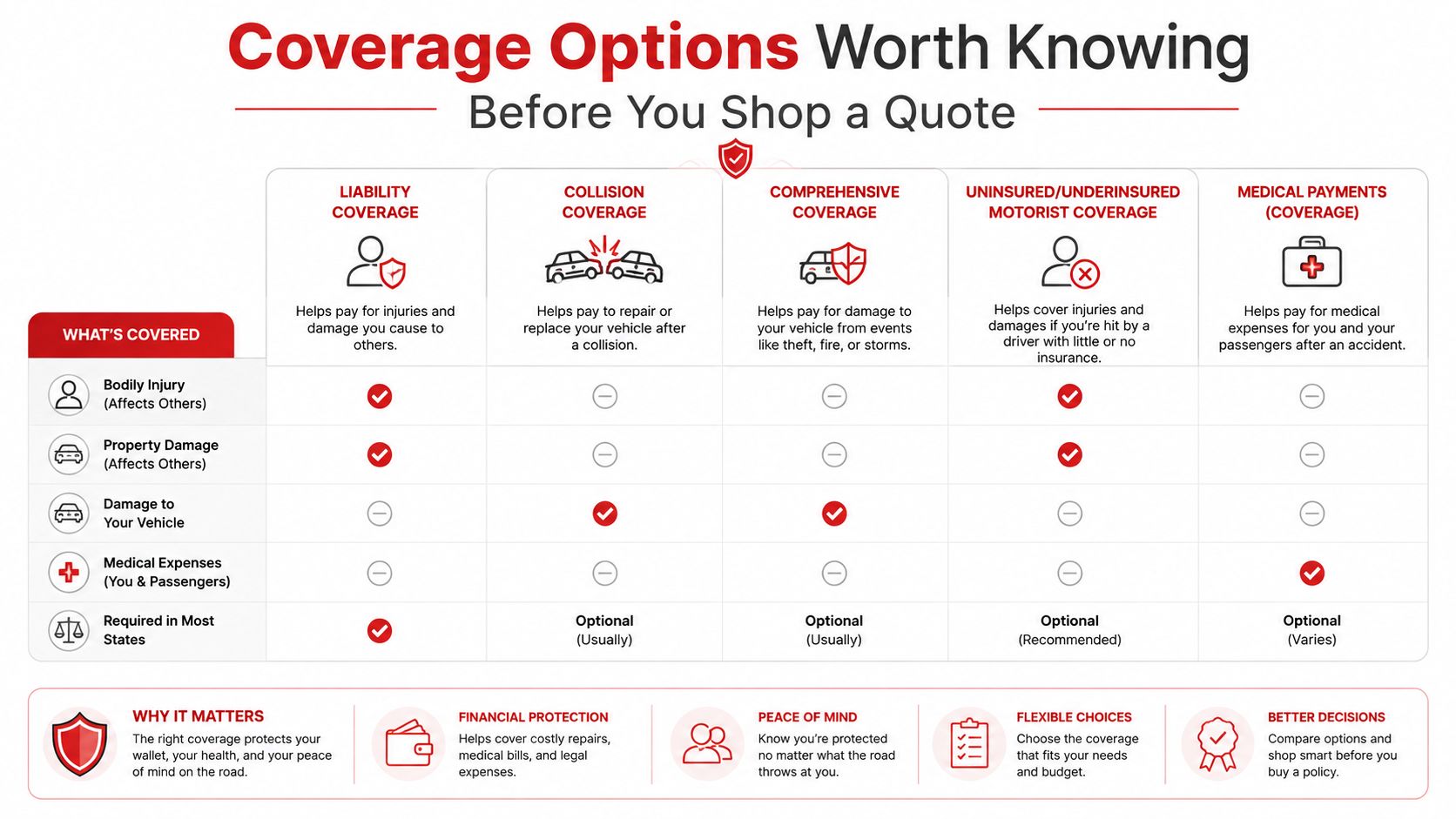
Liability is the starting point, not the finished policy. For a Nashville rider, the right question is which protections address an injury, theft, crash, or hit-and-run around Davidson County.
The three coverages I'd treat as the baseline
Higher liability limits are the first upgrade I recommend. Limits such as 50/100/50 or 100/300/100 provide more room when a crash injures someone, damages several vehicles, or leads to a serious legal claim. For a plain explanation of the financial consequences, read this guide to bodily injury coverage financial protection. It separates the legal duty from the money at risk.
Collision coverage pays for damage to your motorcycle after a crash, including situations where you cause the wreck or the other driver cannot pay enough. That matters after a lane-change collision on a busy Nashville corridor or a hard drop that leaves a Sportster, Gold Wing, or another bike needing major repairs.
Full coverage for other-than-collision losses addresses theft, vandalism, flood, and similar damage. A motorcycle parked outside near downtown, an apartment complex, or a regular commute route faces different exposure from a bike stored securely in rural Tennessee. If the motorcycle would be difficult to replace, include this protection in the quote.
Direct advice: If the bike has meaningful value, carry collision and other-than-collision protection. Paying for repairs yourself can turn one incident into a major financial setback.
Uninsured and underinsured motorist coverage deserves serious attention in Nashville. A hit-and-run or driver with insufficient insurance can leave you paying for injuries and damage, while motorcycle riders have less physical protection in the initial impact. Ask for limits that match your liability selection rather than accepting the smallest available option.
Medical payments coverage helps with early medical bills while the full injury claim develops or health insurance processes the expense. It does not replace liability or UM/UIM, but it can provide useful first-dollar support after a crash.
Guest passenger liability and accessory coverage depend on how you ride. Carry guest protection if you regularly ride two-up, and insure custom fairings, exhaust parts, or other additions if replacing them would strain your budget. The Select Insurance Group motorcycle insurance guide offers a broader explanation of how these options can fit together.
My Nashville coverage baseline
I would quote higher liability limits, UM/UIM, and collision plus other-than-collision coverage for any motorcycle worth protecting. Add medical payments coverage if you want help with immediate bills, then adjust guest and accessory protection around your actual riding habits, parking arrangement, and bike value.
Use an independent agency that can compare 20 to 40 carriers in one pass. Nashville pricing can differ sharply from rural Tennessee, so one quote rarely shows the full range of available coverage and premium options.
Why Nashville Itself Changes the Math
Nashville does not price like a sleepy rural county, and it should not. Davidson County carries heavier traffic, more congestion, and a tougher loss pattern than riders see outside the metro area. Insurers price that into motorcycle coverage before they ever look at your driving record.
The crash numbers make the point. Tennessee crash statistics from the Department of Safety show Davidson County recorded 26,319 crashes and 133 deaths in 2022, 27,102 crashes and 138 deaths in 2023, 26,154 crashes and 111 deaths in 2024, and 26,985 crashes and 112 deaths in 2025. Motorcycle-specific reporting also shows 2,875 motorcycle crashes statewide in 2021 with 160 fatalities, plus 310 motorcycle crashes in Davidson County in 2024. The Metro Nashville Police fatal-crash dashboard lists 78 motorcycle deaths among Nashville crash categories. Those figures are not background noise. They are the claim environment your premium has to absorb.
That is why Nashville riders should expect higher pressure on pricing and tighter coverage recommendations than riders in rural Tennessee. More traffic, more intersection conflict, and more uninsured-driver exposure mean a policy that looks fine on paper can be underbuilt for the city. If you want the local version of auto-risk context, Select Insurance Group's Nashville auto insurance page shows how the agency approaches metro-area pricing and coverage fit.
UM/UIM matters more here because motorcycles have almost no physical buffer in a crash, and Tennessee still has plenty of uninsured drivers. When the other driver's policy is thin or missing, your own limits carry more of the load. In Nashville, that is the practical reality of riding in a city with real traffic pressure and real loss exposure.
Nashville riders need a policy built for Davidson County roads, not a postcard version of Tennessee.
Cost Drivers That Move Your Motorcycle Quote Up or Down
A Nashville motorcycle quote can swing a lot before you ever speak to a human being, and that's because underwriters price the bike, the rider, and the storage situation together. If your quote came back higher than you expected, don't assume the market is random. There's usually a reason hiding in the profile.
The bike and the ZIP code matter first
A higher-performance bike, a more expensive MSRP, custom parts, or year-round street parking will usually push pricing up. So will a garaging address in a dense Nashville ZIP code, especially if the bike lives outside or gets parked where theft and vandalism are easier to imagine than prevent. Commute mileage matters too, because a bike that lives on I-24, I-40, or I-65 sees more exposure than one that rolls out a few sunny weekends a month.
Rider history then takes over. Age, licensing experience, endorsement history, tickets, prior claims, and coverage gaps all affect the final number. A clean-record rider on a mid-displacement cruiser usually looks very different to an underwriter than a younger rider on a high-output street bike. If you want a sense of how violations can affect insurance pricing more broadly, this discussion of how much rates rise after a speeding ticket is a useful reminder that a moving violation doesn't just stay on the road record, it reaches into the premium.
What a Nashville quote usually reacts to
| Rider and Bike Profile | Liability Limits | Estimated Annual Premium Range | Primary Cost Drivers |
|---|---|---|---|
| Clean record, mid-displacement cruiser, secured garage | Moderate to higher | Lower end of local spread | Lower exposure, stable storage, simpler risk profile |
| Younger rider, sport bike, street parking | Moderate to higher | Higher end of local spread | Bike type, age, garaging, city traffic |
| Experienced rider, touring bike, year-round commute | Moderate to higher | Mid to higher range | Mileage, route exposure, bike value |
| Rider with tickets or prior claim history | Moderate to higher | Higher than comparable clean-profile rider | Violation history, claim history, underwriting caution |
If your quote seems out of line, it's usually one of those variables, not the policy form itself, that's driving it.
Discounts That Actually Trim a Nashville Motorcycle Premium
Discount hunting works best when it's deliberate. Carriers don't all reward the same behaviors, and the riders who save the most usually stack a few clean discounts instead of waiting for one magic break.
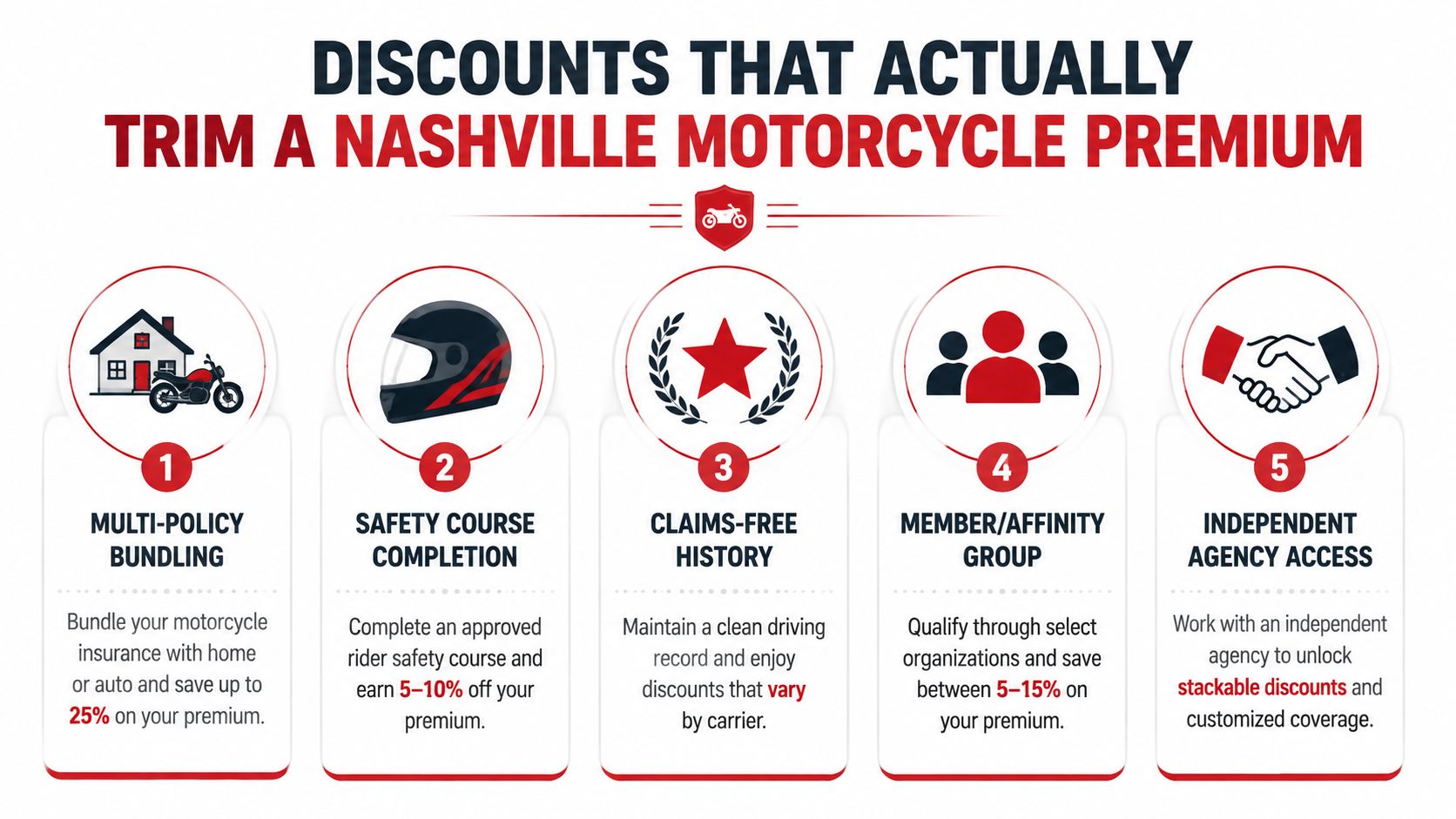
Start with bundling. If your motorcycle sits alongside your auto or home policy, the carrier often has room to sharpen the price. For Nashville households, that matters because the motorcycle isn't the only risk they're insuring, and the whole account can help the rate make more sense. A safety course is the next move I'd look at, especially for newer riders. If you've completed a Motorcycle Safety Foundation course or an equivalent approved program, bring that certificate and make sure it gets applied.
Paid-in-full matters more than people admit. Monthly installments look easier, but they usually come with extra friction or fees that raise the true cost of the policy. Secured garaging helps too, especially if the bike stays in a locked area, a monitored garage, or an apartment complex with controlled parking. Loyalty and continuous coverage can help as well, though I care less about brand loyalty and more about whether the carrier rewards claim-free riding.
Useful habit: Ask for every discount before you bind, not after the first bill arrives.
Affinity groups can help in some cases, including motorcycle clubs or rider organizations. The right independent agency can also uncover combinations that a direct quote flow misses, especially when a carrier rewards more than one behavior at the same time. One Nashville rider with a clean record, a secured garage, bundled auto and home, and a safety course completion often ends up with a noticeably leaner premium than the baseline shopper who skips the questions and buys online in a rush.
Tickets, Claims, and Lapses Without the Runaround
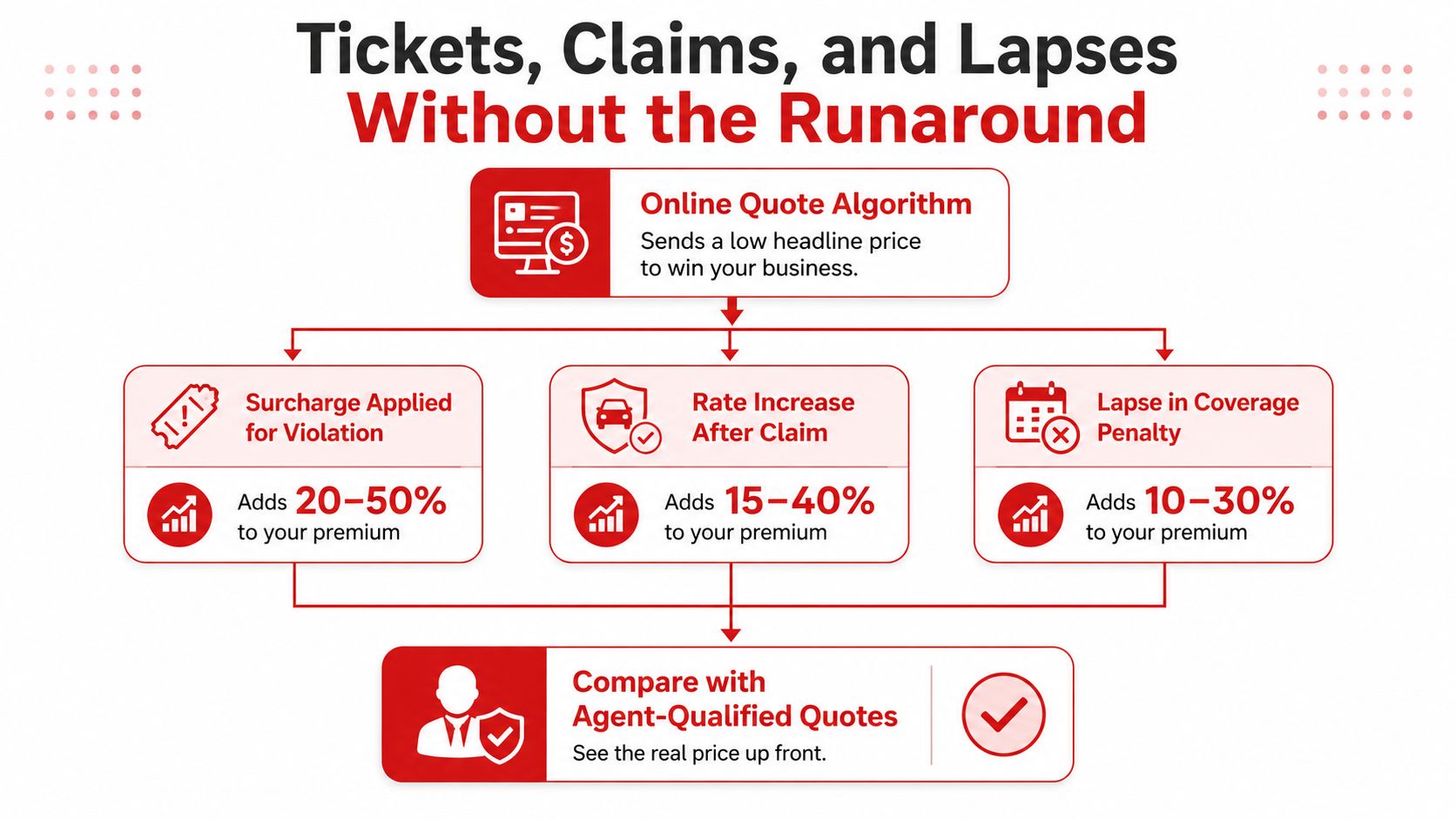
Online quote engines often show a smooth headline number, but the final price appears after binding or the carrier refuses the risk entirely. That's a bad way to shop if you've got a ticket, a recent claim, or even a short lapse in coverage.
A speeding ticket, especially on a motorcycle in Davidson County, can keep a premium high for years. An at-fault crash with injury gets even uglier because the carrier is now thinking about severity, not just the citation itself. A lapse also raises eyebrows fast, and for younger riders it can be enough to make a quote look far worse than it should.
What actually works when your record isn't perfect
The answer is not guessing through one website after another. It's a transparent, agent-assisted shop where a Tennessee-licensed independent agency can line up real quotes, flag which carriers care about which violations, and steer you away from options that will only disappoint later. That kind of help matters when the carrier wants a filing, a policy start date chosen carefully, or a clean explanation of a dismissed ticket or an older claim.
The point is control. If you let the system surprise you, it will usually surprise you at the worst moment, right after you think the cheap quote is bound and done.
Don't shop your record like it's clean if it isn't. The first honest conversation saves the most time.
A short lapse, a moving violation, or a claim doesn't mean you're uninsurable. It means you need a process that tells the truth upfront instead of punting the problem to underwriting after the fact.
How to Pull Fast Competitive Quotes the Right Way
A prepared Nashville rider can complete a multi-carrier comparison in under 30 minutes. Have the VIN, title, current mileage, garaging ZIP, declarations page, and motorcycle endorsement or safety course certificate ready before the first quote request. Missing documents create follow-up calls and delay a binding decision.
Use a Tennessee-licensed independent agency when you want several carrier options reviewed in one pass. You should not spend an afternoon repeating the same information to separate call centers. Select Insurance Group, Inc. handles motorcycle insurance comparisons by collecting the details once, then presenting coverage and pricing options for review.
What to compare before you bind
Compare the full policy, not only the premium. Check deductibles, roadside assistance, rental support, OEM parts treatment, accessory coverage, and UM/UIM limits. Ask for identical liability limits, collision and total-loss terms, and medical payments coverage across every quote. Otherwise, the cheapest option may contain less protection.
Request every available discount at the same time. Ask about bundling, safety course credits, paid-in-full pricing, garaging discounts, and valid member or affinity credits. A complete quote includes the coverage you intend to carry and the credits the carrier will apply.
The order I'd use
- Gather documents first. VIN, mileage, endorsement, and current policy details reduce back-and-forth.
- Set coverage targets. Choose liability, UM/UIM, collision, and MedPay limits before quoting.
- Request every discount. Do not assume the quoting system found them all.
- Compare out-of-pocket exposure. A lower premium with higher deductibles or narrower coverage is not automatically a better deal.
- Choose the start date carefully. Coordinate the new policy with the old one so you avoid an accidental lapse.
Give the agency your actual riding pattern, garaging location, motorcycle use, and desired limits. Those details help an agent place the request with carriers that fit the risk instead of producing a cheap quote that falls apart during underwriting.
If you quote online without the documents or coverage targets, delays are likely. With the information ready, an independent agency can move from intake to side-by-side options during one short session, then explain the trade-offs before you bind.
Putting It All Together for Nashville Riders
If you ride in Nashville, there are three decisions I wouldn't postpone. First, lift liability above the minimum, because 25/50/25 is a weak place to stop in a city with real crash exposure. Second, add UM/UIM at the same limits as your liability, because uninsured and underinsured drivers are a live problem here. Third, carry medical payments or at least enough medical protection to cover the first bills that show up after a crash.
That's the practical order. Get the liability layer strong, make sure you're protected when the other driver can't pay, and don't ignore the medical gap that appears before health insurance or a settlement catches up. If you do those three things, you've already moved past the stripped-down policy that gets marketed to first-time buyers and casual shoppers.
The local advantage is real too. An independent Tennessee-licensed agency that can compare 20 to 40 carriers in one pass usually has a better shot at matching coverage to your actual riding pattern than a direct website does. That matters whether you're a weekday commuter, a touring rider, or someone who only rolls the bike out when the weather is right.
Revisit the policy every year and after any ticket, claim, or garaging change. Nashville rewards riders who stay honest about risk and adjust before the next problem shows up, not after.—
Select Insurance Group, Inc. helps Tennessee riders compare motorcycle insurance across multiple carriers and match the policy to the way they ride in Nashville. If you want a direct quote review and a coverage conversation that doesn't waste your time, visit Select Insurance Group, Inc. and ask for a motorcycle insurance quote built around your bike, your ZIP code, and your budget.